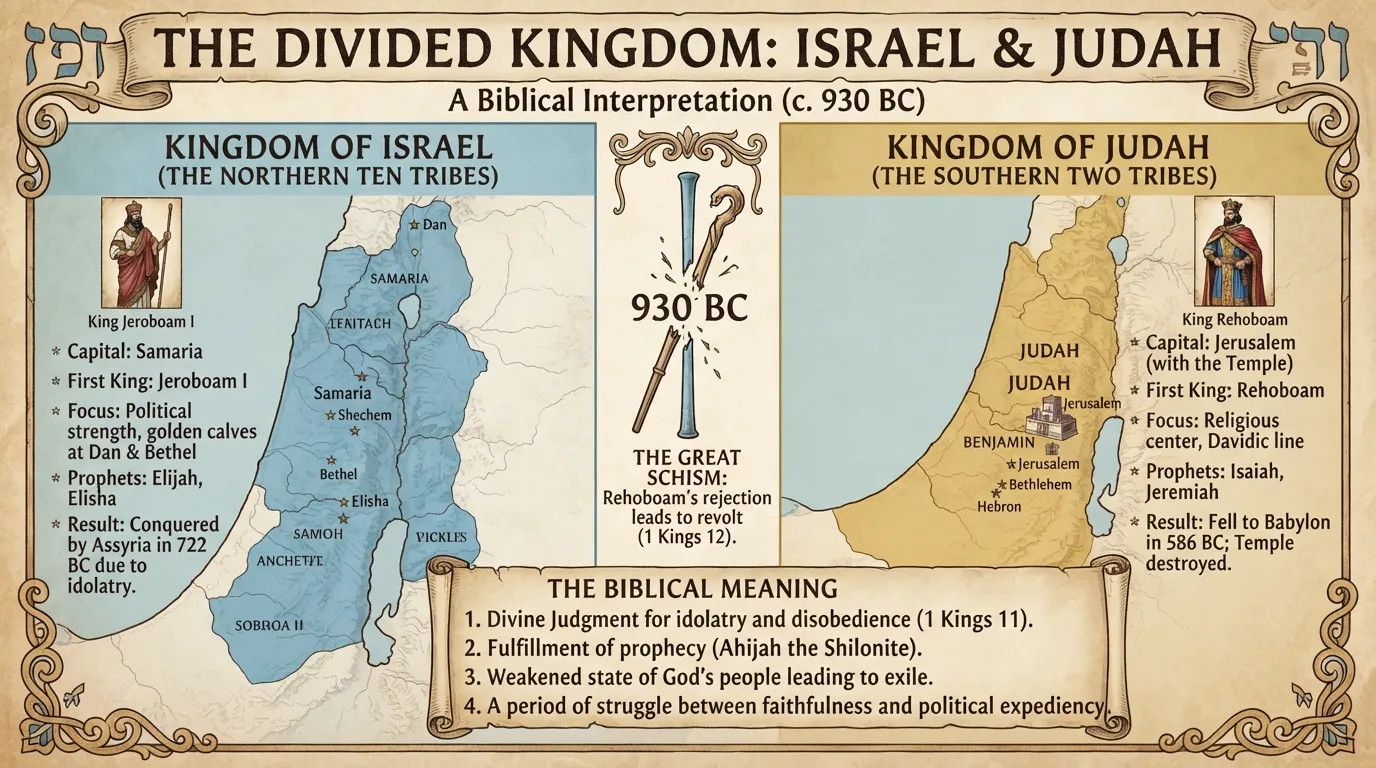
The kingdom that David built and Solomon gilded lasted barely a lifetime. One generation after its golden age, it split in two — and it never came back together. The story of the divided kingdom is the story of how a nation breaks: slowly at first, through compromise and drift, and then all at once, through one harsh decision. It is recorded in 1 Kings 11–12, and it is one of the most politically and spiritually instructive narratives in the Bible.
The division was not an accident. It was the consequence of choices made by two kings, a prophet’s warning, and a people’s exhaustion — all woven together by a God who remained sovereign even in the fracture. To understand it, follow two men: Solomon, who drifted, and Rehoboam, who cracked.
Solomon’s Drift: How a Golden Age Rots
Solomon began as the wisest king who ever lived. God offered him anything, and he asked for wisdom to govern. God gave him wisdom, wealth, peace, and an empire — and then Solomon spent the second half of his reign dismantling what the first half had built. “His wives turned away his heart after other gods” (1 Kings 11:4). Solomon married hundreds of women from surrounding nations, many of them political alliances, and he built high places for their gods — Chemosh, Molech, Ashtoreth — on the hills facing Jerusalem.
The drift was gradual, which is how drift always works. Nobody wakes up one morning and decides to abandon God. Solomon accommodated, compromised, and rationalized, one marriage and one altar at a time, until the man who built the temple was building shrines to gods who demanded child sacrifice. Wisdom, it turns out, does not inoculate a person against sin. It only makes the sin more articulate.
God’s response was a prophetic sentence delivered through Ahijah: the kingdom would be torn from Solomon’s family. But even in judgment, there was mercy and covenant loyalty: one tribe would remain with David’s line, “for the sake of David my servant and for the sake of Jerusalem, which I have chosen” (1 Kings 11:13). God keeps His promises even when His people break theirs. The Davidic line would survive — diminished, chastened, but unbroken — because God had promised David an everlasting throne.
Solomon’s other legacy was economic. His building projects — the temple, the palace, the fortifications — were financed by heavy taxation and forced labor. The glory of Solomon’s Jerusalem was built on the backs of the people. By the end of his reign, the nation was wealthy, exhausted, and resentful. The golden age had a bill, and it was about to come due.
Rehoboam’s Answer: Three Days That Split a Nation
When Solomon died, his son Rehoboam went to Shechem to be crowned. The northern tribes came with a delegation led by Jeroboam, a former official who had fled to Egypt after rebelling against Solomon. Their request was modest: “Your father made our yoke heavy. Now therefore lighten the hard service of your father and his heavy yoke on us, and we will serve you” (1 Kings 12:4). They were not asking for independence. They were asking for relief.
Rehoboam asked for three days to decide. He consulted the elders, who told him: serve the people, speak kindly, and they will be your servants forever. Then he consulted his young friends, who told him: show strength, threaten them, and promise them worse. Rehoboam chose the young men. He answered the people: “My father made your yoke heavy, and I will add to your yoke. My father disciplined you with whips, but I will discipline you with scorpions” (1 Kings 12:14).
The kingdom split on the spot. Ten northern tribes rejected Rehoboam and crowned Jeroboam. Only Judah and Benjamin stayed with the house of David. The northern kingdom kept the name Israel; the southern kingdom became Judah. The division was permanent. The two kingdoms would fight, ally, and drift apart for two centuries, until each was conquered in turn — Israel by Assyria in 722 BC, Judah by Babylon in 586 BC.
Rehoboam’s failure is the Bible’s great case study in leadership. He inherited a crisis and had exactly one tool that could have resolved it: listening. Instead, he confused strength with cruelty, and authority with intimidation. He listened to the wrong counselors — men who told him what his ego wanted to hear. And he discovered that power used to crush people does not produce loyalty. It produces secession.
Jeroboam’s Altars: The Second Fracture
The division might have been political only, but Jeroboam made it religious. Fearing that his people would drift back to Jerusalem to worship at the temple — and back to Rehoboam’s rule — he set up golden calves at Dan and Bethel and announced, “Behold your gods, O Israel, who brought you up out of the land of Egypt” (1 Kings 12:28). He invented a priesthood, a festival, and a worship system designed to keep his kingdom separate.
The move worked politically and failed spiritually. The golden calves became the original sin of the northern kingdom. Every subsequent king of Israel is measured against Jeroboam’s standard: “He did what was evil in the sight of the LORD and walked in the way of Jeroboam.” A political decision became a spiritual inheritance. The north never had a good king. The south had a few. The difference began at Dan and Bethel.
Jeroboam’s story is a warning about the separation of faith from power. When worship is redesigned to serve politics — when churches, movements, or nations reshape God to fit their agenda — the result is always idolatry with better branding. The calves at Dan and Bethel were not presented as false gods. They were presented as the true God, worshiped in a more convenient way. That is how idolatry usually arrives: not as a denial of God, but as a revision of Him.
God’s Sovereignty in the Fracture
Behind the human decisions, Scripture insists on a deeper layer: “The king did not listen to the people, for it was a turn of affairs brought about by the LORD, that he might fulfill his word, which the LORD spoke by Ahijah the Shilonite to Jeroboam” (1 Kings 12:15). The division was both a human failure and a divine purpose. Rehoboam’s foolishness was real. Solomon’s idolatry was real. Jeroboam’s ambition was real. And God was sovereign over all of it, working His judgment and His promise through human choices without excusing them.
That sovereignty is the only comfort in the story. The kingdom was broken, but the promise was not. The prophets kept speaking — Elijah, Elisha, Amos, Hosea, Isaiah, Jeremiah — calling both kingdoms back to God. And the promise to David survived the split, the exiles, and the centuries of silence, until a child was born in Bethlehem, in the line of David, to reunite what sin had divided. The divided kingdom is not the end of the story. It is the dark middle of a story that ends with a King who will “reign over the house of Jacob forever, and of his kingdom there will be no end” (Luke 1:33).
What the Division Teaches
The Long Aftermath: Two Kingdoms, Two Fates
The division lasted more than two centuries, and the two kingdoms traveled very different roads. The north, Israel, never had a single good king. Its nineteen kings are all rated evil in the books of Kings, and its history is a cycle of coups, assassinations, and idolatry. The prophet Elijah confronted its king Ahab on Mount Carmel. Elisha ministered through its wars. Amos and Hosea pronounced its judgment. In 722 BC, Assyria conquered Samaria and deported its people — the ten tribes scattered, never to return as a nation.
The south, Judah, lasted longer. It had a few good kings — Asa, Jehoshaphat, Hezekiah, Josiah — who reformed worship, repaired the temple, and called the people back to God. But the pattern of drift continued, and in 586 BC, Babylon destroyed Jerusalem, burned the temple, and carried Judah into exile. The divided kingdom ended the way divided things end: in collapse. Yet even in exile, the promise survived. The prophets spoke of a new covenant, a new David, a new temple. The division was not the end of God’s story. It was the dark chapter before the return — and before the coming of the King who would reunite what sin had split.
The divided kingdom teaches that nations, churches, and families break the same way: through slow compromise at the top, harsh leadership in a crisis, and the redesigning of worship to serve politics. It teaches that listening is a leadership superpower — Rehoboam had one chance to listen, and he blew it. It teaches that consequences outlive their causes: Solomon’s compromises outlived Solomon. And it teaches that God remains sovereign in the fracture. He does not abandon His people when they divide. He works through the wreckage, keeps His promises, and one day restores what was broken. For the historical background of this period, see the article on the Kingdom of Judah and its relationship to the northern kingdom.










