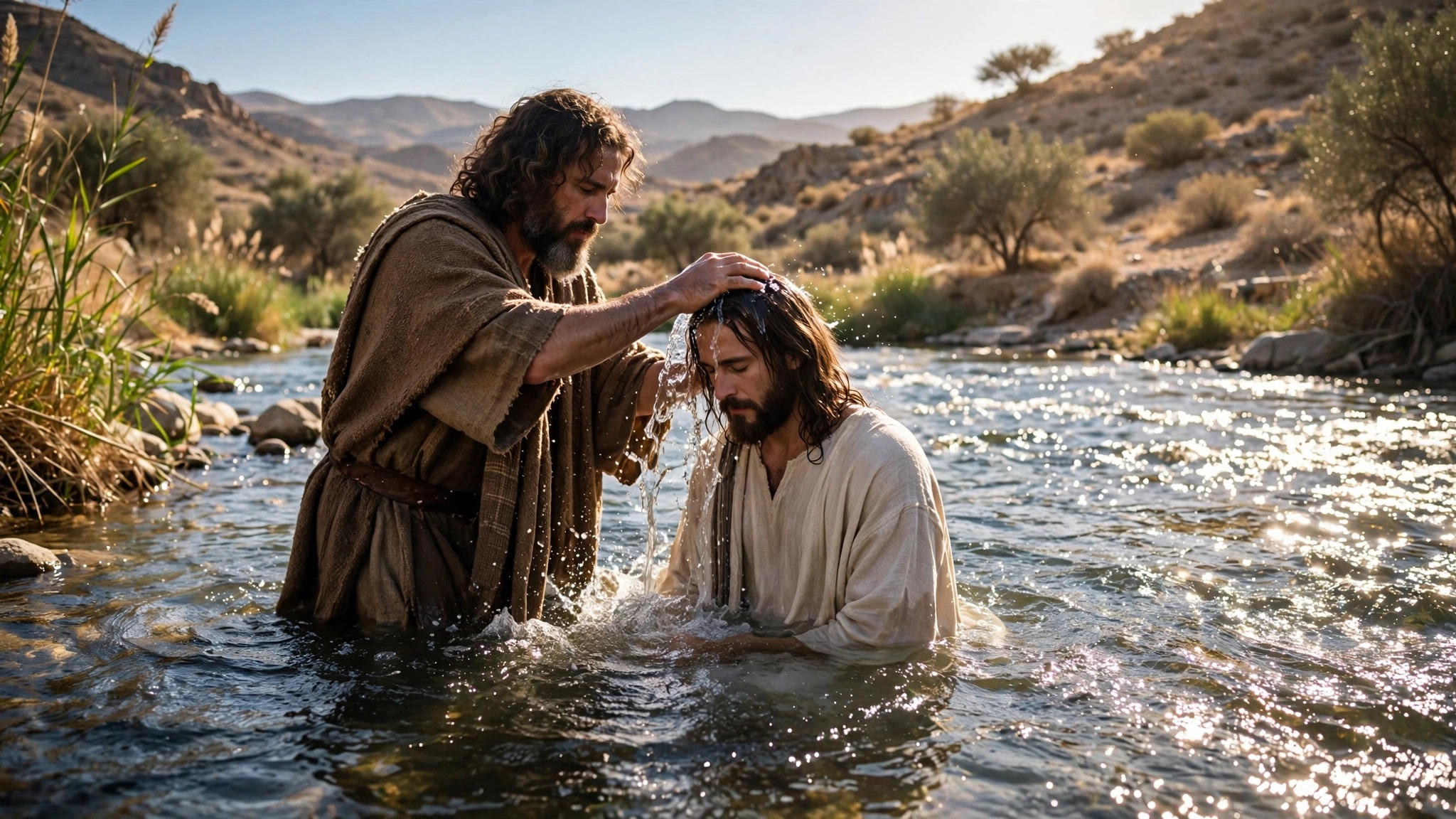
It is one of the most puzzling moments in all of Scripture. John the Baptist is preaching repentance at the Jordan River, baptizing sinners who confess their wrongs. Then Jesus — the sinless Son of God — walks into the water and asks to be baptized too. John is stunned. “I need to be baptized by you, and do you come to me?” (Matthew 3:14). It’s a fair question. If baptism is about repentance from sin, what business did the sinless Jesus have in that water?
The Jesus baptism meaning in the Bible is richer, deeper, and more beautiful than most Christians realize. This single event — recorded in Matthew 3:13–17, Mark 1:9–11, Luke 3:21–22, and described in John 1:29–34 — marks the public launch of Jesus’ ministry. Heaven opened. The Spirit descended. The Father spoke. In one breathtaking moment, the Trinity was revealed and Jesus was anointed for His mission. Let’s wade into those waters and discover why the sinless Savior chose to be baptized — and what His baptism means for yours.
Four Gospels, Four Angles on One Moment
All four Gospels record or reference the event, each adding texture.
Matthew 3:13–17 gives the fullest account. Jesus came from Galilee to the Jordan to be baptized by John. John tried to stop Him, but Jesus replied, “Let it be so now; it is proper for us to do this to fulfill all righteousness” (Matthew 3:15). As Jesus came up from the water, heaven was opened, the Spirit of God descended like a dove and rested on Him, and a voice from heaven said, “This is my Son, whom I love; with him I am well pleased.”
Mark 1:9–11 adds that Jesus saw heaven “torn open” — the Greek suggests a violent ripping, like the temple veil would later tear at His death. The heavens were ripped open for Him, and would be ripped again when He died.
Luke 3:21–22 notes that Jesus was praying as He was baptized when heaven opened — and specifies the Spirit descended “in bodily form like a dove.” Luke also places the baptism right before Jesus’ genealogy and temptation, framing it as His commissioning.
John 1:29–34 gives us John the Baptist’s testimony afterward: “I saw the Spirit come down from heaven as a dove and remain on him… I have seen and I testify that this is God’s Chosen One.” John explains that God told him the Spirit’s descent would identify the Messiah.
One more detail worth noting: Jesus was about thirty years old (Luke 3:23) — the age when priests began their service (Numbers 4:3). His public ministry was beginning with divine ceremony.
Why Was Jesus Baptized? Four Biblical Reasons
1. To fulfill all righteousness. Jesus’ own explanation is the anchor: “it is proper for us to do this to fulfill all righteousness” (Matthew 3:15). Jesus came to do everything God required of His people, perfectly. He kept the law we broke. His baptism was an act of obedient identification with God’s will — the same righteousness He would later credit to us: “God made him who had no sin to be sin for us, so that in him we might become the righteousness of God” (2 Corinthians 5:21).
2. To identify with sinners. Jesus did not need repentance, but He stood in the water with those who did. He was identifying with the people He came to save. This was the first step toward the cross, where He would fully take our place. John called Him “the Lamb of God, who takes away the sin of the world” (John 1:29) — and the Lamb walked into the water with the sheep.
3. To be publicly identified as the Messiah. God had told John that the Spirit’s descent would mark the Messiah (John 1:33). The baptism was Jesus’ public unveiling. The Father’s voice combined Psalm 2:7 (“You are my son”) and Isaiah 42:1 (“my servant, whom I uphold”) — King and Servant in one sentence.
4. To be anointed for ministry. The Spirit’s descent was an anointing. Peter later summarized Jesus’ ministry as beginning when “God anointed Jesus of Nazareth with the Holy Spirit and power” (Acts 10:38). The dove recalled the Spirit’s work at the beginning of creation and the dove returning to Noah with an olive leaf (Genesis 8:11) — the sign of a new beginning. Immediately afterward, Jesus was “full of the Holy Spirit” and led into the wilderness (Luke 4:1) — and He returned “in the power of the Spirit” (Luke 4:14). The baptism was His commissioning.
The Trinity at the Jordan
The baptism is one of Scripture’s clearest revelations of the Trinity. The Son stands in the water. The Spirit descends like a dove. The Father speaks from heaven. Three persons, one God, one moment. The Father’s words are worth lingering over: “This is my Son, whom I love; with him I am well pleased” (Matthew 3:17). Before Jesus had performed a single miracle, preached a single sermon, or resisted a single temptation, the Father was already pleased with Him. His identity was not earned by performance; it was declared by the Father. The same is true for you: if you are in Christ, the Father’s pleasure over you rests on Christ’s performance, not yours. The Father would speak similar words again at the Transfiguration (Matthew 17:5) — this time adding, “Listen to him.”
The Jordan’s Echoes: Priests, Prophets, and Passages
The Jordan River was thick with history. Israel had crossed it into the Promised Land. Elijah had struck it and passed over (2 Kings 2:8). Naaman had washed in it and been cleansed of leprosy (2 Kings 5:14). Priests were washed and anointed when consecrated (Exodus 29:4, 7), and David was anointed king (1 Samuel 16:13). Jesus’ baptism gathered all these threads: consecration like a priest, anointing like a king, and a new crossing into a new exodus. He was stepping into every office — Prophet, Priest, and King — at once.
What His Baptism Means for Yours
Jesus’ baptism is not a substitute for yours; it is the pattern and foundation of yours. When you are baptized, you are publicly identifying with Him — just as He publicly identified with sinners at the Jordan. Paul explains: baptism unites us with Christ’s death and resurrection: “We were therefore buried with him through baptism into death in order that, just as Christ was raised from the dead… we too may live a new life” (Romans 6:3–4). The same heaven that opened over Jesus opens over every believer: you are a beloved child, and the Father says over you, in Christ, “with you I am well pleased.” The Spirit who descended on Jesus dwells in you (1 Corinthians 6:19). Baptism is not magic and it does not save by the water itself — salvation is by grace through faith — but it is the God-ordained public confession of a heart already made new, and the beginning of a life lived in the Spirit’s power.
Questions People Ask
If Jesus was sinless, why did He submit to a baptism of repentance? He did not need repentance; He chose identification. His baptism was about fulfilling righteousness (Matthew 3:15) and standing with sinners He came to save — the first step on the road to the cross, where He would bear our sin fully (2 Corinthians 5:21).
Did Jesus baptize anyone Himself? John’s Gospel notes that Jesus’ disciples baptized, while Jesus Himself did not personally baptize (John 4:1–2). His own baptism was unique — a once-for-all commissioning, not a ministry pattern of baptizing others.
Does baptism save you? Baptism is the biblical response of faith, commanded by Christ — but Scripture is clear that salvation is by grace through faith, and the thief on the cross entered paradise without baptism. Baptism declares what God has done; it does not replace it.
Conclusion: The Beloved Son and His Beloved Children
The baptism of Jesus is the moment heaven tore open and the Father spoke over the Son — and, by extension, over everyone who would ever belong to the Son. Jesus stepped into the water not because He needed cleansing, but because He wanted to stand with you. He fulfilled all righteousness so that His righteousness could become yours. He was anointed with the Spirit so that the Spirit could dwell in you. And the Father’s voice over the Jordan still echoes over every believer today: You are my beloved child. With you, in Christ, I am well pleased. If you have not yet been baptized, consider this your invitation: follow your Savior into the water. Identify with Him publicly, the way He identified with you. And if you have been baptized, remember it — in your temptations, in your failures, in your doubts. The heavens opened once over the Jordan; they remain open over you, because the One who stood in the river for you now stands at the Father’s right hand for you. For more on the history and traditions surrounding this event, see the Wikipedia article on the Baptism of Jesus.










