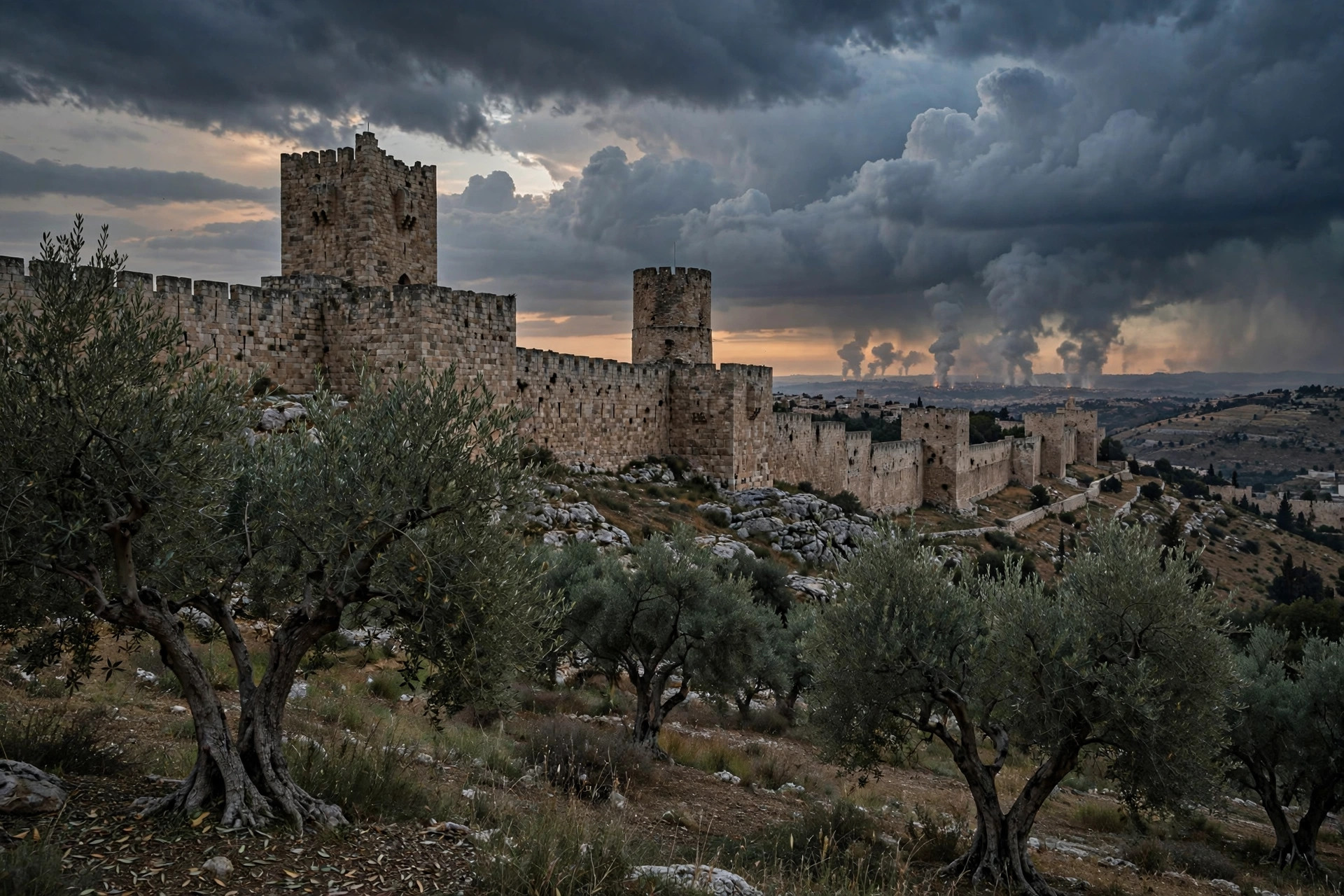
When the news shows images of conflict in Jerusalem — sirens, smoke, frightened families running for shelter — many Christians feel a knot in their stomach. We pray, we worry, and we wonder: what does the Bible say about this? The Jerusalem attacks meaning in the Bible is a topic that blends ancient prophecy with today’s headlines, and it calls for both careful study and deep compassion. Let us be clear from the start: the Bible does prophesy conflict surrounding Jerusalem in the last days. But the Bible also warns us against sensationalism, date-setting, and using prophecy to spread fear. Our goal here is to look honestly at what Scripture says, grieve with those who suffer, and hold onto the hope that God is in control.
Jerusalem in God’s Plan
Jerusalem holds a unique place in Scripture. God chose it as the city where His name would dwell (1 Kings 11:36). David made it his capital. Solomon built the temple there. Jesus wept over it, died outside its walls, and will one day return to it. Psalm 122:6 commands God’s people: “Pray for the peace of Jerusalem.” This is not just a suggestion — it is a standing order for every believer in every age. When we see Jerusalem under attack, our first response should be prayer, not speculation.
Zechariah 12:3 contains a striking prophecy: “On that day, when all the nations of the earth are gathered against her, I will make Jerusalem an immovable rock for all the nations. All who try to move it will injure themselves.” This verse suggests that Jerusalem will be a focal point of international conflict in the last days — and that God Himself will defend it. Jerusalem is not just another city in prophecy; it is the city God calls His own, the city where the world’s story will climax.
Jerusalem Attacks in Bible Prophecy
Several prophetic passages describe attacks against Jerusalem. Let us look at the major ones with care.
Zechariah 12–14 describes a future time when nations gather against Jerusalem. Zechariah 14:2 says, “I will gather all the nations to Jerusalem to fight against it.” But the same passage promises God’s dramatic intervention: “Then the Lord will go out and fight against those nations” (Zechariah 14:3). The chapter ends with the Lord becoming king over the whole earth. The prophecy is not a message of despair; it is a message of divine victory. God allows the siege — and then He ends it, personally.
Ezekiel 38–39 describes an invasion of Israel by a coalition of nations led by “Gog, of the land of Magog.” Many Bible teachers believe this describes a future attack on Israel. God promises to defeat the invaders supernaturally: “I will execute judgment on him with plague and bloodshed” (Ezekiel 38:22). The purpose is clear: “Then they will know that I am the Lord” (Ezekiel 39:22). The invasion is not random; it is the stage on which God displays His glory to the nations.
Luke 21:20–24 records Jesus’ own words: “When you see Jerusalem being surrounded by armies, you will know that its desolation is near.” Jesus predicted the destruction of the temple (Luke 21:6) and warned His followers to flee when they saw the signs. That prophecy was fulfilled in AD 70, when Rome destroyed Jerusalem and the temple. But many scholars believe Jesus’ words also point beyond AD 70 to a future time of trouble: “Jerusalem will be trampled on by the Gentiles until the times of the Gentiles are fulfilled” (Luke 21:24). The prophecy has a near fulfillment and a far horizon.
Revelation completes the picture. Armageddon (Revelation 16:16) describes the gathering of the kings of the earth for the final battle, and Revelation 19 pictures Christ returning as the conquering King. The story ends not with Jerusalem’s destruction but with the New Jerusalem — a city where God dwells with His people and wipes every tear from their eyes (Revelation 21:4).
A History of Attacks on Jerusalem
Jerusalem has been attacked, besieged, and destroyed more than almost any city on earth — and Scripture records the pattern. Babylon destroyed the city and the temple in 586 BC, carrying Judah into exile. The exile did not end the story: God brought His people back, and the temple was rebuilt. Rome destroyed the temple again in AD 70, exactly as Jesus predicted. The city has been fought over by crusaders, sultans, and empires ever since. Each destruction has felt final to those who lived through it. None of them was.
The pattern teaches two things. First, Jerusalem’s sufferings are real, and God never trivializes them. The prophets wept over the city (Jeremiah’s Lamentations is a whole book of grief). Second, Jerusalem’s story is not one of endless defeat. God has preserved a remnant through every catastrophe, and He has promised a future for the city that no army can cancel. The God who brought Israel back from Babylon can bring peace to Jerusalem again.
How Christians Should Respond to Attacks on Jerusalem
Pray. “Pray for the peace of Jerusalem” (Psalm 122:6) is the first and most important response. Pray for the protection of civilians, for wisdom for leaders, for the gospel to advance, and for peace to come. Prayer is not a passive response; it is the most powerful thing a believer can do for a city under fire.
Grieve with those who suffer. “Rejoice with those who rejoice; mourn with those who mourn” (Romans 12:15). The casualties in Jerusalem are not chess pieces in a prophecy chart; they are mothers, children, soldiers, and grandparents. Compassion is not a distraction from prophecy; it is the heart of it. God loves the people of Jerusalem — Israelis and Palestinians alike — and so should we.
Love your enemies. Jesus commanded love for enemies (Matthew 5:44) even in the context of a nation under occupation. Christians must not let concern for prophecy curdle into hatred for any people group. The gospel is for all people (Romans 1:16), and the church’s calling is peacemaking, not cheerleading for war.
Do not set dates or spread fear. Jesus was explicit: “About that day or hour no one knows” (Matthew 24:36). Every generation has had its date-setters, and every one of them has been wrong. Prophecy is given to produce hope and holiness, not panic. If your study of prophecy makes you afraid, you are reading it wrong. “Do not be anxious about anything, but in every situation, by prayer and petition, with thanksgiving, present your requests to God” (Philippians 4:6–7).
Trust God’s sovereignty. The nations rage, but God reigns. Isaiah promises that one day, “He will judge between the nations and will settle disputes for many peoples. They will beat their swords into plowshares” (Isaiah 2:2–4). The Prince of Peace (Isaiah 9:6) will have the last word.
One more response matters: refuse to use prophecy as a weapon. It is tempting, when headlines flare, to declare that this attack or that war is the fulfillment of a specific verse — and to use that claim to score points. Scripture warns against exactly that kind of speculation. Jesus said no one knows the day or the hour (Matthew 24:36), and the apostles warned against those who unsettle believers with false alarms. Prophecy was given to produce hope and holiness, not headlines. When you see conflict in Jerusalem, let it drive you to prayer and compassion, not to prediction and panic. The God who holds the future does not need our help to announce it.
Should Christians Visit Jerusalem Today?
Many Christians long to walk where Jesus walked. Visiting Jerusalem can be a life-changing experience — standing on the Mount of Olives, praying in the Garden of Gethsemane, walking the Via Dolorosa. But wisdom is needed. Check travel advisories, travel with reputable guides, and be honest about risks. A pilgrimage is a wonderful gift, not a duty; God is not more present in Jerusalem than He is in your living room. If you go, go as a peacemaker: respect all the communities who call the city home, listen to local believers — Jewish, Arab, and Palestinian Christians alike — and let the trip deepen your love for all of Jerusalem’s people, not just one side.
The Future Hope for Jerusalem
The Bible’s final word about Jerusalem is not war; it is peace. Zechariah’s siege ends with the Lord reigning as King over the whole earth. Ezekiel’s invasion ends with the nations knowing the Lord. Revelation’s battles end with a new heaven and a new earth, where God dwells with His people and wipes every tear from their eyes (Revelation 21:4).
Conclusion: Pray, Trust, and Hope
When you see Jerusalem under attack, do what Scripture tells you to do. Pray for the peace of Jerusalem (Psalm 122:6). Grieve for the suffering. Refuse hatred. Refuse panic. And hold onto hope: the God who chose Jerusalem, defended Jerusalem, wept over Jerusalem, and died outside Jerusalem has not abandoned it. “Fear not, for I am with you; be not dismayed, for I am your God” (Isaiah 41:10). The city that has survived Babylon, Rome, and two thousand years of war will survive this too — and one day, the Prince of Peace will stand on the Mount of Olives, and the wars will end forever. Until then, pray, trust, and hope. For historical background on the city itself, see the Wikipedia article on Jerusalem.










