Everyone loves a victory story. The underdog team, the impossible odds, the final triumphant moment — these tales stir something deep in us. But the greatest victory stories in Scripture are not about human strength or clever strategy. They are about a man named Joshua who learned that real victory comes from trusting God completely.
Joshua led Israel into the Promised Land around 1400 BC and won battle after battle — not because Israel had the biggest army, but because they had the greatest Commander. The Joshua victories in the Bible go far beyond ancient battlefields. They are a blueprint for facing the giants in your own life today.
The Man Behind the Victories
Joshua’s story began long before he was a general. He was Moses’ aide from his youth — the young man who stayed in the tent of meeting after Moses left (Exodus 33:11, in substance). He was one of the twelve spies sent into Canaan, and one of only two who believed God could give them the land (Numbers 14:6-9, in substance). His original name was Hoshea, meaning “salvation”; Moses renamed him Joshua — “Yahweh saves” (Numbers 13:16). The name was the mission.
When Moses died, God commissioned Joshua with words that have echoed through the centuries: “Be strong and courageous, because you will lead these people to inherit the land I swore to their ancestors to give them. Be strong and very courageous. Be careful to obey all the law my servant Moses gave you; do not turn from it to the right or to the left, that you may be successful wherever you go” (Joshua 1:6-7). And the promise underneath it all: “As I was with Moses, so I will be with you; I will never leave you nor forsake you” (Joshua 1:5).
Joshua’s victories began before any battle, in that promise. He did not win because he was brilliant. He won because God was with him. “Keep this Book of the Law always on your lips; meditate on it day and night, so that you may be careful to do everything written in it. Then you will be prosperous and successful” (Joshua 1:8). Victory, in Joshua’s life, was the fruit of presence and obedience — God’s presence with him, and his obedience to God’s word.
The First Victory: Crossing the Jordan
Before Joshua fought a single battle, he had to cross a river. The Jordan was at flood stage, and Israel had to cross it on foot, with children, livestock, and supplies. God told Joshua the priests would carry the ark into the water — and when their feet touched it, the river would stop. “As soon as the feet of the priests who carried the ark touched the water’s edge, the water from upstream stopped flowing” (Joshua 3:15-16, in substance).
The crossing was the first victory, and it taught the pattern for all the rest: God acts when his people step out in faith. The water did not part before the priests moved. It parted when they stepped in. Faith is not waiting until you feel safe. It is stepping into the river and trusting God to hold the water back.
Israel built a memorial of twelve stones from the riverbed (Joshua 4:6-7, in substance), so that future generations would ask, “What do these stones mean?” — and the answer would be: God brought us through. Every victory needs a memorial, because memory is the fuel of future faith.
The Victory at Jericho: Winning by Worship
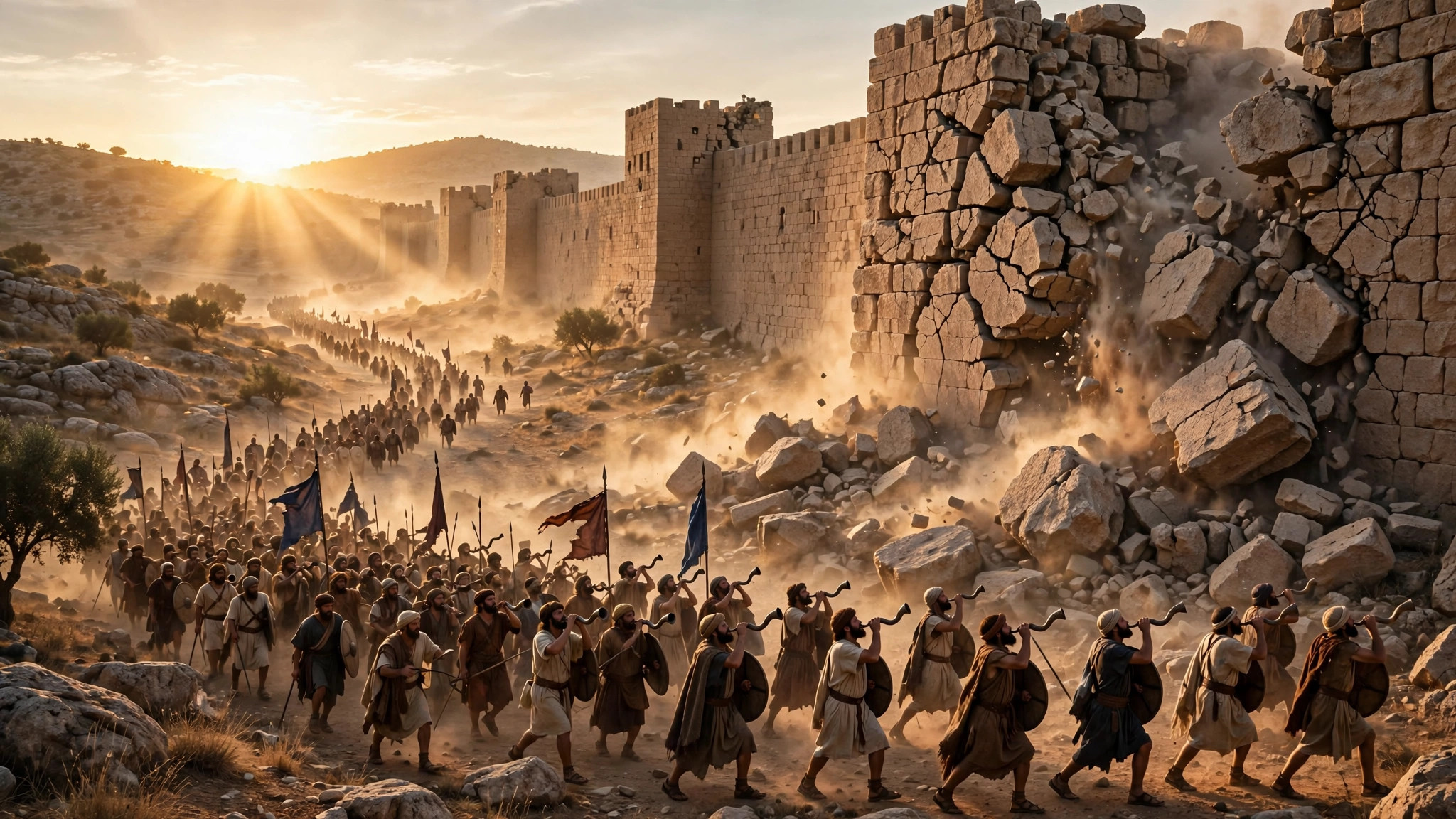
Jericho was the most fortified city in Canaan — double walls, a powerful army, a reputation for invincibility. God’s battle plan was absurd by every military standard: march around the city once a day for six days, seven times on the seventh day, blow trumpets, shout — and the walls would fall (Joshua 6:3-5, in substance).
Israel obeyed. The priests blew trumpets, the people shouted, and the walls collapsed. “When the trumpets sounded, the army shouted, and at the sound of the trumpet, when the men gave a loud shout, the wall collapsed; so everyone charged straight in, and they took the city” (Joshua 6:20).
Jericho teaches the strangest truth about spiritual victory: sometimes the battle is won by worship, not by weapons. Israel’s greatest weapon at Jericho was obedience to a plan that made no sense. The walls did not fall because Israel was strong. They fell because God was faithful — and because his people trusted him enough to look foolish. Some of the walls in your life — the addiction, the fear, the broken relationship — will not fall to striving. They will fall to obedient, worshiping trust.
The Defeat at Ai: The Cost of Hidden Sin
After Jericho came Ai — a small town, an easy target. Joshua sent a small force, confident of victory. Israel was routed. Thirty-six men died, and the whole nation panicked. “At this the hearts of the people melted in fear and became like water” (Joshua 7:5).
The reason was hidden sin. A man named Achan had taken devoted things from Jericho — a robe, silver, gold — and hidden them in his tent. One man’s secret sin had defeated a whole army. When Achan confessed and the sin was dealt with, Israel returned to Ai and won (Joshua 7–8, in substance).
Ai is the warning inside the victory story: you can win Jericho and lose Ai. Public victories do not protect against private sin. The hidden things — the compromise no one sees, the habit no one knows about — can undo everything God is doing. Victory requires not just courage on the battlefield but honesty in the tent.
The Long Day: The Sun Stands Still
Joshua’s most famous victory came against a coalition of five Amorite kings who attacked Gibeon. Joshua marched his army all night, fell on the enemy by surprise, and God fought with him: “The Lord threw them into confusion before Israel” and “the Lord hurled large hailstones down on them from the sky” (Joshua 10:10-11). Then Joshua prayed the boldest prayer in military history: “Sun, stand still over Gibeon, and you, moon, over the Valley of Aijalon” (Joshua 10:12). “The sun stopped in the middle of the sky and delayed going down about a full day. There has never been a day like it before or since, a day when the Lord listened to a human being” (Joshua 10:13-14).
The long day teaches us that God answers bold prayers. Joshua did not pray a timid prayer. He asked for the impossible — and God gave it. The God who stopped the sun is the God who hears your prayers today. “Nothing is impossible with God” is not a slogan in Joshua’s story. It is a battlefield report.
The Northern Campaign and the Long Obedience
The victories did not end at Gibeon. A northern coalition under Jabin of Hazor gathered an army “as numerous as the sand on the seashore” (Joshua 11:4). Joshua defeated them too — and the campaign went on for years. “Joshua waged war against all these kings for a long time” (Joshua 11:18). The conquest was not a single weekend. It was a long obedience.
That matters, because we tend to want instant victories. Joshua’s story says that some victories take years. The land was given, but it had to be taken — town by town, hill by hill, year by year. God gave Israel the land by promise, and Israel possessed it by persistence. Both are true, and both are necessary. The promise is God’s; the persistence is ours.
At the end, the book of Joshua records a stunning summary: “So the Lord gave Israel all the land he had sworn to give their ancestors, and they took possession of it and settled there… Not one of all the Lord’s good promises to Israel failed; every one was fulfilled” (Joshua 21:43, 45). Every one. That is the record of God’s faithfulness — and the foundation of ours.
Winning Your Battles God’s Way
Joshua’s victories give us a battle plan for our own giants. First, start with God’s presence. “Be strong and courageous, because… the Lord your God will be with you wherever you go” (Joshua 1:9). Courage is not the absence of fear; it is the presence of God in the face of fear.
Second, obey even when the plan seems foolish. Marching around Jericho made no military sense. It made perfect faith sense. God’s strategies often look foolish to the world — “the foolishness of God is wiser than human wisdom” (1 Corinthians 1:25).
Third, deal with hidden sin. Ai proves that private compromise has public consequences. Confession is not optional for victory; it is the doorway to it. “Whoever conceals their sins does not prosper, but the one who confesses and renounces them finds mercy” (Proverbs 28:13).
Fourth, pray boldly. Joshua asked for the sun to stand still. What are you asking for? The God of Joshua has not shrunk. “You do not have because you do not ask God” (James 4:2, in substance) — so ask, boldly, for the victory only he can give.
Finally, remember who wins the war. “Thanks be to God! He gives us the victory through our Lord Jesus Christ” (1 Corinthians 15:57). Joshua’s name means “Yahweh saves” — and Jesus’ name in Hebrew is the same name. Joshua led Israel into the land; Jesus leads us into rest. The battle belongs to the Lord (1 Samuel 17:47), and the victory is already won at the cross.
A Prayer for Victory
Lord, give me Joshua’s courage — to step into the river before it parts, to march around walls that will not fall to my strength, to confess the hidden sin that defeats me, and to pray for the impossible. Remind me that the battle is yours, the victory is yours, and the glory is yours. Make me strong and courageous, because you are with me wherever I go. For the historical background of this great leader, the Wikipedia article on Joshua offers a helpful overview.










