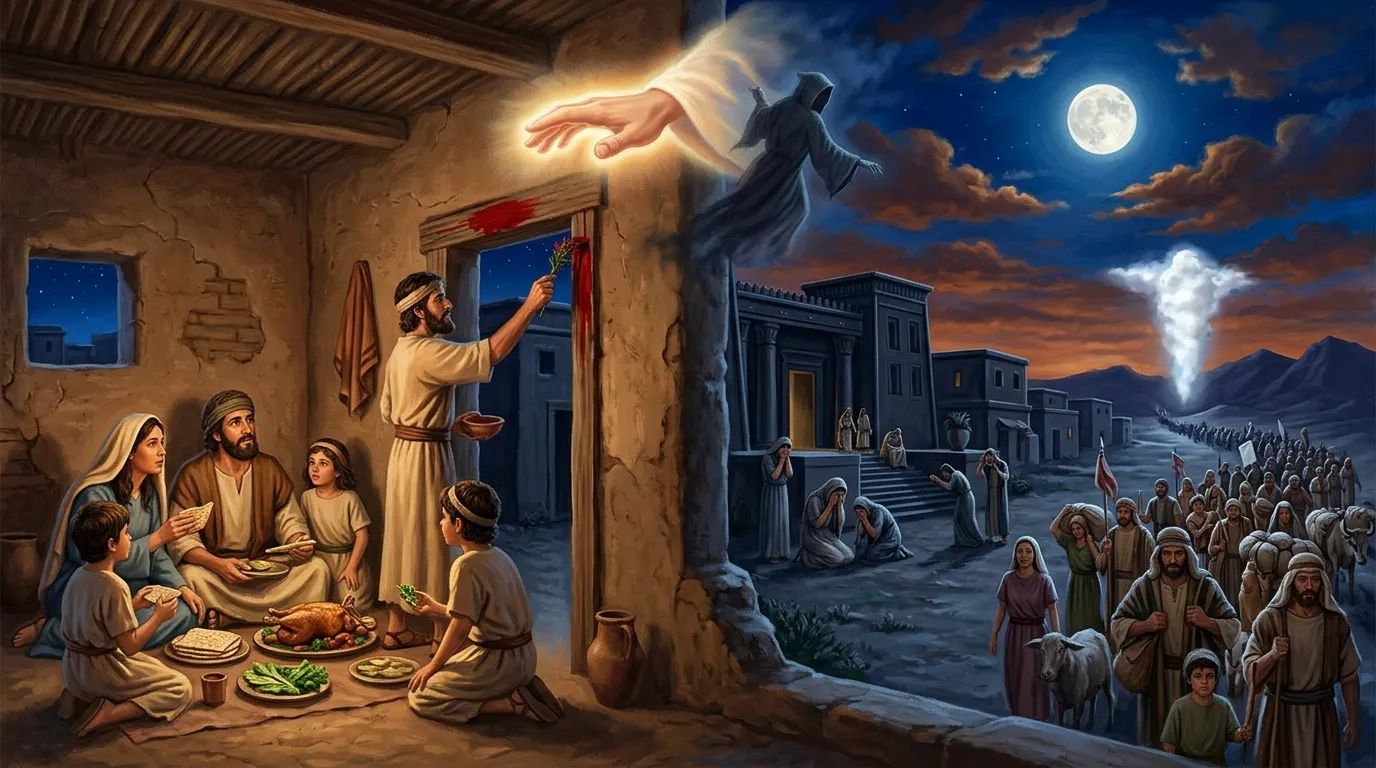
It is midnight in Egypt, and inside one small house a family is doing something strange: they are fully dressed, sandals on, staff in hand, eating a hurried meal while blood dries on their doorframe. Outside, the most powerful empire on earth is about to break. They are not soldiers. They are slaves — bricklayers and field hands. But tonight they are participants in the event that will define their nation for three thousand years, and point beyond itself to the rescue of the world. Tonight is Passover. And to understand it is to understand the entire Bible in miniature.
A Night of Terror and Deliverance
The story is Exodus 12, and its backdrop is nine plagues deep into a confrontation between Yahweh and Pharaoh. Egypt’s gods have been systematically dismantled — the Nile turned to blood, the sun darkened — and now comes the final plague: the death of the firstborn. But before it falls, God gives Israel astonishingly detailed instructions: on the tenth day of the month, each household is to take a lamb; on the fourteenth, slaughter it at twilight; put the blood on the sides and tops of the doorframes; roast the meat and eat it with bitter herbs and unleavened bread, “with your cloak tucked into your belt, your sandals on your feet and your staff in your hand. Eat it in haste; it is the LORD’s Passover” (Exodus 12:11).
Feel the strangeness of it. God’s deliverance does not come through Israel’s strength — they have none. It does not come through negotiation — Pharaoh has refused. It comes through obedience to strange instructions: kill a lamb, paint with its blood, eat dressed for travel. Salvation, from the very first Exodus, is received by faith expressed in obedience — not by merit, not by might, not by bargaining. The pattern will never change.
At midnight the LORD struck down the firstborn of Egypt (Exodus 12:29), and “there was loud wailing… for there was not a house without someone dead.” But in Goshen, behind blood-marked doors, slaves ate in peace. The difference between the two Egypts that night was not morality, worthiness, or nationality. It was the blood on the door. That sentence is the whole gospel in eleven words.
The Lamb Without Blemish
God’s specifications for the lamb are precise and prophetic: “The animals you choose must be year-old males without defect” (Exodus 12:5). Taken on the tenth day, kept until the fourteenth, examined for four days — the lamb had to be inspected perfection. No blemish, no broken bone (Exodus 12:46 adds that no bone was to be broken — a detail John will later apply directly to Jesus, John 19:36).
Why such fuss over a farm animal? Because the lamb was a placeholder — a living prophecy of a perfection it did not possess. Every unblemished lamb for fourteen centuries whispered the same question: where is the truly spotless one? The New Testament answers with a shout. John the Baptist sees Jesus and cries, “Look, the Lamb of God, who takes away the sin of the world!” (John 1:29). Peter describes redemption “with the precious blood of Christ, a lamb without blemish or defect” (1 Peter 1:19). The writer of Hebrews explains that the old sacrifices could never perfect anyone — which is why they had to be repeated, year after year, pointing always forward (Hebrews 10:1-4). The Passover lamb was God’s object lesson in substitution: an innocent dies so the guilty live — rehearsed annually until the true Innocent arrived.
And note the household scope: “each man is to take a lamb for his family, one for each household” (Exodus 12:3). If a household was too small, neighbors shared (v. 4). Salvation has always been household-shaped in Scripture — not individualistic. The jailer is told “you and your household” will be saved (Acts 16:31). God’s rescue moves in families, and Passover was its first great demonstration.
“When I See the Blood”
The theological center of the whole event is a single divine sentence: “The blood will be a sign for you on the houses where you are, and when I see the blood, I will pass over you” (Exodus 12:13). The Hebrew verb is pasach — to pass over, to spare, to hover protectively. (Some scholars note the word can also suggest a protective leaping over, like a bird sheltering its young — either way, it is deliverance, not indifference.)
Meditate on the grammar of grace here. God does not say, “When I see your worth, I will pass over you.” He does not say, “When I see your effort.” He says, “When I see the blood.” The ground of deliverance is entirely outside the Israelite — on the doorframe, not in the heart. They were not saved because they were better than Egyptians; they were saved because they were covered. This is justification by faith in Old Testament dress: the sinner sheltered by a substitute, accepted on the basis of Another’s blood.
And it was applied blood that saved, not merely shed blood. A lamb slain but left in the pen saved no one. The blood had to be taken — by hyssop, by hand — and put on the door. The gospel has always required this personal application: Christ died for sinners generally, but He saves believers particularly. “Believe in the Lord Jesus, and you will be saved” (Acts 16:31) is the New Testament’s hyssop — the means by which the blood gets from the cross to the doorframe of your life.
Christ Our Passover
Paul makes the identification explicit, in a sentence that should stop every reader cold: “For Christ, our Passover lamb, has been sacrificed” (1 Corinthians 5:7). Not “like” our Passover lamb. Our Passover lamb. The apostle is saying that everything Exodus 12 enacted in shadow, Calvary enacted in substance.
The parallels are deliberate and detailed. Jesus was examined — by Pilate, by Herod, by the Sanhedrin — and declared without fault: “I find no basis for a charge against him” (John 18:38). He was crucified at Passover, at the very hour the lambs were being slaughtered in the temple courts — John times it precisely (John 19:14). His bones were not broken, fulfilling Exodus 12:46 (John 19:36). He was “led like a lamb to the slaughter” (Isaiah 53:7), silent before His shearers. And His blood, applied by faith, causes the judgment of God to pass over the believer — “we have been justified by his blood” (Romans 5:9).
This is why the Last Supper was a Passover meal. Jesus took the ancient symbols — the bread, the cup — and filled them with Himself: “This is my body… This cup is the new covenant in my blood” (Luke 22:19-20). He was not abolishing Passover. He was becoming it. Every communion table since is a Passover table, and every believer is an Israelite behind a blood-marked door on the night the judgment passes.
The Meal That Remembers
God commanded the meal to be memorial, not merely historical: “This is a day you are to commemorate; for the generations to come you shall celebrate it as a festival to the LORD — a lasting ordinance” (Exodus 12:14). The unleavened bread (haste — no time for yeast to rise), the bitter herbs (the bitterness of bondage), the roasted lamb (the cost of deliverance) — every element was edible theology, designed so that children would ask, “What does this mean?” (Exodus 12:26) and parents would tell the story.
Notice God’s pedagogy: He did not command a monument. He commanded a meal — something tasted, shared, repeated. Truth that is eaten is truth that is remembered. This is why Jesus instituted His own memorial meal “in remembrance of me” (Luke 22:19). Christianity is a faith that eats its theology: bread and cup, week after week, telling the Exodus story in its final form until children ask and the church answers.
Keeping the Feast Today
Paul draws the present-tense conclusion: “Therefore let us keep the Festival, not with the old bread leavened with malice and wickedness, but with the unleavened bread of sincerity and truth” (1 Corinthians 5:8). Passover is not nostalgia. It is a way of life:
- Live as the delivered. Israel left Egypt; too many Christians keep commuting back. “You were bought at a price” (1 Corinthians 6:20) — the Exodus logic applied to holiness. The blood that saved you from judgment also saved you for freedom. Stop building bricks for Pharaoh.
- Keep the door marked. The blood was a public sign — visible from the street. There is no secret Passover. Baptism, confession, communion: the New Testament’s doorframe-markers, declaring openly whose house this is.
- Eat in haste — stay ready. Sandals on, staff in hand: the Passover posture is readiness. “Be dressed ready for service and keep your lamps burning” (Luke 12:35). The delivered people are a pilgrim people, packed for the promised land.
- Tell the children. The meal existed so the story would survive. Your testimony is someone’s Passover liturgy. Tell it — at the table, in the car, before bed — until the next generation knows what the blood on the door means.
Fourteen centuries of lambs, one midnight in Egypt, and a cross outside Jerusalem converge on a single promise: when I see the blood, I will pass over you. That is Passover — judgment averted, bondage broken, a people set marching toward home. For the historical and cultural background of the festival as observed through the centuries, the overview of Passover is a helpful companion — but the meaning itself is in Exodus 12, where a family behind a blood-marked door ate in peace while an empire fell, rehearsing the night when God would pass over the whole world.










