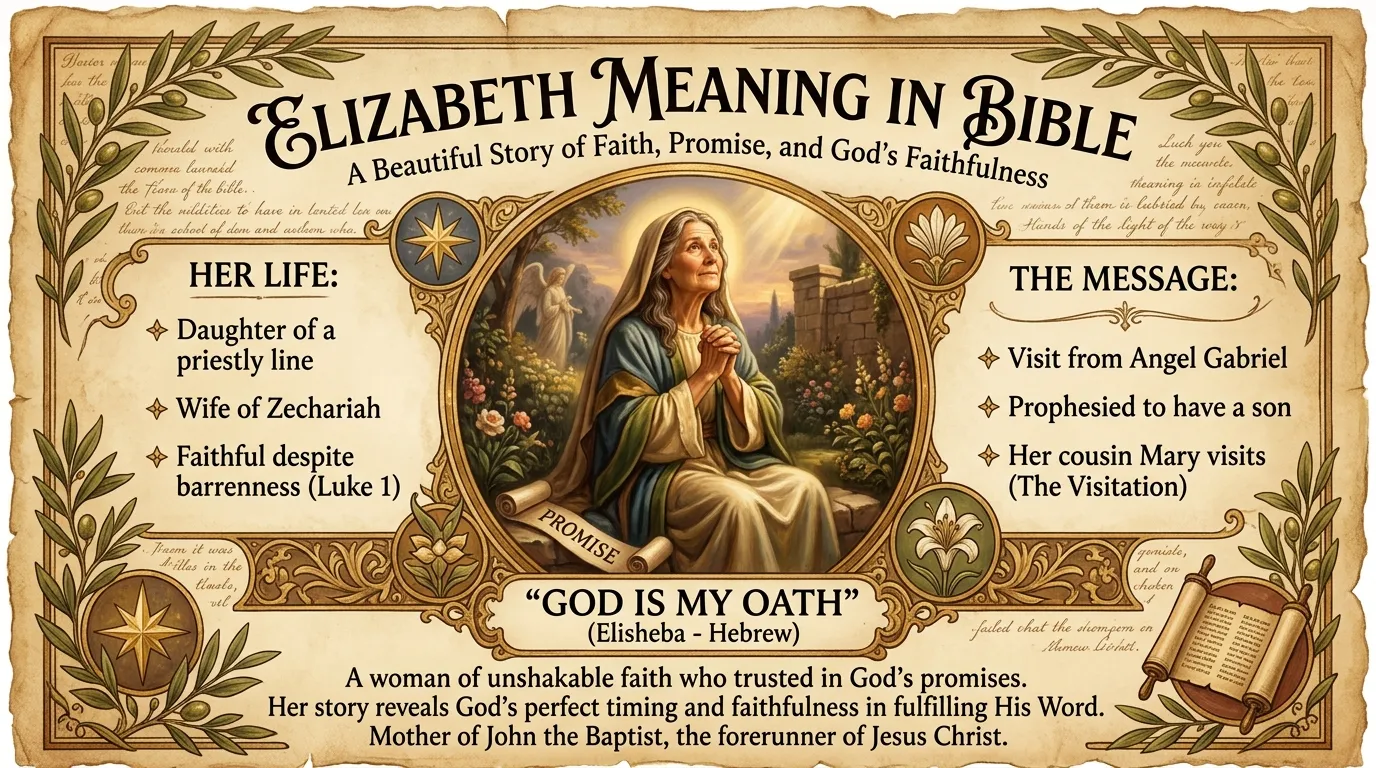
Some names are labels. Others are theology — compact doctrines you can speak in a single breath. Elizabeth is the second kind. In Hebrew she is Elisheba: El (God) + sheba (oath, pledge, fullness) — “My God is an oath,” or “God is my pledge.” Every time the name is spoken, it preaches: God has sworn, God has promised, God will not fail. And in Luke’s Gospel, the woman who bore the name became the living proof of it — the barren wife who conceived in old age, the first person in the New Testament to confess Jesus as Lord, the mother of the Forerunner. To study Elizabeth is to study the God who keeps His oaths.
“My God Is an Oath”: The Theology in the Name
In Scripture, an oath is God’s strongest form of speech. When God swore to Abraham “by myself” (Genesis 22:16; Hebrews 6:13), He bound His own character to His promise — there was nothing greater to swear by. The name Elisheba takes that divine oath and makes it personal: not “God swore” in the abstract, but “my God is an oath” — my God is promise-keeping by nature, covenant-faithful down to His name.
The name first appears in Exodus 6:23: Elisheba, daughter of Amminadab, wife of Aaron the high priest, mother of the priestly line. From its first biblical bearer, the name is associated with priestly households — fitting, since Luke’s Elizabeth is also “of the daughters of Aaron” (Luke 1:5), married to the priest Zechariah. The name traveled through the priesthood like a family heirloom, gathering meaning: God keeps His oaths, generation after generation, in the very line set apart to mediate His promises.
Righteous, Barren, and Waiting: Luke 1
Luke introduces the couple with a striking pairing: “they were both righteous before God, walking blamelessly in all the commandments and statutes of the Lord. But they had no child, because Elizabeth was barren, and both were advanced in years” (Luke 1:6-7). Righteous and barren. Blameless and childless. Luke deliberately breaks the simplistic equation of suffering with sin — Elizabeth’s barrenness was not punishment; it was preparation. Like Sarah, Rebekah, Rachel, and Hannah before her, her empty womb was the stage God chose for displaying that children are His gift, not human achievement.
Then the angel Gabriel appeared to Zechariah in the temple: “Your prayer has been heard, and your wife Elizabeth will bear you a son, and you shall call his name John” (Luke 1:13). Note your prayer has been heard — this was not a new request but an old one, prayed so long ago Zechariah had stopped expecting the answer. Elizabeth’s story is for everyone praying a prayer they’ve nearly given up on: God heard it the first time, and His timing is not His forgetfulness.
When Elizabeth conceived, she hid herself for five months, saying, “Thus the Lord has done for me in the days when he looked on me, to take away my reproach among people” (Luke 1:24-25). Barrenness in her culture was social shame; God’s oath reversed it. Her first recorded words are testimony: the Lord has done this. The woman named “God is my oath” became the woman who could say “God kept His oath — to me.”
The First Confession: Elizabeth and Mary
The narrative’s peak comes when Mary — newly told she will bear the Messiah — hurries to Elizabeth’s hill country home. At Mary’s greeting, the baby leaped in Elizabeth’s womb, “and Elizabeth was filled with the Holy Spirit, and she exclaimed with a loud cry, ‘Blessed are you among women, and blessed is the fruit of your womb! And why is this granted to me that the mother of my Lord should come to me?'” (Luke 1:41-43).
This is the first human confession of Jesus’ lordship in the New Testament — and it comes from Elizabeth, by the Spirit, before Jesus is even born. “The mother of my Lord”: the older woman honors the younger; the mother of the forerunner bows to the mother of the King. Elizabeth’s greatness was her decrease — she would later raise John to say of Jesus, “He must increase, but I must decrease” (John 3:30), and she modeled it first.
Her final blessing to Mary is Scripture’s great beatitude of faith: “Blessed is she who believed that there would be a fulfillment of what was spoken to her from the Lord” (Luke 1:45). Elizabeth — who had lived the long wait — pronounced blessing on believing the promise before its fulfillment. She knew: the oath is sure even when the womb is still empty, even when the promise is still invisible. Blessed are the believing.
The Naming of John: Elizabeth’s Quiet Courage
Eight days after the birth, the neighbors and relatives gathered for the circumcision, “and they would have called him Zechariah after his father, but his mother answered, ‘No; he shall be called John'” (Luke 1:59-60). The objection was immediate: “None of your relatives is called by this name.” Naming a child outside the family tradition was a break with custom — and Elizabeth, the new mother, made the break alone, while her husband was still mute under Gabriel’s discipline.
They motioned to Zechariah, who asked for a tablet and wrote, “His name is John” — and instantly his mouth was opened (Luke 1:63-64). The scene reveals Elizabeth’s steel: she had received the angel’s word secondhand (through her silenced husband), believed it, carried it for nine months, and now defended it against social pressure. “He shall be called John” — not is, as a wish, but shall be, as a decree. The woman named “God is my oath” acted like someone who believed oaths outrank customs.
There is a wider lesson in her courage. God’s callings rarely fit family expectations — John was the first prophet in four hundred years, the forerunner of the Messiah; “Zechariah Jr.” would have been a smaller story. Elizabeth chose the God-given name over the family-approved one. Every believer faces versions of this choice: the career the family expects versus the calling God gives, the safe tradition versus the risky obedience. Elizabeth’s precedent: when God’s word and custom collide, go with the word — even if you stand alone at first. (Zechariah, to his credit, backed her the moment he could speak.)
“And all who heard them laid them up in their hearts, saying, ‘What then will this child be?’ For the hand of the Lord was with him” (Luke 1:66). The neighbors sensed what Elizabeth already knew: this was no ordinary birth. Her courage at the naming was the first public testimony to John’s extraordinary calling — a mother’s faith, spoken firmly, opening the door for a father’s released praise.
The God of the Oath Today
Elizabeth’s theology — my God is an oath — is not antique; it is the daily ground of Christian confidence. Every promise in Scripture is an oath backed by God’s character: “he who promised is faithful” (Hebrews 10:23). The same God who opened Elizabeth’s womb in her old age opens impossible situations still — not always as we picture, but always as He promised: working “all things together for good for those who love God” (Romans 8:28).
For the waiting, Elizabeth offers three gifts. The gift of continued righteousness — she and Zechariah walked blamelessly during the barren years, not just after the answer. Waiting is not wasted when it is worshipful. The gift of testimony — “thus the Lord has done for me” turns private mercy into public witness. Answered prayer is meant to be told. The gift of joyful decrease — Elizabeth’s greatest moment was celebrating Someone else’s greater calling. The oath-keeping God frees us from competing for the spotlight; we can rejoice when others are exalted, because our worth was sworn long ago.
And here is Elizabeth’s final gift to the waiting: she never saw the whole oath. She died (presumably) before John’s ministry began, before the Jordan baptisms, before “Behold, the Lamb of God.” She believed the promise, bore the forerunner, blessed the Messiah’s mother — and left the rest to God. Most of us will be Elizabeths in this sense: we will see part of what God does with our faithfulness, not all of it. The oath-keeping God does not owe us the full view; He asks for the full trust. Blessed, indeed, are those who believe before the fulfillment — for they shall see, in God’s time, what Elizabeth now sees face to face.
What does Elizabeth mean spiritually?
“My God is an oath” — God is promise-bound, covenant-faithful, pledged to His people. Spiritually, the name is a confession: the God I serve does not merely make promises; He is promise-keeping. To bear or give the name is to declare trust in His sworn word.
Why is Elizabeth important in the Bible?
She is the mother of John the Baptist, the forerunner of Christ; the first person to confess Jesus as Lord (Luke 1:43); a model of righteous waiting through decades of barrenness; and the speaker of Scripture’s great blessing on believing God’s promises before seeing them (Luke 1:45).
From Exodus to Luke, from Aaron’s wife to John’s mother, the name has preached one sermon: God swears, and God performs. Elizabeth lived the proof. For the historical figure behind the name, see Elizabeth (biblical figure).










