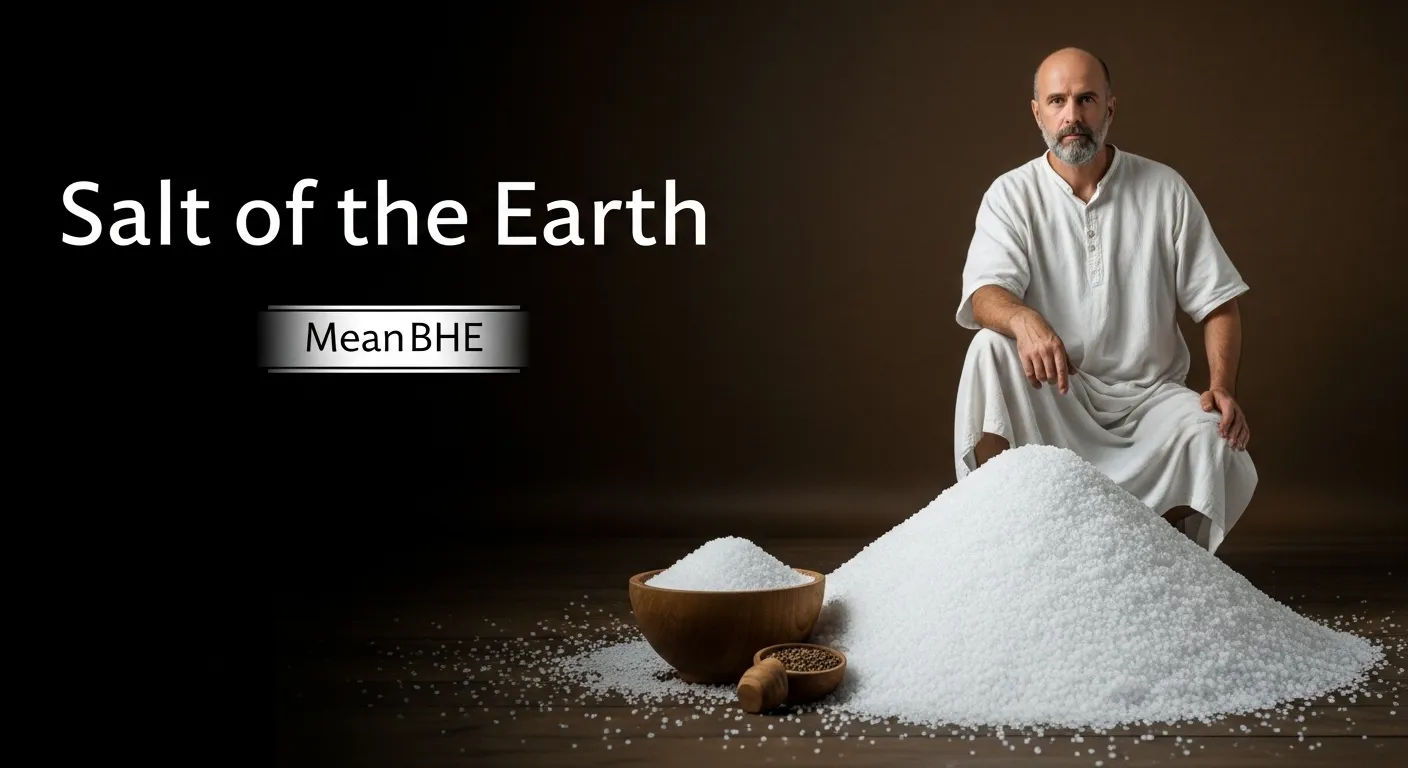
Jesus had just finished describing the world’s most unlikely heroes — the poor in spirit, the mourners, the meek, the persecuted — when He turned to that ragged hillside crowd and gave them the most astonishing job description in history: “Ye are the salt of the earth” (Matthew 5:13). Not you should try to become. Not you might one day be. You are. Fishermen, tax collectors, nobodies — declared, in the present tense, to be the preserving agent of the entire world. To grasp what Jesus meant, you have to forget the salt shaker on your table and remember what salt was before refrigeration: precious, powerful, covenantal — the difference, quite literally, between life and rot.
An Identity Before a Task
The grammar matters. In the Sermon on the Mount, the Beatitudes describe character (“blessed are the meek”), and then the salt and light sayings describe function — what that character does in the world. The order is crucial: being comes before doing. Jesus does not say “act salty and you will become the salt.” He declares an identity and lets the behavior follow. The Christian’s influence on the world flows from who they are in Christ, not from techniques they master.
This also means the statement is corporate as much as personal. “Ye” is plural — y’all are the salt of the earth. No single believer preserves the world alone; it is the community of the humble, scattered through neighborhoods, workplaces, and nations, that collectively arrests decay. The lone grain of salt does little. The salt of the earth — spread, dissolved, everywhere — changes everything it touches.
And note the scope: “of the earth.” Not of the church. Not of Israel. The commission is planetary. The meek inheriting the earth (Matthew 5:5) are simultaneously seasoning it. Christian faith was never meant to be a private hobby or a Sunday enclosure; it is a world-preserving mission, and every believer is enlisted by identity, not by volunteer form.
Against the Rot
In the ancient world, salt’s supreme value was preservation. Without refrigeration, meat spoiled within hours in the Middle Eastern heat; fish rotted before it reached market. Salt was the technology of survival — rubbed into flesh, it halted decay, held corruption at bay, kept food food instead of poison. Every hearer on that hillside understood: salt is what stands between a community and ruin.
Jesus’ metaphor is therefore a diagnosis before it is a commission. The world, He implies, is decaying — morally, spiritually, relationally. Left to itself, human society rots: truth corrupts into lies, justice into oppression, love into exploitation. The Christian’s first function is preservative: to slow the rot. Where believers live with integrity, corruption finds it harder to spread. Where they speak truth, lies lose ground. Where they practice mercy, cruelty meets resistance.
This preservation is usually invisible — which is why it is undervalued. Salt works silently; you notice its absence, not its presence. The honest clerk whose integrity steadies an office, the neighbor whose kindness holds a street together, the parent whose prayers preserve a family through a dark decade — none of them trend, but all of them are doing exactly what Jesus described. The world rarely thanks its salt. It simply, slowly, would fall apart without it.
A Covenant Seasoned
There is a dimension of salt most modern readers miss entirely, and it deepens the metaphor enormously. In ancient Israel, covenants were sealed with salt. God calls His grant to Aaron’s priesthood “a covenant of salt for ever before the LORD” (Numbers 18:19); His promise to David’s dynasty is likewise “a covenant of salt” (2 Chronicles 13:5). Salt’s incorruptibility made it the perfect emblem of permanence: what is salted does not rot, and what is covenanted with salt does not break. Every grain offering in the temple had to include it: “neither shalt thou suffer the salt of the covenant of thy God to be lacking from thy meat offering” (Leviticus 2:13).
To be “the salt of the earth,” then, is to be a covenant people — carriers of God’s unrotting promise in a world of broken contracts. Where marriages fracture, the salty preserve fidelity. Where business deals dissolve into fraud, the salty keep their word. Where nations break treaties, the salty remember that some promises are seasoned with something eternal. The Christian does not merely oppose decay; they embody permanence — living proof that faithfulness is still possible because God is still faithful.
Paul extends the metaphor to the smallest unit of influence — conversation: “Let your speech be alway with grace, seasoned with salt” (Colossians 4:6). Words, too, can preserve or corrupt. Gracious speech arrests the decay of a conversation; bitter speech accelerates it. Every discussion is a small piece of the earth, and every believer’s tongue is either salt or solvent.
Salt and Light: The Hidden and the Visible
Jesus pairs the two metaphors deliberately: “Ye are the salt of the earth… Ye are the light of the world” (Matthew 5:13-14). They describe one mission in two modes. Salt works within — hidden, dissolved, in contact with decay, influencing by presence. Light works upon — visible, set on a stand, exposing and guiding, influencing by witness. The Christian is both: quietly arresting rot, openly displaying Christ.
The order matters: salt comes first. Before the visible witness of light, there is the hidden work of salt — character formed in secret, integrity practiced when no one watches, prayers prayed in the closet. Light without salt is glare: a witness with no substance behind it, brightness that exposes others while the lamp itself is hollow. But salt without light is incomplete too — influence that never becomes testimony, goodness that never names its Source. “Let your light so shine before men, that they may see your good works, and glorify your Father which is in heaven” (Matthew 5:16): the works are the salt’s doing, but the glory must go to the Father — which requires the light to be visible enough to point somewhere.
Together they correct two opposite errors. Withdrawal — the salt that stays in the shaker, the light hidden under a bushel — disobeys both metaphors; salt was made for the meat, light for the darkness, and a Christianity that never touches the world preserves and illuminates nothing. Dissolution — the salt that so blends with the world it cannot be distinguished, the light dimmed to match the room — loses both taste and brightness; contact without distinctness is contamination, not mission. The salty, shining Christian lives in the world with a flavor and a brightness from another world: honest in the dishonest workplace, pure in the impure dorm, generous in the grasping market, hopeful in the despairing ward.
When the Salt Goes Flat
Jesus attaches a warning with a blade in it: “but if the salt have lost his savour, wherewith shall it be salted? it is thenceforth good for nothing, but to be cast out, and to be trodden under foot of men” (Matthew 5:13). Chemically, pure salt cannot lose its saltiness — but the impure salt of the ancient world, mixed with gypsum and minerals, could leach until only tasteless residue remained. The warning is precise: compromised salt becomes worthless salt.
What leaches the saltiness out of a Christian? The Sermon’s own context answers: anger nursed into contempt (Matthew 5:21-22), lust entertained (5:27-28), retaliation instead of mercy (5:38-42), love rationed to friends (5:43-47). Salt loses its taste when believers absorb the world’s flavor instead of imparting Christ’s — when the church mirrors its culture’s materialism, division, and sensuality while maintaining the structures of faith. Present in the shaker, absent in effect.
And Jesus’ verdict is unsparing: “good for nothing… trodden under foot.” Not “less useful” — useless. A tasteless Christianity is not a milder version of the real thing; it is a contradiction of it, and the world treats it accordingly — with contempt rather than curiosity. The remedy is always return: to the pure Salt, Christ Himself, and to the repentance that re-salts His people.
On a Galilean hillside, Jesus looked at nobodies and named them the world’s preservative. The commission has not changed, and neither has the chemistry: get out of the shaker, stay pure enough to sting and preserve, keep the covenant seasoned, and let the world discover — in ordinary, faithful, salty lives — the flavor of a grace that does not rot. For background on the substance behind the metaphor, the Wikipedia article on salt covers its history and uses; the Sermon on the Mount covers its meaning — and the meaning is you, wherever God has scattered you, holding back the dark one faithful act at a time.










