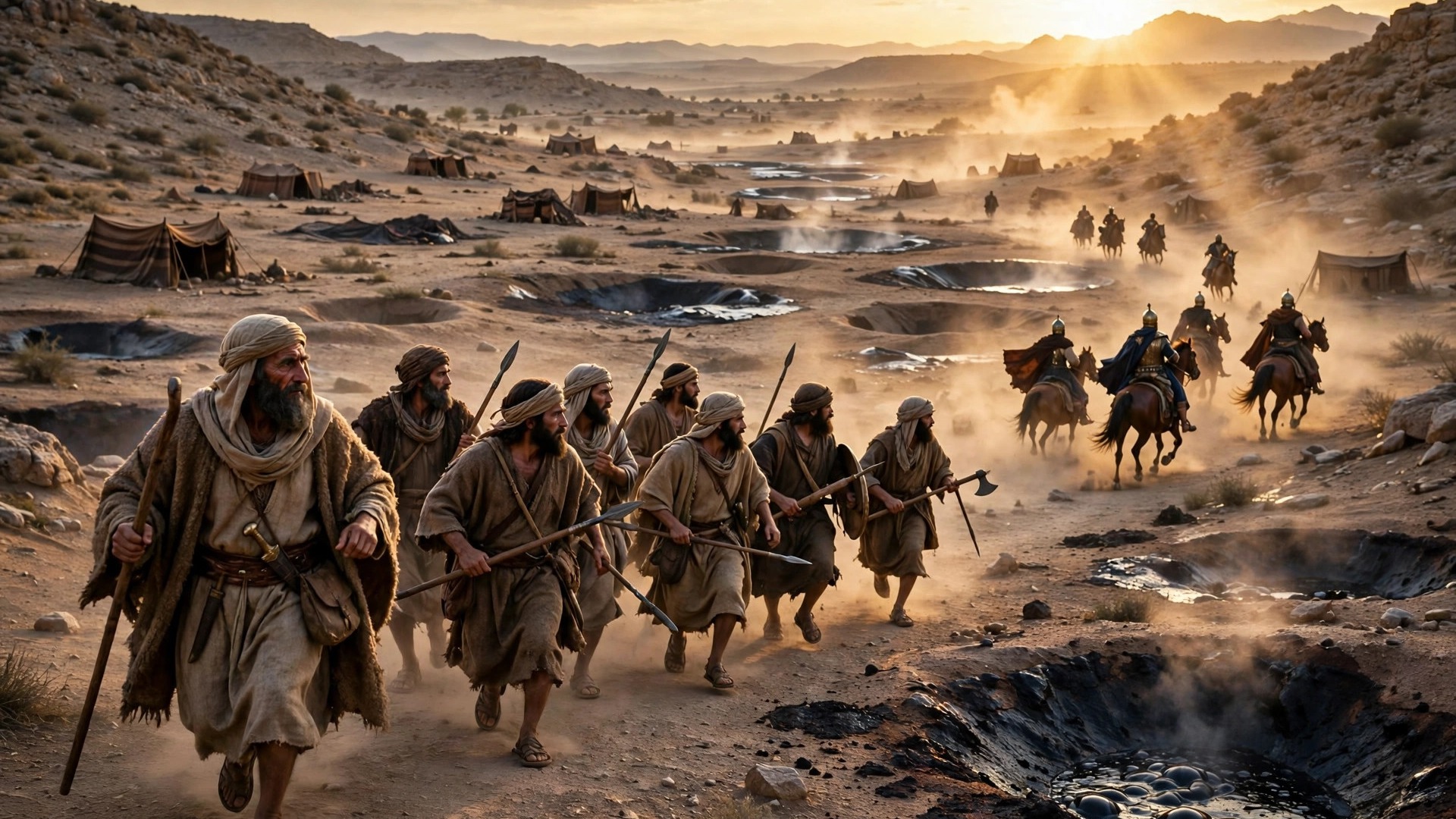
Before David faced Goliath, before Joshua marched on Jericho, Scripture records a war most people have never heard of — and it introduces the Bible’s great themes of rescue, blessing, and the mysterious priest-king Melchizedek. Understanding the first war in the Bible will change how you read every battle that follows, and how you face the battles in your own life.
Four Kings Against Five
Genesis 14 tells it vividly. Four kings from the east, led by Kedorlaomer king of Elam, marched west and conquered the cities of the plain — including Sodom and Gomorrah — making them pay tribute for twelve years. In the thirteenth year, the five kings of the plain rebelled. In the fourteenth year, Kedorlaomer returned with his allies and crushed everyone in his path (Genesis 14:1–11).
The battle ended in the Valley of Siddim, where the kings of Sodom and Gomorrah fled — some falling into tar pits — and the victors plundered the cities, carrying off all their goods and food. They also took Lot, Abraham’s nephew, who had been living in Sodom, along with his possessions (Genesis 14:12). The Hebrew vocabulary here is worth pausing on: war is milchamah, from the root lacham, “to fight” — the standard word for warfare throughout the Old Testament, used for Israel’s battles and for the Lord’s battles, since God is called “a warrior” (Exodus 15:3). And Siddim itself is associated with tar pits — literally a slippery, treacherous place. The kings of Sodom fled and fell into the pits of their own valley: the ground of wickedness gives way beneath those who trust in it.
318 Men and a Night Raid
When Abraham heard that his relative had been taken captive, he did something remarkable. He “called out the 318 trained men born in his household and went in pursuit as far as Dan” (Genesis 14:14). Abraham — a shepherd and pilgrim, not a king — defeated the armies of four kings in a night raid, recovered all the goods, and brought back Lot, the women, and the people (Genesis 14:15–16).
Notice what this says about the Bible’s view of battle. Abraham did not start the war; he responded to it to rescue someone he loved. Scripture never glorifies aggression, but it honors courageous rescue — the same pattern that appears when David rescues the captives of Ziklag (1 Samuel 30) and, ultimately, when Christ rescues us from the dominion of darkness (Colossians 1:13). And victory belonged to God, not to military might: 318 household servants against the armies of four kings. “Some trust in chariots and some in horses, but we trust in the name of the Lord our God” (Psalm 20:7).
Bread, Wine, and a King Named Righteousness
On his way home, two figures met Abraham. The king of Sodom offered him all the recovered goods. And Melchizedek, king of Salem and “priest of God Most High,” brought out bread and wine, blessed Abraham, and received a tenth of everything from him (Genesis 14:17–20). Abraham refused the king of Sodom’s offer, saying he would not take “even a thread or the strap of a sandal,” so that no one could say they had made him rich — only God (Genesis 14:22–23).
Melchizedek’s name means “king of righteousness,” and Salem means “peace.” The one who meets Abraham after the war is literally the king of righteousness from the city of peace — and the writer of Hebrews makes the meaning explicit: Melchizedek is “first, king of righteousness; and then also king of Salem — that is, king of peace” (Hebrews 7:2), a picture of Jesus Christ, our eternal priest-king. His blessing also gives Scripture its first use of the majestic title El Elyon, “God Most High, Creator of heaven and earth” (Genesis 14:19) — declared in the context of war, announcing that Abraham’s God outranks every king and every god of the nations. The first tithe appears here too: Abraham gave a tenth centuries before the law of Moses commanded it. Generosity toward God is older than the law; it flows from gratitude, not obligation.
Why the Church Still Reads This War
Melchizedek is the key to the passage, and the New Testament confirms it. Psalm 110:4 prophesies of the Messiah, “You are a priest forever, in the order of Melchizedek,” and Hebrews 5–7 explains that Jesus is our high priest in that order — a priesthood older than and greater than the Levitical priesthood. God’s plan of redemption was already in motion on the first battlefield: in the middle of humanity’s first recorded war, God planted a living prophecy of the Prince of Peace. The bread and wine foreshadow the Lord’s Supper; the blessing foreshadows the gospel. Even in war, God was speaking peace.
Christians commonly interpret Melchizedek as a type of Christ — not Christ Himself appearing, since Scripture never says that explicitly — but a historical figure whose mysterious, kingly priesthood beautifully pictures Jesus. We can celebrate the symbolism without going beyond what the Bible says.
And the New Testament tells us plainly that our battle is spiritual: “For our struggle is not against flesh and blood, but against the rulers, against the authorities, against the powers of this dark world” (Ephesians 6:12). Like Abraham, we fight for others — the “Lot” in your life may be a child wandering from faith, a friend captured by addiction, a family member far from God. Love goes to battle in prayer for them. We fight from victory, not for victory, because Jesus has already defeated the powers of darkness at the cross (Colossians 2:15). After the battle comes blessing: war, then bread and wine, then blessing — worship after warfare is the Bible’s pattern. And like Abraham, we refuse the world’s rewards, so that God alone gets the glory.
Questions Readers Ask
Who was Kedorlaomer? An Elamite king whose name means something like “servant of the god Lagamar.” He represents the pagan empires that would oppress God’s people again and again — a foreshadowing of Egypt, Assyria, Babylon, and Rome.
Was Melchizedek actually Jesus? Scripture never says so, and we should not claim it as fact. He is best understood as a type of Christ: a historical king-priest whose office pictures Jesus’ eternal priesthood (Hebrews 7).
Why did Abraham tithe before the law existed? Because generosity toward God flows from gratitude, not obligation. Abraham gave a tenth of the spoils to God’s priest before doing anything else — a pattern worth imitating when God gives us a win.
What does this war teach about spiritual warfare today? Be ready before the battle comes: Abraham’s men were trained long before the crisis. Spiritual readiness is built in peacetime — daily prayer, Scripture memory, fellowship. You cannot download courage in the moment of crisis; you can only draw on what you have stored.
The God Who Fights for You
The first war in the Bible ends not with a celebration of violence but with bread, wine, blessing, and worship. That is God’s signature: He takes the worst of human conflict and writes redemption into it. The same God who gave Abraham victory over four kings fights for you today — against temptation, against despair, against every force that would capture those you love.
So when battle comes, do what Abraham did: rise in faith, fight in love, refuse the world’s spoils, and receive God’s blessing. And remember the deeper promise hidden in that ancient valley — the King of Righteousness from the city of Peace is coming, and one day He will end every war forever (Revelation 21:4). Until then, trust the God who has never lost a battle.
The Wikipedia article on the Battle of Siddim gives helpful historical context for this ancient campaign.










