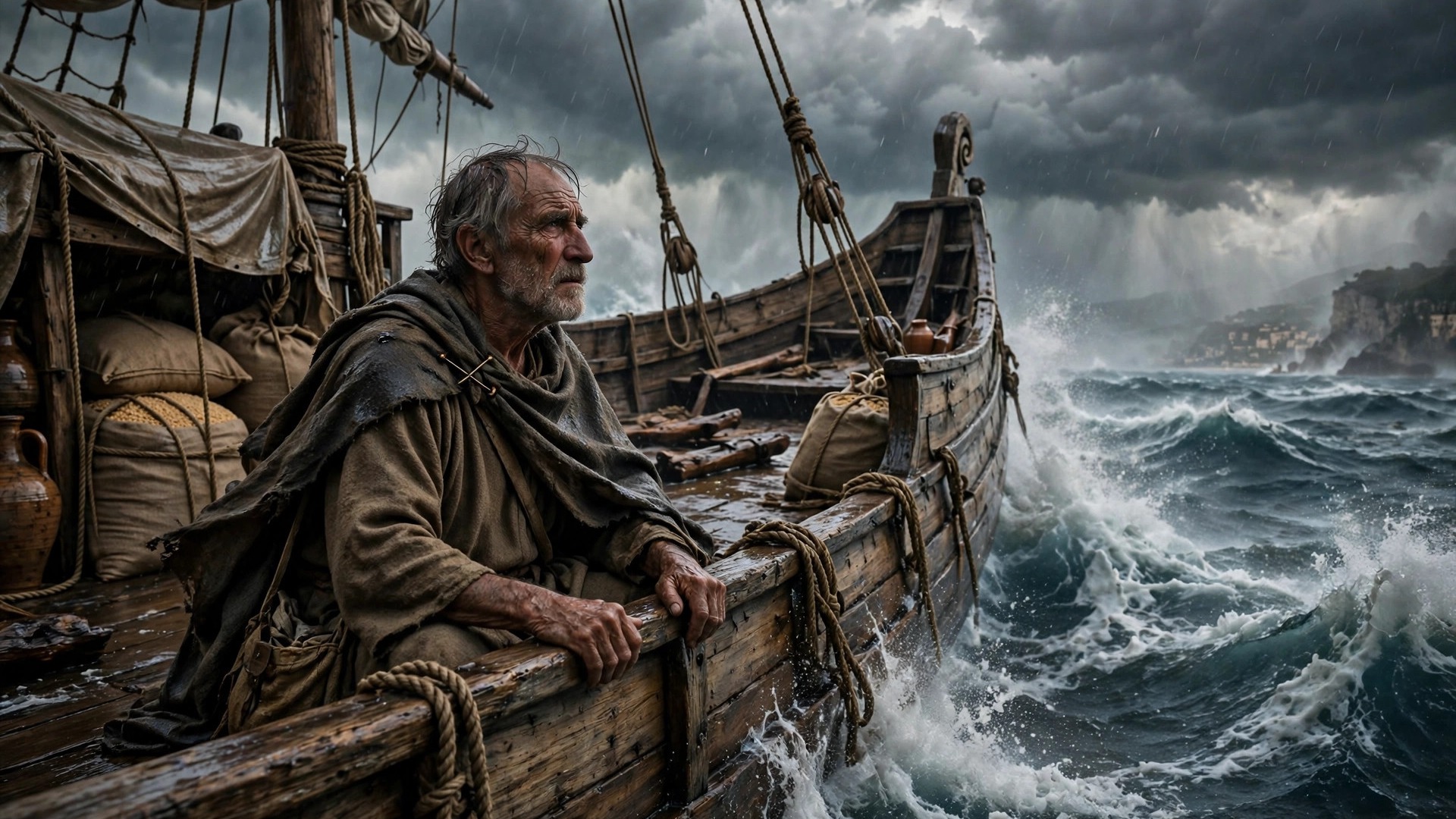
For fourteen days the ship was driven across the Mediterranean, cargo and tackle thrown overboard, until the crew “finally gave up all hope of being saved” (Acts 27:20). Then a prisoner in chains stood up and told 275 terrified people that they would all live. That is the heart of what people mean when they search for Paul fifth journey meaning in the Bible — the most dramatic voyage in the book of Acts, and a story that demands careful, honest handling of Scripture.
First, Let’s Count Honestly
Precision matters here, because God’s Word deserves it. Acts narrates three missionary journeys in detail: the first (Acts 13–14), the second (Acts 15:36–18:22), which carried the gospel onto European soil, and the third (Acts 18:23–21:16), centered on Ephesus, where “all the Jews and Greeks who lived in the province of Asia heard the word of the Lord” (Acts 19:10). Then comes Paul’s arrest in Jerusalem and his long voyage to Rome as a prisoner (Acts 21:17–28:31), often counted as the fourth journey.
So what is the “fifth”? Traditionally it is either the voyage to Rome itself, counted differently, or a possible later journey to Spain after Paul’s release — an intention stated in Romans but never narrated in Scripture. Behind all these travels stands a rich Hebrew idea: derekh, “way” or “road.” God’s people walk in His derekh (Deuteronomy 10:12), and the early Christians were literally called followers of “the Way” (Acts 9:2, 19:9, 24:14). Paul’s journeys were not mere travel; they were the Way advancing, mile by mile, city by city.
Fourteen Days in the Euroclydon
Paul boarded a grain ship with 276 people aboard, sailing late in the season — dangerous waters. He warned them: “Men, I can see that our voyage is going to be disastrous” (Acts 27:10). The centurion ignored him. Then came the Euroclydon, a violent northeaster, and for fourteen days the ship was driven helplessly across the sea.
Then Paul stood up with heaven’s perspective: “Last night an angel of the God to whom I belong and whom I serve stood beside me and said, ‘Do not be afraid, Paul. You must stand trial before Caesar; and God has graciously given you the lives of all who sail with you'” (Acts 27:23–24). God promised Paul would reach Rome — and threw in 275 bonus lives out of sheer grace. The ship wrecked on Malta exactly as promised, and everyone survived (Acts 27:44). “Keep up your courage, men, for I have faith in God that it will happen just as he told me” (Acts 27:25).
Malta: Viper, Healing, Honor
On the beach at Malta, a viper fastened onto Paul’s hand. The islanders waited for him to swell up and die; instead he shook it off into the fire (Acts 28:5). Then Paul healed the island’s sick, and the people honored him greatly (Acts 28:7–10). The pattern of the whole voyage is here in miniature: danger met, God’s protection shown, and grace overflowing to strangers.
Finally Paul reached Rome — in chains, yet triumphant. For two years under house arrest, “he proclaimed the kingdom of God and taught about the Lord Jesus Christ — with all boldness and without hindrance!” (Acts 28:31). Those are the last words of Acts: a prisoner in chains, and the gospel advancing “without hindrance.” Chains could not chain the Word (2 Timothy 2:9). God’s purposes cannot be stopped by storms, shipwrecks, snakes, or soldiers.
Was There a Spain?
Now the honest question. In Romans 15:24 and 15:28, Paul wrote of his intention: “I plan to do so when I go to Spain” and “I will go to Spain and visit you on the way.” Spain was the far western edge of the known world — “the ends of the earth” from Rome’s perspective — and Paul’s stated ambition was to preach “where Christ was not known” (Romans 15:20).
What Scripture does not say is equally important: the Bible never narrates a Spanish journey. Acts ends with Paul under house arrest in Rome, but his later letters (1–2 Timothy, Titus) mention travels — to Crete (Titus 1:5), Nicopolis (Titus 3:12), Troas, and Miletus (2 Timothy 4:13, 20) — that do not fit inside Acts’ timeline. This suggests Paul was released from his first Roman imprisonment, travelled freely for a time, and was later re-arrested and executed under Nero (2 Timothy 4:6–8).
Early church tradition adds weight: Clement of Rome, writing around AD 95, said Paul reached “the farthest limits of the West,” widely understood as Spain, and the Muratorian Canon mentions the same journey. This tradition is early and plausible — but it is tradition, not Scripture, and must never be presented with the certainty of God’s Word. The faithful answer is this: Paul intended a journey to Spain, early Christians believed he made it, and the Bible neither confirms nor denies it.
What This Voyage Leaves Us
God’s promises hold in the storm. Paul had God’s word — “You must stand trial before Caesar” (Acts 27:24) — and that promise did not prevent the storm; it carried him through it. God’s promises do not guarantee smooth sailing; they guarantee safe arrival. Whatever storm you are in — illness, financial crisis, broken relationship — if you belong to Christ, your destination is secure (Romans 8:28–30). Hold the promise tighter than you feel the waves.
Obedience may look like going backward. Paul wanted to reach Rome as a free missionary; he arrived as a prisoner in chains. From the outside it looked like failure; from heaven’s view it was strategy — the gospel reached Caesar’s own household (Philippians 4:22). When your plans collapse, consider that God may be rerouting you to a greater mission. The detour is often the destination.
Your faith steadies others. On that terrified ship, Paul’s calm trust steadied 276 people. Your trust in God during hard times is not just for you — it is a lighthouse for everyone watching. Someone’s courage is anchored to yours. And it is never too late for a new mission: Paul was in his fifties, scarred and imprisoned, and still planning Spain. Age, setbacks, and chains did not retire the apostle. Do not retire yourself either, for as long as you have breath, God has assignments (Ephesians 2:10).
Paul’s last recorded words in Scripture are the goal for us all: “I have fought the good fight, I have finished the race, I have kept the faith” (2 Timothy 4:7). He did not finish bitter about the shipwrecks or the chains. He finished faithful. The goal is not a comfortable journey — it is a completed mission. So keep sailing. The storms will come, but they cannot sink God’s purposes. Your Captain has never lost a ship, and He never will.
For more on the book that records this voyage, see the Wikipedia article on the Acts of the Apostles.










