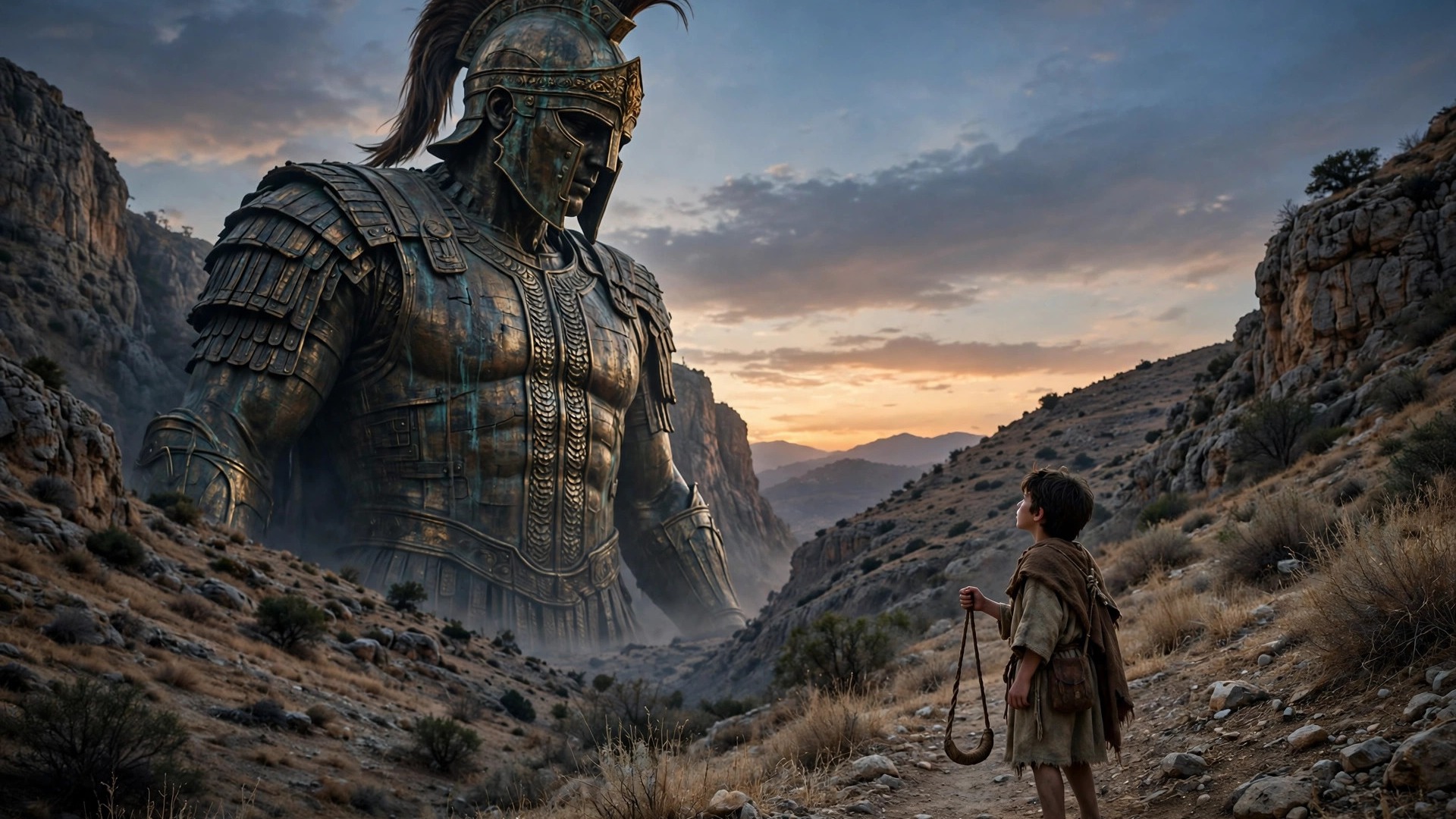
Stand in the valley of Elah and look up. A warrior nearly nine feet tall, armored head to toe, has been mocking your army for forty days. That is the scene most people picture when they hear about giants in the Bible — but Goliath is only one chapter in a much longer story. From Genesis to the conquest of Canaan, Scripture keeps returning to towering figures, and every one of them points to the same truth: no giant is bigger than God.
The First Giants of Genesis
The Bible’s first mention of giants is also its most mysterious. “The Nephilim were on the earth in those days — and also afterward — when the sons of God went to the daughters of humans and had children by them. They were the heroes of old, men of renown” (Genesis 6:4). Who were the Nephilim, and who were the “sons of God”? Christians have debated this for centuries, and honest readers admit the text is genuinely difficult.
Three readings dominate. The fallen-angel view takes the “sons of God” as rebellious angels, pointing to Job 1:6, where the phrase clearly means angels. The godly-line view sees them as descendants of Seth who intermarried with the ungodly line of Cain. The royal-tyrant view reads them as ancient kings claiming divine status and building oppressive dynasties. What Scripture states plainly is that the Nephilim existed, that they were mighty “heroes of old,” and that their age was so corrupt that “every inclination of the thoughts of the human heart was only evil all the time” (Genesis 6:5) — which led to the Flood. The name itself comes from the Hebrew root naphal, “to fall”: whether it means “the fallen ones” or “those who cause others to fall,” the shadow is the same. Where Scripture is unclear, we hold our views humbly and never build doctrine on speculation.
The Spies’ Grasshopper Problem
Centuries later, twelve spies entered Canaan and ten returned terrified: “We saw the Nephilim there… We seemed like grasshoppers in our own eyes, and we looked the same to them” (Numbers 13:33). Whether these were literal descendants of the pre-Flood Nephilim or simply people of great stature described with the same word, the result was identical — fear. Only Joshua and Caleb trusted God, and the fearful generation wandered forty years in the wilderness. Giants look enormous when we forget how big our God is.
Og, king of Bashan, offers the same lesson in miniature. Deuteronomy 3:11 notes that his iron bed was more than thirteen feet long — the Bible’s way of saying this man was enormous. Yet God told Moses, “Do not be afraid of him, for I have delivered him into your hands” (Deuteronomy 3:2). Israel defeated him. Size did not save Og; only God saves.
David, Goliath, and the Real Contest
Goliath of Gath stood “six cubits and a span” — roughly nine feet tall (1 Samuel 17:4) — and his armor alone weighed as much as a grown man. For forty days he mocked Israel and defied God. Then a shepherd boy walked out with five smooth stones and a sling, declaring, “The battle is the Lord’s” (1 Samuel 17:47). One stone, one giant, one God who never loses.
But David’s victory was not really about a boy beating a giant. It was about God defeating the enemies of His people through weak and willing instruments — a pattern that runs through the whole Bible and reaches its peak at the cross, where Jesus defeated sin and death through apparent weakness (1 Corinthians 1:27). The same word for “mighty ones,” gibborim, describes both the Nephilim (Genesis 6:4) and David’s mighty men (2 Samuel 23:8). Greatness itself is not evil; the question is whom the mighty serve. Goliath’s true opponent was never David; it was the Lord, whom he had defied (1 Samuel 17:36).
A Field Guide to the Giant Peoples
The Old Testament names several peoples of unusual stature, and every one of them was ultimately overcome by God’s power working through His people:
- The Rephaim — an ancient people of great size; the land east of the Jordan was once “called the land of the Rephaim” (Deuteronomy 2:20).
- The Emim — “strong and numerous, and as tall as the Anakites” (Deuteronomy 2:10).
- The Zamzummim — another tall, formidable people defeated with God’s help (Deuteronomy 2:20–21).
- The Anakites — descendants of Anak, who so frightened the spies (Joshua 11:21–22). Joshua defeated them, though some remained in Gaza, Gath, and Ashdod — Goliath’s hometown.
Notice the pattern: the Bible never presents a giant that God could not handle. The Septuagint, the Greek Old Testament, translated Nephilim as gigantes — the source of our English word “giant.” And the New Testament’s verdict on every towering threat is that in Christ, “we are more than conquerors” (Romans 8:37).
Three Questions People Ask
Did giants really exist, or are they myths? The Bible presents them as historical, giving measurements (Deuteronomy 3:11, 1 Samuel 17:4), locations, and genealogies. Christians can trust Scripture’s account while admitting we do not have every detail.
What does “and also afterward” mean in Genesis 6:4? The phrase suggests giant peoples appeared both before the Flood and after it, like the Anakim. The Bible does not explain the mechanism, and we should not invent one. The theological point stands: human greatness apart from God leads to corruption, and God remains sovereign over it all.
Why did God command Israel to destroy these peoples? Scripture presents the Canaanite cultures — including the Anakim — as steeped in centuries of extreme wickedness, including child sacrifice (Deuteronomy 18:10, Leviticus 18:21–25). God’s judgment through Israel was an act of divine justice after generations of patience (Genesis 15:16), not ethnic cruelty. We may not grasp it fully, but we trust the Judge of all the earth to do right (Genesis 18:25).
Facing Your Own Giants
We all have giants. The Bible’s counsel is practical. Name the giant honestly — David never pretended Goliath was small. Remember past victories, as David recalled the lion and the bear (1 Samuel 17:37). Refuse the wrong armor: David rejected Saul’s armor because it was not his (1 Samuel 17:39), so do not fight your battles with the world’s methods. Run toward the battle line — David “ran quickly toward the battle line to meet” Goliath (1 Samuel 17:48), because faith acts. And give God the glory before the stone ever flies; worship before victory is the purest faith.
The Bible’s giants all fell. The Nephilim perished in the Flood. Og’s iron bed became a relic. The Anakim were driven out. Goliath lies buried in Israel’s soil. But the God who felled them all is alive forever. Whatever giant stands in your valley today — fear, illness, temptation, opposition — pick up your smooth stones of prayer, Scripture, faith, and obedience, and run toward the battle line. The God of David is your God too.
If the ancient giant traditions intrigue you, the Wikipedia article on the Nephilim offers useful background.










