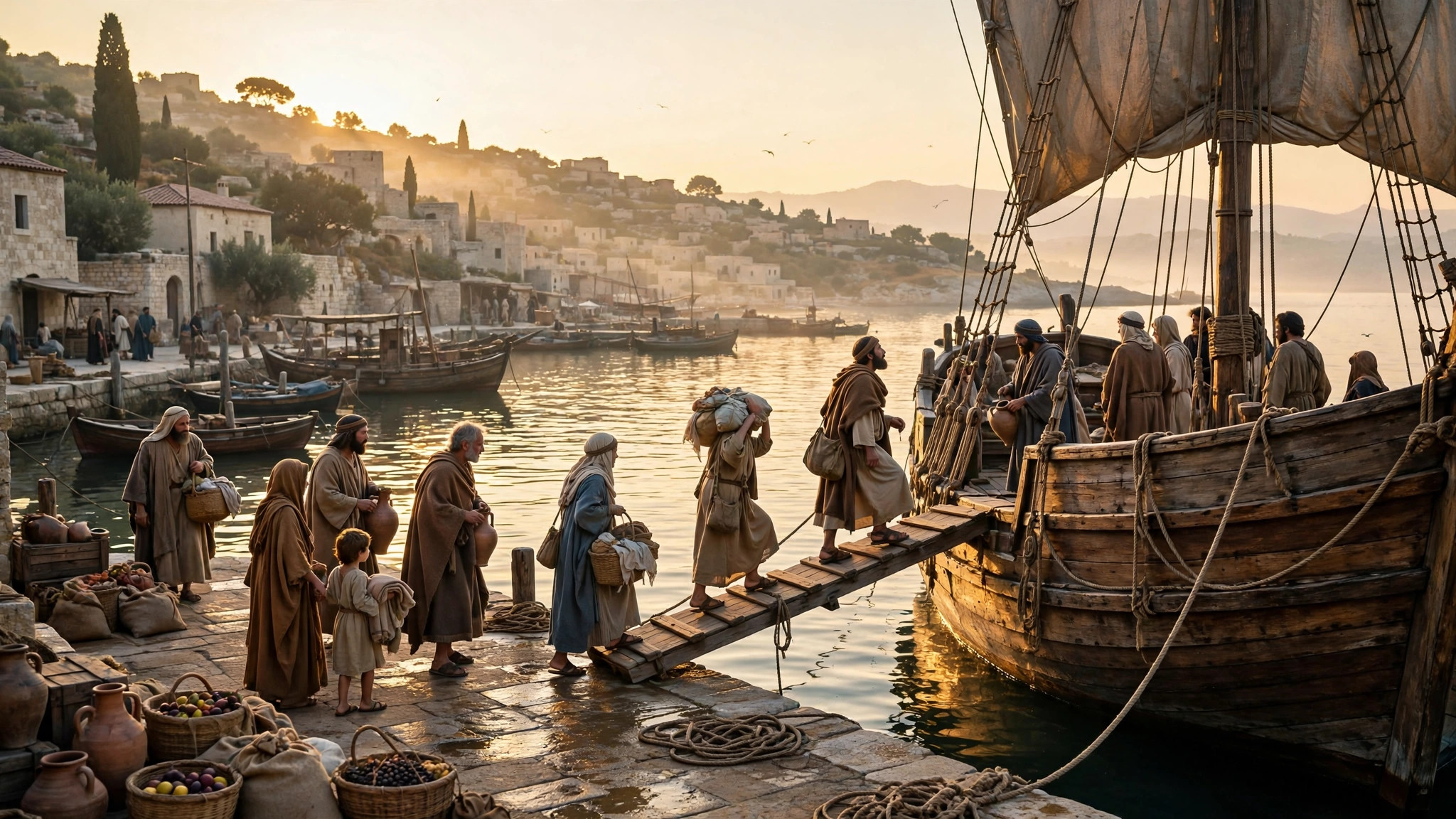
What does it take to carry a message into places that do not want to hear it? Acts 13–14 answers with a journey of roughly 1,400 miles, undertaken by two men who had no army, no wealth, and no guarantee of welcome. The first journey of Paul in the Bible is the story of the church’s first deliberate missionary expedition — and it still sets the pattern for how the gospel travels.
The trip began in Antioch, a young and multiethnic church, and it ended with new congregations scattered across Cyprus and Galatia. Between those two points lie a sorcerer’s defeat, a desertion, a stoning, and a report meeting that changed Christian history. To grasp Paul first journey meaning in the Bible is to see mission as the church’s work, not a hero’s adventure.
Sent, Not Self-Appointed
Everything starts with worship. The believers at Antioch were praying and fasting when the Holy Spirit said, “Set apart for me Barnabas and Saul for the work to which I have called them” (Acts 13:2). The church prayed, laid hands on them, and sent them off. Paul did not volunteer himself into mission; he was sent by a community that had heard God speak.
That sending carries the Bible’s own language. Paul’s Hebrew name was Sha’ul, meaning “asked for,” and his Roman name, Paulos, means “small” — a fitting name for a man who called himself “the least of the apostles” (1 Corinthians 15:9). Behind his travels stands the Hebrew word shalach, “to send,” the same idea behind the Greek apostellō, from which we get “apostle,” literally “sent one.” The journey also fulfilled an older promise: through Abraham, “all peoples on earth will be blessed” (Genesis 12:3). The blessing was now on the move.
The Route, City by City
Cyprus, from Salamis to Paphos (Acts 13:4–12). Sailing to Barnabas’s home island, the pair preached in the synagogues at Salamis. At Paphos they confronted Elymas the sorcerer, who opposed them before the Roman proconsul Sergius Paulus. Paul pronounced judgment, Elymas was struck blind, and the proconsul believed. It is here that Saul is first called by his Roman name, Paul. The gospel had confronted spiritual darkness — and won.
Pisidian Antioch (Acts 13:13–52). On the mainland, in what is now Turkey, John Mark deserted the party and returned to Jerusalem (Acts 13:13), a failure that would later cause a sharp break between Paul and Barnabas (Acts 15:38–39). In the synagogue, Paul preached his first recorded sermon, sweeping from Israel’s history to Jesus’ resurrection (Acts 13:16–41). Many believed, but jealous leaders stirred up persecution, and the missionaries were expelled. They “shook the dust off their feet” (Acts 13:51) and left “filled with joy and with the Holy Spirit” (Acts 13:52).
Iconium, Lystra, and Derbe (Acts 14:1–20). At Iconium they preached boldly despite a plot to stone them. At Lystra, Paul healed a lame man, and the pagan crowd tried to worship the missionaries as gods; Paul tore his clothes and begged them to turn to the living God (Acts 14:14–17). Then hostile opponents arrived, turned the crowd, and Paul was stoned, dragged outside the city, and left for dead. But he got up and walked back into the city (Acts 14:20) — one of the bravest verses in Scripture.
The way home (Acts 14:21–28). Rather than taking the shortest road back, Paul and Barnabas retraced their steps, “strengthening the disciples and encouraging them to remain true to the faith” and appointing elders in each church (Acts 14:22–23). Their warning was honest: “We must go through many hardships to enter the kingdom of God.” Back in Antioch, they reported “all that God had done through them and how he had opened a door of faith to the Gentiles” (Acts 14:27).
When the Mission Hurt
It is easy to romanticize this journey, but Acts refuses to. There were desertions, expulsions, and a stoning. Some Christians read Paul’s sufferings as a formula — no suffering, no faithfulness — but Scripture does not teach that. Seasons of fruitfulness and joy (Acts 13:52) sit right alongside the hardships. Nor should we call Paul “the first missionary” without qualification: Philip had already carried the gospel to Samaria (Acts 8), and unnamed believers had reached Antioch (Acts 11:19–21). What was new here was the deliberate, church-sent expedition. Mission is not a solo adventure; it is the church’s work.
What the Journey Established
Four things from this trip became the template for everything that followed. First, the gospel is for the nations, not one people. Second, preaching is paired with church planting — the goal was never crowds alone but congregations with elders of their own. Third, hardship is normal, not a sign of failure. Fourth, the report matters: the church that sends deserves to hear what God has done. The open door of Acts 14:27 has never closed.
Questions Readers Ask
How long did Paul’s first missionary journey take? Scholars estimate about two years, roughly AD 47–48, covering some 1,400 miles by land and sea through Cyprus and modern-day Turkey.
Who travelled with Paul? Barnabas, his senior partner and encourager, and John Mark, their helper, who left partway through at Perga (Acts 13:13). Mark was later restored and valued by Paul (2 Timothy 4:11) — failure is not final.
Carry It With You
Most of us will never sail to Cyprus, but the journey’s logic still applies. Let worship come before strategy: Antioch prayed before it planned. Go with companions rather than alone — Paul never travelled solo. Preach Christ clearly from Scripture, as Paul did at Pisidian Antioch, without needing to be clever. And when opposition comes, remember Lystra: getting up and walking back in is sometimes the most powerful sermon of all.
Pray: “Holy Spirit, speak to me as You spoke to Antioch. Set me apart for Your work, give me Paul’s courage and Barnabas’s encouragement, and keep the joy that hardship cannot steal.” Then take the first step. The journey of a thousand miles began with a single act of obedience — and yours can too.
For a broader historical backdrop on Paul’s life and travels, see the Wikipedia article on Paul the Apostle.










