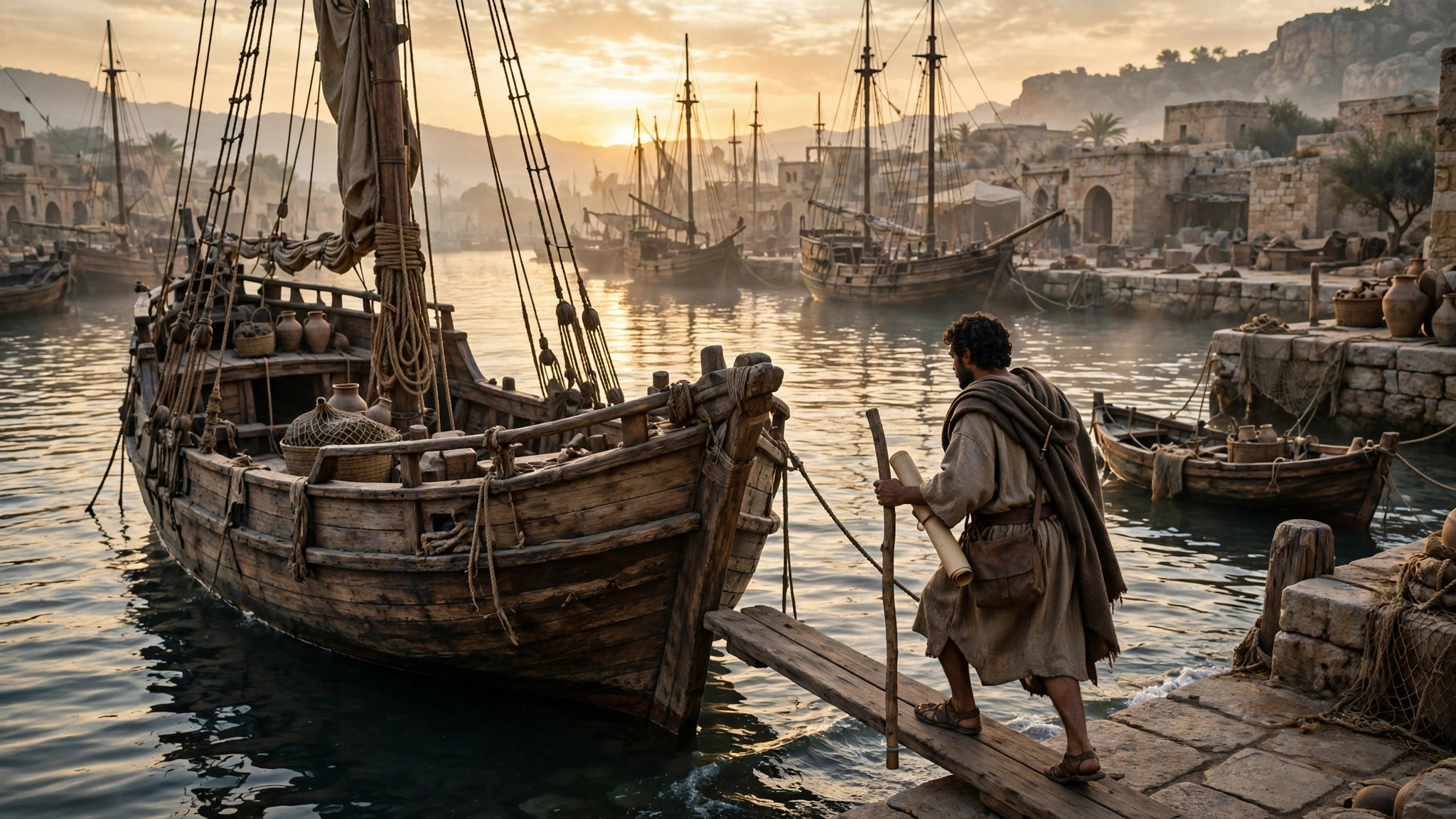
The dust on the Damascus road is red in the noon heat. A man named Saul rides hard at the head of an armed party, letters of arrest in his saddlebag, his heart burning with a holy fury. He has watched a deacon named Stephen die under stones and called it justice. He is breathing threats the way other men breathe air. Then — light. Not the light of the sun. A blaze from heaven knocks him flat into the dirt, and a voice speaks his name twice: Saul, Saul. When he stumbles to his feet, the hunter is blind, led by the hand into the very city where he meant to make arrests. The persecutor has become the pursued, and nothing in the history of the church will ever be the same.
The Hunter Becomes the Hunted: Damascus Road
Everything about Paul's missionary work starts here, not in Antioch and not on a ship. The book of Acts tells the story three times (Acts 9, 22, and 26), and each retelling adds weight: this was not a career change, it was a capture. The Lord's own summary of the assignment is staggering. Speaking to Ananias, Jesus says of this former persecutor, he is a chosen instrument of mine to carry my name before the Gentiles (Acts 9:15). Carry — that is the whole meaning of Paul's missionary work in one verb. He was not the source of the message. He was the vessel. God poured the gospel in, and Paul carried it, trembling and burning, to nations that had never heard the name of Jesus.
Notice the direction of the story. Saul did not volunteer. He did not feel a nudge and prayerfully consider his options. He was stopped, blinded, and remade. Mission in the Bible is never a man's idea succeeding; it is God's idea seizing a man. Ananias lays hands on him, scales fall from his eyes, and within days the man who hunted Christians is preaching Christ in the synagogues of Damascus. The gospel he had tried to strangle now runs through his own veins.
Three Journeys, One Pattern
What we call Paul's three missionary journeys span roughly a decade, and though the map changes, the pattern never does: enter a city, preach in the synagogue first, then turn to the Gentiles, gather believers into a church, appoint leaders, and move on — often with fresh scars. Let us walk the road with him.
The First Journey: Proving the Gospel Works (~AD 46–48)
It begins in Antioch, where the Spirit speaks during worship: set apart Barnabas and Saul for the work (Acts 13:2). They sail to Cyprus, then to Pisidian Antioch, where Paul preaches a sweeping sermon tracing Israel's story to Jesus. Many believe — and many rage. The two are driven out, shaking the dust from their feet. In Lystra, after a lame man is healed, the crowds try to worship Paul and Barnabas as gods; Paul tears his clothes in horror. Days later the same crowd stones him and drags his body outside the city, leaving him for dead. He gets up. He walks back into the city. The next day he leaves for Derbe, and then — astonishingly — retraces his steps through Lystra, Iconium, and Pisidian Antioch, strengthening the very churches born in the storm. That is the first journey in miniature: gospel preached, opposition endured, churches planted, leaders appointed (Acts 14:23).
The Second Journey: The Door to Europe (Acts 15:36–18:22)
The second journey nearly didn't happen — Paul and Barnabas quarreled so sharply over John Mark that they parted ways. Yet God used even the fracture: Barnabas took Mark to Cyprus, Paul took Silas through Syria and Cilicia. Then comes one of the most famous moments in Acts: in Troas, Paul sees a vision of a Macedonian man pleading, come over and help us (Acts 16:9). The gospel crosses into Europe. In Philippi, Lydia's heart is opened, a slave girl is freed from a spirit, and Paul and Silas are beaten and jailed — only to sing hymns at midnight while the jailer asks how to be saved. Thessalonica brings a riot; Berea brings noble-minded listeners who check the Scriptures daily. In Athens, Paul stands before the philosophers on the Areopagus and quotes their own poets back to them, proclaiming the unknown God. In Corinth he stays eighteen months, and a church takes root that will receive two of his greatest letters. The pattern holds: suffering, then fruit.
The Third Journey: Ephesus and the Long Goodbye (Acts 18:23–21:16)
The third journey centers on Ephesus, where Paul spends nearly three years — his longest stay anywhere. The word spreads so powerfully that silversmiths who craft shrines of Artemis riot because the gospel is cutting into the idol business (Acts 19). Seven sons of a priest try to copy his ministry and are beaten by the very demon they tried to cast out. Handkerchiefs touched by Paul carry healing. Yet the journey ends with tears: at Miletus, Paul summons the Ephesian elders and warns them that wolves will come, charging them to shepherd the flock (Acts 20:28-31). He knows chains await him in Jerusalem. He goes anyway. Three journeys, one pattern — the gospel advances, and it always costs the carrier something.
The Method Heaven Used
Paul's missionary method was not a technique he invented; it was a surrender he practiced. Look closely at the engines that drove the work, and four stand out.
First, he was Spirit-sent, not self-sent. The church at Antioch didn't commission Paul because he was available; the Holy Spirit spoke and the church obeyed (Acts 13:2). Every journey flows from that moment. When the Spirit later blocked his plans in Asia and Bithynia (Acts 16:6-7), Paul submitted to the closed doors as gladly as the open ones. Mission, in his hands, was never self-directed ambition wearing a spiritual costume.
Second, he embraced suffering as the price of the seed. Beatings, stonings, shipwrecks, prison — Paul catalogs them almost casually later (2 Corinthians 11:23-28). He never treated hardship as evidence that God had left him. He treated it as the normal weather of the road. The churches he planted learned the gospel not only from his sermons but from his scars.
Third, he planted churches and then let them stand. Paul did not build a personal empire of dependent outposts. He preached, gathered believers, appointed elders in every church (Acts 14:23), and moved on — entrusting fragile new congregations to the Holy Spirit and to the Scriptures. His letters then did the long-distance pastoring. The goal was never followers of Paul; it was communities rooted in Christ.
Fourth, he was all things to all people without becoming nothing to anyone. To the Jews he reasoned from the Scriptures; to the Greeks he quoted their poets; to the weak he became weak (1 Corinthians 9:22). Flexibility of method, rigidity of message. The gospel never changed shape in his hands, but the wrapping always fit the recipient.
There is a word worth pausing over, and it needs no special heading because it is woven into everything Paul did. The New Testament calls him an apostolos — literally, “one who is sent.” A king's apostolos carried the king's authority the way an ambassador carries a nation's seal. Paul never sent himself; he was sent, and the sending carried the authority. That is why his letters open with the claim and his life backed it: the message was not his invention, and the power was not his own. To be an apostle was to be a dispatched man — and Paul spent the rest of his life being dispatched.
What This Means for Ordinary Believers
Most of us will never sail the Aegean or preach on Mars Hill. So what does Paul's missionary work mean for a believer with a desk job, a classroom, or a kitchen table? Everything, because the pattern scales down without losing its power.
You are sent before you are ready. Paul's resume for ministry was a persecution record. God did not wait until Saul was presentable; He sent the broken man and let the sending do the shaping. Your past is not a disqualification from God's work — in Paul's case, it was the raw material.
Your mission field is wherever your feet are. Paul crossed seas because that was his assignment; yours may be a neighborhood, a nursing shift, or a group chat. The Spirit who redirected Paul's travel plans still redirects ours — through closed doors and unexpected Macedonian calls alike. Pay attention to the interruptions; they may be the itinerary.
Suffering is not a detour from the mission; often it is the mission's vehicle. The Philippian jailer was not converted by a sermon in a synagogue but by a hymn in a dungeon. The chains Paul wore in Rome became, in his words, a means by which the gospel advanced (Philippians 1:12). When your plans collapse, ask not only “why is this happening to me” but “who is this happening for.”
Finally, plant something that outlives you. Paul invested in elders, in Timothy and Titus, in letters that still preach. Disciple one person. Strengthen one church. Write down what God taught you. The missionary's true monument is not a map of journeys but a lineage of faith.
Questions People Ask
How many missionary journeys did Paul take?
The book of Acts records three great missionary journeys, followed by a fourth voyage — as a prisoner — to Rome. The three journeys span roughly AD 46 to 57, covering Cyprus, Asia Minor, Macedonia, Greece, and finally a long ministry in Ephesus.
Why is Paul called the apostle to the Gentiles?
On the Damascus road, Jesus declared Paul His chosen instrument to carry His name before the Gentiles (Acts 9:15). While Peter's ministry centered on Jewish believers, Paul's commission — confirmed by the Jerusalem leaders in Galatians 2 — was to take the gospel to the nations.
Did Paul's missionary work really involve that much suffering?
Yes. He was stoned in Lystra, beaten and jailed in Philippi, run out of Thessalonica and Berea, mocked in Athens, and eventually imprisoned in Rome. He listed his hardships in 2 Corinthians 11 not to boast but to prove that the gospel's power shows clearest in human weakness.
What was Paul's main missionary strategy?
He preached Christ first in the synagogues, then turned to the Gentiles; he planted self-governing churches and appointed local elders; he stayed long enough to root the believers and wrote letters to keep shepherding them from afar. Spirit-led, suffering-embraced, church-planting, and Scripture-saturated — that was the method heaven used.
Conclusion
Paul's missionary work was never really about Paul. It was about a God who takes a persecutor off a dusty road, fills him with a message he did not invent, and sends him to nations he never planned to visit — and then does it again in every generation through ordinary, willing carriers. The gospel to the nations is still looking for vessels. For broader historical background on the man behind the missions, see the Wikipedia article on Paul the Apostle.










