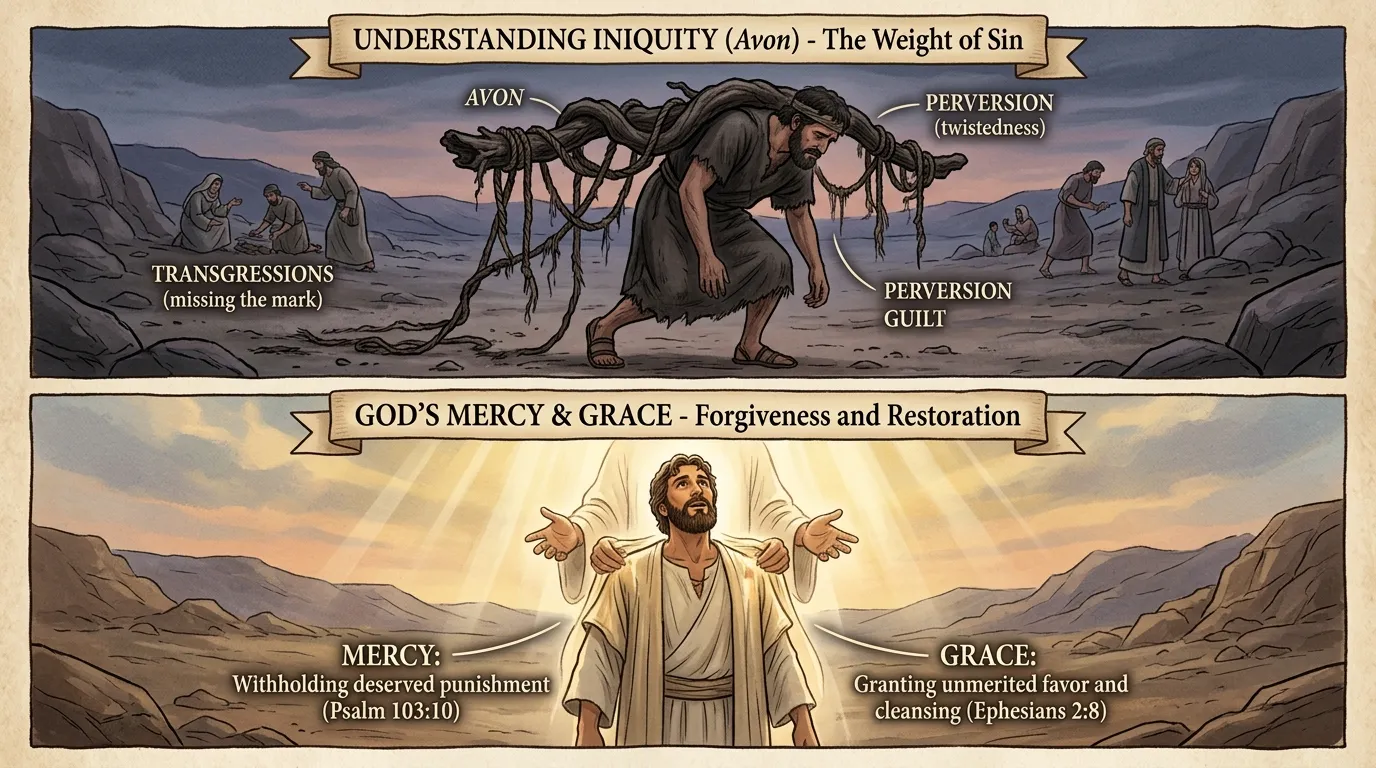
The English Bible uses three different words where we might use one — sin — and the distinctions are worth learning, because they diagnose different diseases of the soul. One of those words is iniquity, and it is the darkest of the three. If sin is missing the mark and transgression is crossing the line, iniquity is what happens when the archer, the line, and the aim are all bent.
The Hebrew word is ‘avon (עָוֹן), from a root meaning to bend, twist, or pervert. Iniquity is not a mistake; it is a deformation — goodness twisted out of shape, the straight made crooked. And Scripture reserves this word for the deep structure of human wrongness: not just what we do, but what we have become.
Three Words, Three Depths
The Bible’s vocabulary of wrongdoing is precise, and iniquity sits at the bottom of it:
Sin — Hebrew chatta’ah, Greek hamartia — is literally missing the mark, the archer’s term. It describes the act: falling short of God’s standard. “All have sinned, and come short of the glory of God” (Romans 3:23). The image is failure — tragic, but in principle correctable by better aim.
Transgression — Hebrew pesha’, Greek parabasis — is rebellion: deliberately crossing a known boundary. It is not missing the mark but defying the Marker. “Where no law is, there is no transgression” (Romans 4:15) — transgression requires a line to cross, and crosses it on purpose.
Iniquity — ‘avon — is perversity: the twisted condition that produces both. It is the bent bow that cannot shoot straight, the crooked heart from which crooked acts flow. When David confesses, he stacks all three: “wash me throughly from mine iniquity, and cleanse me from my sin” (Psalm 51:2), then “I acknowledge my transgressions” (51:3). He knows his problem is not one bad act but a bent nature — “I was shapen in iniquity; and in sin did my mother conceive me” (51:5).
The progression matters pastorally. Many people will admit sins (mistakes) and even transgressions (rebellions) while resisting iniquity — the admission that something in them is fundamentally twisted. But Scripture insists the diagnosis go that deep, because only the deep diagnosis explains why we keep doing what we hate (Romans 7:15-20).
“The LORD Hath Laid on Him the Iniquity of Us All”
Iniquity’s most important appearance is in Isaiah’s portrait of the Suffering Servant. “All we like sheep have gone astray; we have turned every one to his own way; and the LORD hath laid on him the iniquity of us all” (Isaiah 53:6). Not just our sins — our iniquity. The twistedness itself, the bent condition, the perversity at the root — laid on Him.
The verse before explains the mechanism: “he was wounded for our transgressions, he was bruised for our iniquities: the chastisement of our peace was upon him; and with his stripes we are healed” (Isaiah 53:5). Healed — the word choice is deliberate. Iniquity is a sickness, a deformity; what it needs is not merely pardon but straightening. The cross does both: it bears the guilt and begins the cure.
This is why the New Testament speaks of the cross in transformational terms, not just transactional ones: “who his own self bare our sins in his own body on the tree, that we, being dead to sins, should live unto righteousness” (1 Peter 2:24). The purpose clause — that we should live unto righteousness — shows the aim: not merely forgiven bentness but unbent lives.
The Iniquity That Accumulates
Scripture also warns that iniquity grows. Jesus tells the Pharisees they “fill up… the measure” of their fathers’ guilt (Matthew 23:32). Paul describes those who “treasurest up unto thyself wrath against the day of wrath” (Romans 2:5) — iniquity compounded like interest. Genesis 15:16 speaks of “the iniquity of the Amorites” not yet being “full” — as though nations have a cup of twistedness that fills over generations until judgment comes.
The image is sobering: unaddressed iniquity does not stay static. The bent gets benter. Habits harden into character; character hardens into destiny. “His own iniquities shall take the wicked himself, and he shall be holden with the cords of his sins” (Proverbs 5:22). The twisted thing you feed becomes the cord that binds you.
But the same compounding works in reverse under grace. Confession interrupts the accumulation: “If we confess our sins, he is faithful and just to forgive us our sins, and to cleanse us from all unrighteousness” (1 John 1:9). Cleanse — the unbending begins the moment the bent is brought into the light.
What God Does With Iniquity
The Bible’s promises about iniquity are among its most beautiful, precisely because the problem is so deep:
- He forgives it. “Who is a God like unto thee, that pardoneth iniquity?” (Micah 7:18). Pardon is His signature — no other god in the ancient world was known for forgiving.
- He removes it. “As far as the east is from the west, so far hath he removed our transgressions from us” (Psalm 103:12). Infinite distance, east to west — the direction that never meets.
- He subdues it. “He will subdue our iniquities; and thou wilt cast all their sins into the depths of the sea” (Micah 7:19). Not merely pardoned — subdued, brought under dominion, drowned in the deep.
- He forgets it. “I will forgive their iniquity, and I will remember their sin no more” (Jeremiah 31:34). The omniscient God practices a holy amnesia toward confessed iniquity.
- He straightens it. “The crooked shall be made straight” (Luke 3:5, quoting Isaiah 40:4) — the Messiah’s mission includes the unbending of the bent.
Facing Your Own ‘Avon
Here is the honest application. Name the bend, not just the breaks. It is easier to confess “I lost my temper” (sin) than “I am a resentful person” (iniquity) — but the second confession is the one that leads to transformation. David’s Psalm 51 is the model: specific about acts (“my transgressions”), honest about condition (“shapen in iniquity”), and pleading for the deep work — “create in me a clean heart, O God; and renew a right spirit within me” (51:10). Create — the word of Genesis 1. Only the Creator can unmake the twist.
Then live in the straightening. Sanctification is the slow unbending: “being confident of this very thing, that he which hath begun a good work in you will perform it until the day of Jesus Christ” (Philippians 1:6). The bent bow does not straighten overnight. But it does straighten — under the hands of the One who bore the iniquity of us all.
Iniquity in the Psalms: The Prayer Language of the Bent
The Psalms return to ‘avon more than any other book, and they turn the darkest diagnosis into prayer. David’s great confession is the centerpiece — “wash me throughly from mine iniquity” (Psalm 51:2) — but the psalmists pray the word in every direction:
Iniquity as weight: “Mine iniquities are gone over mine head: as an heavy burden they are too heavy for me” (Psalm 38:4). The image is drowning — iniquity as water over the head, a burden too heavy to carry. Confession is the cry of a man going under.
Iniquity as inheritance: “I was shapen in iniquity” (Psalm 51:5). David traces the bend to its source — not to excuse himself (“against thee, thee only, have I sinned,” 51:4) but to be honest about the depth. The prayer that names the root can receive the root’s cure: “create in me a clean heart” (51:10) — create, the word of Genesis, because only new creation fixes old deformation.
Iniquity forgiven as the ground of worship: “If thou, LORD, shouldest mark iniquities, O Lord, who shall stand? But there is forgiveness with thee, that thou mayest be feared” (Psalm 130:3-4). The logic is startling: forgiveness produces reverence. The God who does not mark iniquity is the God who is feared — grace does not relax worship; it deepens it.
The Psalms teach the church to pray iniquity honestly — as burden, as birth-condition, as the thing only God’s forgiveness can lift. This is the prayer language of people who have stopped negotiating with their bentness and started confessing it.
Questions About Iniquity
What is the difference between sin and iniquity?
Sin (chatta’ah) is missing the mark — the wrong act. Iniquity (‘avon) is the bent, twisted condition that produces wrong acts — the deeper deformation of the heart. Scripture uses both because both are true: we do wrong because something in us is wrong.
Does God punish children for their parents’ iniquity?
The phrase “visiting the iniquity of the fathers upon the children” (Exodus 20:5) describes consequences, not judicial punishment of the innocent — children suffer the fallout of parents’ twisted patterns. But Ezekiel 18 explicitly rejects the idea that God condemns children for parents’ guilt: “the soul that sinneth, it shall die” (Ezekiel 18:4). Each person answers for their own.
Can iniquity be completely removed?
Positionally, yes — fully forgiven and removed at the cross (Psalm 103:12). Practically, the straightening is progressive in this life (Philippians 1:6) and complete only at glorification (1 John 3:2). The Christian is simultaneously pardoned and being unbended.
Iniquity is the Bible’s darkest diagnosis and therefore the stage for its brightest grace: the God who sees the full twist of the human heart, lays it on His Son, and then sets about straightening what was bent. For the theological history of how the church has understood sin in all its depths, the Wikipedia article on sin surveys the major traditions; for the cure, Isaiah 53 remains the deepest well — “with his stripes we are healed.”