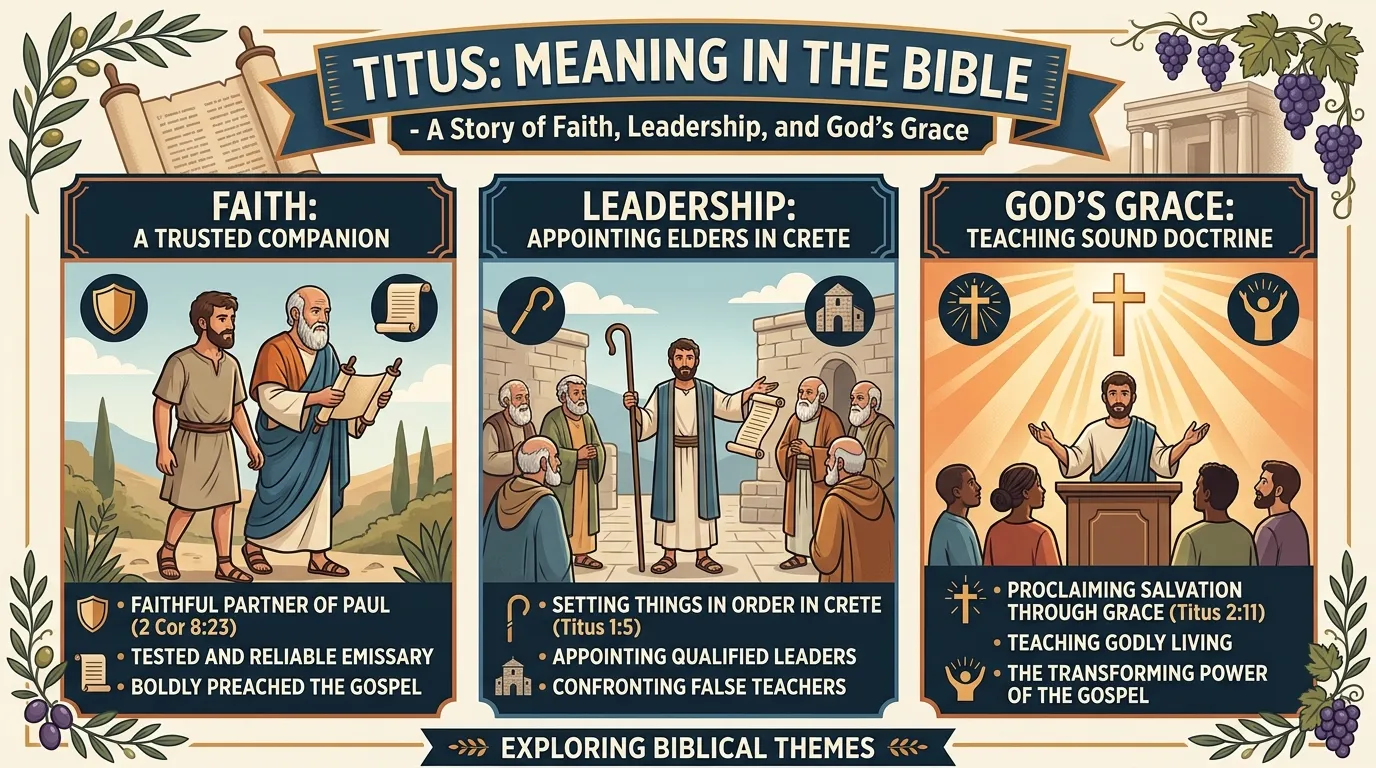
“For this cause left I thee in Crete, that thou shouldest set in order the things that are wanting, and ordain elders in every city, as I had appointed thee” (Titus 1:5).
Imagine receiving that assignment. Crete — the island whose own poet called its people “always liars, evil beasts, slow bellies” (Titus 1:12, quoting Epimenides). A young church, no structure, a culture famous for dishonesty, and Paul leaves you there. Alone. To set things in order.
That is the Titus story: the trusted lieutenant, the fixer, the man Paul sends into the hardest places. He never wrote a gospel, never performed a recorded miracle, never became famous. He simply did the unglamorous work of leadership — and the letter Paul wrote him became one of the church’s great manuals for getting things in order.
The Man Behind the Name
Titus was a Gentile believer — and that fact made him historically important before he ever led anything. When Paul took him to Jerusalem, the question of whether Gentile converts must be circumcised came to a head, and Paul refused to yield: “neither Titus, who was with me, being a Greek, was compelled to be circumcised” (Galatians 2:3). Titus’s uncircumcised presence in Jerusalem was a living argument: the gospel is for the nations as they are. His body was a theological statement.
His name is Latin — Titus was a common Roman praenomen, possibly connected with the Sabine word for “honorable” or with the title-bearing tradition of Rome. A Gentile with a Roman name, standing uncircumcised in Jerusalem, embodying the gospel’s reach: Titus is, from the start, a bridge figure.
Paul’s trust in him deepens through the Corinthian crisis. When the church in Corinth spirals, Paul sends Titus — not with a letter only, but in person — to deliver the “severe letter” and gauge the response (2 Corinthians 7:6-7, 13-15). Titus returns with good news: the Corinthians have repented. Paul’s joy overflows: “we were comforted… yea, and exceedingly the more joyed we for the joy of Titus, because his spirit was refreshed by you all” (2 Corinthians 7:13). The fixer has a pastor’s heart — he does not merely deliver rebuke; he rejoices in repentance.
Later, Paul sends him to organize the collection for Jerusalem’s poor (2 Corinthians 8:6, 16-17) — money, the most delicate assignment of all — and finally to Dalmatia (2 Timothy 4:10), still serving, still sent, to the end.
The Cretan Assignment: Order Out of Chaos
Crete needed everything. Paul’s instructions in the letter’s first chapter are organizational: appoint elders “in every city” (Titus 1:5), with qualifications that emphasize character over charisma — “blameless, the husband of one wife, having faithful children” (1:6), “not selfwilled, not soon angry… but a lover of hospitality, a lover of good men, sober, just, holy, temperate” (1:7-8). In a culture of liars, the church’s leaders must be conspicuously truthful.
Then the counter-mission: “rebuke them sharply, that they may be sound in the faith” (1:13). Titus is not sent to be nice; he is sent to be straight. False teachers are “subverting whole houses” (1:11), and the prescription is sharp rebuke for the sake of soundness. Leadership, in Paul’s vision, includes confrontation — always for restoration, never for sport.
The Letter’s Great Themes
Sound doctrine. The word “sound” (hygiainō — healthy) recurs like a drumbeat: sound doctrine (1:9; 2:1), sound in faith (1:13; 2:2), sound speech (2:8). Doctrine is not academic decoration; it is health. A church can survive many troubles, but it cannot survive sick teaching.
Ordered lives by category. Chapter 2 addresses the church household by household: older men, older women, young women, young men, servants (2:2-10). Each group gets specific, practical instruction — sober, grave, temperate; teachers of good things; discreet, chaste, keepers at home; sober-minded; obedient, honest. The gospel, Paul insists, must be visible in every demographic, “that the word of God be not blasphemed” (2:5) and “that he that is of the contrary part may be ashamed, having no evil thing to say of you” (2:8). Behavior is apologetics.
Grace that teaches. The letter’s theological summit is 2:11-14: “For the grace of God that bringeth salvation hath appeared to all men, teaching us that, denying ungodliness and worldly lusts, we should live soberly, righteously, and godly, in this present world.” Grace is not only the means of salvation; it is the teacher of holiness. The same grace that saves instructs — denying, disciplining, directing. Any “grace” that leaves ungodliness untouched is not the grace of Titus 2.
Good works, emphasized. No New Testament letter stresses good works more insistently: “a pattern of good works” (2:7), “zealous of good works” (2:14), “ready to every good work” (3:1), “careful to maintain good works” (3:8), “learn to maintain good works” (3:14). Five times. Paul the apostle of grace is also Paul the apostle of getting things done — because grace produces what law demanded but could not deliver.
Titus 3: The Final Charge
The letter’s closing chapter is Titus’s marching orders in miniature — and it reads like Paul distilling a lifetime of ministry wisdom into a few paragraphs.
“Put them in mind to be subject to principalities and powers, to obey magistrates, to be ready to every good work” (Titus 3:1). The Cretan church, in a Roman province, is to be exemplary citizens — obedient, peaceable, ready for good works. The gospel does not produce rebels against legitimate authority; it produces the best neighbors in the empire. “To speak evil of no man, to be no brawlers, but gentle, shewing all meekness unto all men” (3:2).
“For we ourselves also were sometimes foolish…” (3:3). Before instructing Titus to correct others, Paul reminds him of the before picture: “foolish, disobedient, deceived, serving divers lusts and pleasures, living in malice and envy, hateful, and hating one another.” Every rebuke Titus delivers must be delivered by a man who remembers he was once the rebuked. Grace humbles the corrector.
“But after that the kindness and love of God our Saviour toward man appeared” (3:4) — one of the New Testament’s great sentences. Salvation comes “not by works of righteousness which we have done, but according to his mercy he saved us, by the washing of regeneration, and renewing of the Holy Ghost” (3:5). The whole gospel in one verse: mercy, not merit; washing and renewing, not self-improvement; the Holy Spirit, poured out “abundantly through Jesus Christ our Saviour” (3:6).
“Avoid foolish questions, and genealogies, and contentions, and strivings about the law; for they are unprofitable and vain” (3:9). The fixer must know what not to fix. Some controversies are not worth the church’s energy — “unprofitable and vain.” Discernment includes knowing which battles to decline.
Titus 3 is the letter in seed form: godly citizenship, remembered grace, mercy-based salvation, good works maintained, foolish controversies avoided. It is Paul’s last word to his lieutenant — and a fitting job description for every Titus since.
Titus and Timothy: A Study in Contrasts
Paul’s two great lieutenants make a fascinating pair — and the contrast illuminates Titus. Timothy was half-Jewish, circumcised by Paul for ministry among Jews (Acts 16:3), timid by temperament (“let no man despise thy youth,” 1 Timothy 4:12; “God hath not given us the spirit of fear,” 2 Timothy 1:7), and stationed in Ephesus — a major, established church.
Titus was fully Gentile, never circumcised (Galatians 2:3) — Paul’s living proof that Gentiles come as they are — bold enough to be sent into Corinth’s chaos and Crete’s corruption, and stationed in the hardest fields. If Timothy is the pastor-teacher, Titus is the apostolic fixer: the one you send when things are broken.
The church needs both. It needs Timothys to nurture established congregations with patience and tears, and Tituses to walk into messes and set them in order. Neither is superior; the assignment differs. The question is not which you are but whether you are faithful in the posting you have been given — Ephesus or Crete, nurture or repair, tears or order.
What Titus Teaches the Unfamous
Most Christians will be Titus, not Paul. They will not plant the movements; they will order them. They will not write the letters; they will deliver them. They will be sent to difficult places — difficult churches, difficult families, difficult workplaces — with the unglamorous instruction to “set in order the things that are wanting.”
Titus shows what faithfulness looks like there: be trustworthy with hard assignments (Corinth, Crete, the collection — Paul never had to ask twice); combine sharpness with joy (rebuke the false teachers; rejoice over the repentant); insist on character (elders qualified by life, not gift); let grace do the teaching (the gospel itself produces the order no management technique can); and finish sent — last seen heading for Dalmatia (2 Timothy 4:10), still on mission at the end.
History remembers the apostles. Heaven, one suspects, keeps a special honor for the Tituses — the reliable ones, the order-bringers, the men and women who go where they are sent and set things right. “A faithful man shall abound with blessings” (Proverbs 28:20). The Wikipedia article on the Epistle to Titus outlines the letter’s background and structure; the man himself needs no encyclopedia — only imitators.










