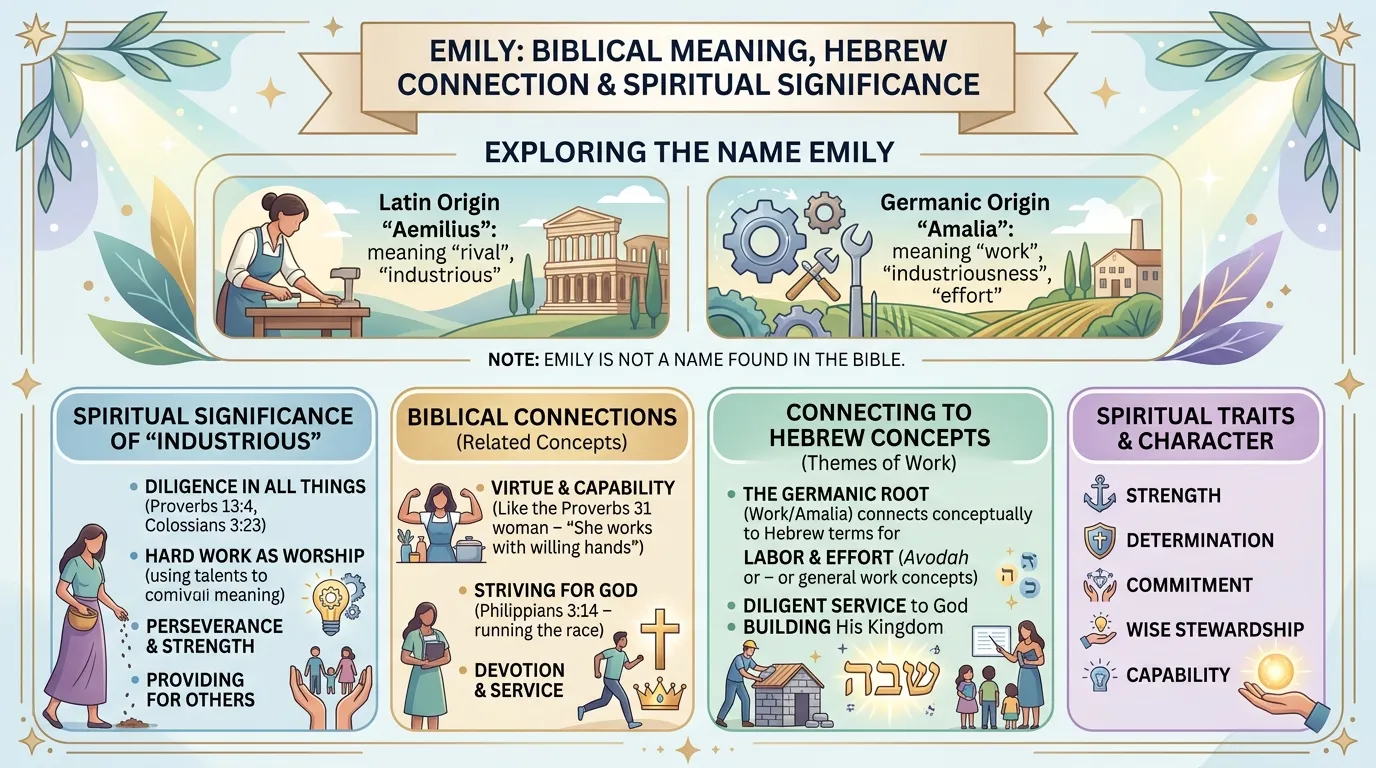
Let us begin with the plain truth, because you deserve it: Emily is not a biblical name. It does not appear anywhere in Scripture — not in the Old Testament, not in the New. It is not Hebrew, not Greek, not Aramaic. It will not be found in any concordance, and no honest study can trace it to a biblical root. Emily comes from Latin: it is the feminine form of Aemilius, one of ancient Rome’s great family names, built on the Latin word aemulus — meaning “rival,” “competitor,” or more warmly, “one who strives eagerly.” The standard rendering of its meaning is “rival” or “industrious, striving.”
That may feel disappointing if you came hoping for a hidden Hebrew meaning. But do not close the page. A name does not have to appear in the Bible for the Bible to have something to say to the person who bears it. Scripture speaks profoundly about striving — the very thing the name Emily means — about rivalry and ambition, about working hard and about resting in grace. What follows is an honest look at the name’s real origins and the genuine spiritual reflections its true meaning invites. No invented etymology. No pretending. Just the truth, and what the truth opens up.
The Real Story of the Name
To understand Emily, we go to Rome, not Jerusalem. The Aemilii were among the most distinguished patrician families of the Roman Republic — statesmen, generals, consuls. The feminine form Aemilia passed through medieval Europe, was carried by saints and queens, and eventually gave English the beloved Emily. The root, aemulus, carried a double edge even in Latin: it meant eager striving and emulation on the one hand, and rivalry — the desire to outdo another — on the other. Our English words emulate (to strive to equal, nobly) and emulous (competitive, rivalrous) both descend from it. The name contains both possibilities from its first syllable: striving toward something worthy, or striving against someone else.
It is important to say plainly what this means for the “biblical meaning” question. Some name-meaning websites, eager to please, invent Hebrew roots for names that never had them — connecting Emily to invented Semitic wordplay or claiming biblical figures who never existed. That is dishonest, and it does a disservice both to the name and to Scripture. The Bible’s Hebrew names — Hannah (“grace”), Nathan (“gift”), Abigail (“my father’s joy”) — are beautiful precisely because their meanings are real. Emily’s meaning is real too, but it is Latin, not Hebrew. Honesty about that is the foundation everything else here is built on.
And here is the liberating corollary: a name’s worth does not depend on its appearance in Scripture. Most of the Christians who have ever lived bore names never found in the Bible. The New Testament church itself was full of Latin and Greek names — Priscilla, Claudia, Phoebe, Urbanus — ordinary names of their cultures, carried by extraordinary saints. God does not grade names by their etymology. He calls people by name (Isaiah 43:1), whatever language that name comes from.
Striving, in Two Directions
If Emily means “the striving one,” then the Bible’s teaching on striving becomes this name’s true spiritual commentary — and Scripture draws the line between two kinds of striving with unusual sharpness.
There is a striving that Scripture commands. Paul, the hardest-working apostle, uses athletic language without embarrassment: “I press on toward the goal for the prize of the upward call of God in Christ Jesus” (Philippians 3:14). He tells the Corinthians to “run that you may obtain” the prize (1 Corinthians 9:24). The writer of Hebrews urges believers to “run with endurance the race that is set before us” (Hebrews 12:1). Diligence itself is commended everywhere in Proverbs; the industrious woman of Proverbs 31 “works with willing hands” and her lamp “does not go out at night.” For the Emily who is driven, ambitious, industrious — the girl or woman who hears “she’s so driven” as a compliment — Scripture does not say, “stop striving.” It says, strive for the right prize. Ambition aimed at God’s kingdom is not a flaw to fix; it is fuel to steward.
And there is a striving that Scripture warns against. This is the other edge of aemulus — rivalry, the need to outdo, to be seen, to win the comparison game. “Where jealousy and selfish ambition exist, there will be disorder and every vile practice” (James 3:16). Paul lists “rivalry” among the works of the flesh (Galatians 5:20) and pleads with the Philippians to “do nothing from selfish ambition or conceit” (Philippians 2:3). The difference between the two strivings is the object: emulation strives toward excellence; rivalry strives against people. One builds up; the other tears down. The name Emily holds both in tension, and every bearer of it gets to choose, daily, which one she feeds.
This is worth sitting with, because driven people feel the tension most. The same energy that builds a business, earns the degree, or serves the church tirelessly can curdle into comparison, envy, and exhaustion. Scripture’s answer is not to blunt the drive but to aim it: “Whatever you do, work heartily, as for the Lord and not for men” (Colossians 3:23). Striving “as for the Lord” transforms ambition from a competition into an offering.
What About Rest?
There is a second word the striving one needs, and it is the word driven people resist most: rest. Scripture pairs its commands to strive with commands to stop. “Be still, and know that I am God” (Psalm 46:10). Jesus’s own invitation is addressed precisely to the weary strivers: “Come to me, all who labor and are heavy laden, and I will give you rest” (Matthew 11:28).
This is the paradox at the heart of the Christian life, and the Emily who takes her name’s meaning seriously must learn it: we strive from acceptance, not for it. The gospel declares that in Christ, the verdict is already in — “there is therefore now no condemnation for those who are in Christ Jesus” (Romans 8:1) — which means the striving is freed from desperation. You can work hard without working to prove yourself. You can pursue excellence without your worth riding on the outcome. The Latin root says “strive.” Grace adds the word the root was missing: “rest.”
Parents naming a daughter Emily sometimes ask what blessing to speak over the name. Here is an honest one, built on the name’s true meaning and Scripture’s true teaching: “May you strive with all your heart — not against others, but toward everything good; not to earn love, but because you are already loved.” That is a blessing no invented Hebrew root could improve.
Biblical Figures for the Striving Heart
Though no Emily walks the pages of Scripture, the Bible is full of strivers — people whose drivenness, rightly aimed, changed the world. Their stories are the real “biblical commentary” on this name:
- Nehemiah — the cupbearer whose burden for ruined Jerusalem drove him to organize, labor, and rebuild the walls in fifty-two days despite mockery and threats. Industrious striving harnessed to God’s cause.
- The Proverbs 31 woman — who “rises while it is yet night,” plants vineyards, trades profitably, and extends her hands to the poor. Ambition and compassion in the same life, with no contradiction.
- Mary of Bethany — whose striving took the opposite form: she stopped striving, sat at Jesus’s feet, and chose “the good portion” (Luke 10:42). Sometimes the most spiritual thing a driven person can do is sit still.
- Paul — who could say “I worked harder than any of them, though it was not I, but the grace of God that is with me” (1 Corinthians 15:10). The perfect synthesis: maximum effort, zero self-reliance. Striving from grace, not for it.
None of them was named Emily. All of them show what the name’s true meaning looks like when it is lived well.
What a Name Can and Cannot Do
A closing honesty, to match the opening one. A name cannot determine a destiny. Scripture is clear that character is formed by choices, not syllables — and the clearest proof is that the Bible’s own villains often bore beautiful names. What a name can do is serve as a reminder, a small daily sermon etched into your identity. Every time an Emily hears her name, she can hear the question inside it: what are you striving for today — and for whom?
And there is one more truth, deeper than etymology. Whatever your name means in Latin or Hebrew or any tongue, Scripture says God calls His own by a name that goes beyond all of them: “Fear not, for I have redeemed you; I have called you by name, you are mine” (Isaiah 43:1). In Revelation, the overcomer is promised “a new name” written on a white stone (Revelation 2:17) — known fully, finally, by the One who named the stars. Emily means “the striving one.” But to God, every Emily who belongs to Christ is first and finally His — and that identity outranks every dictionary.
So keep the name with confidence. It is Latin, it is ancient, it is honest — and its meaning, rightly understood, points straight at one of Scripture’s great themes: strive hard, strive for the right things, and rest in the grace that makes striving joyful rather than desperate. Readers curious about the name’s documented journey from Roman family name to modern given name can explore the recorded history of Emily as a name through the centuries, which confirms the Latin origins described here.










