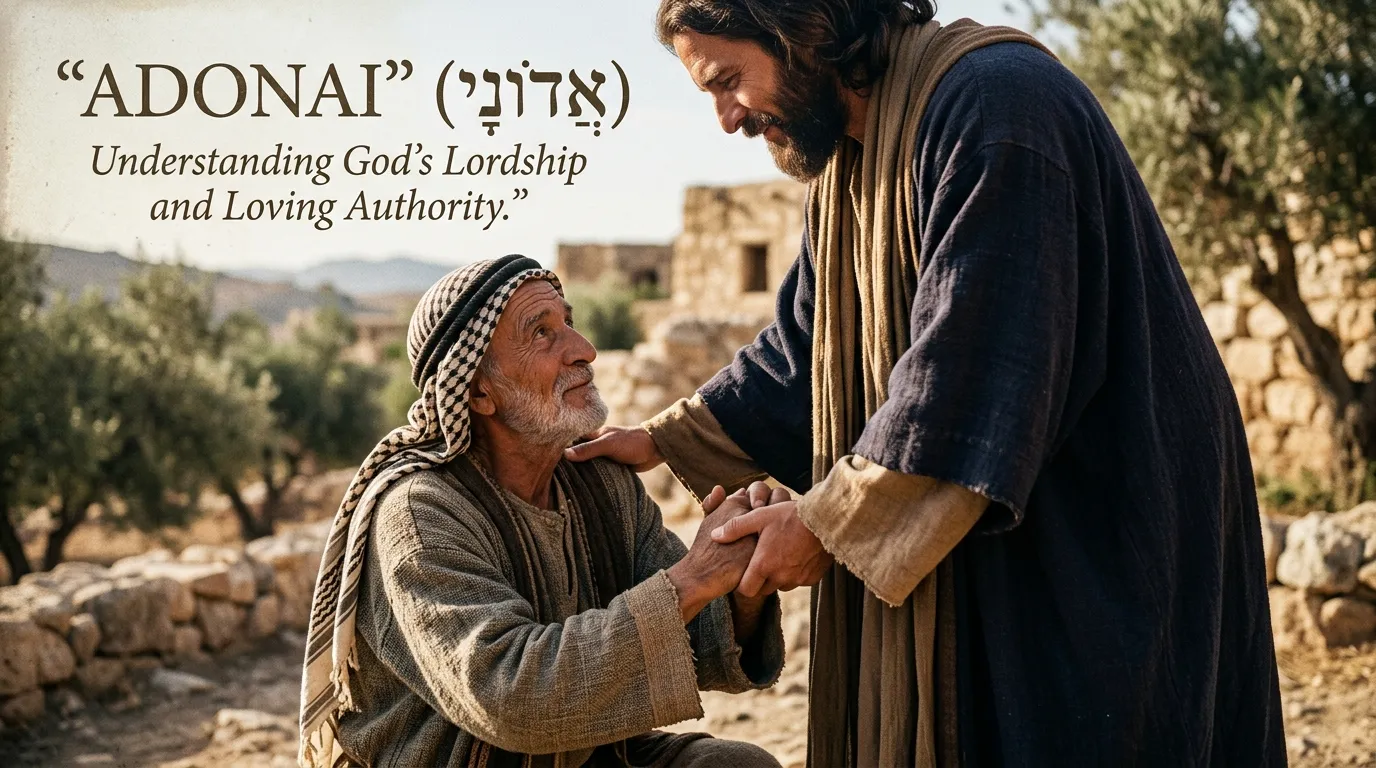
Open almost any English Bible to the Old Testament and you will notice something odd: the word LORD appears in small capital letters, hundreds of times, as if the translators wanted you to see that something lies beneath the surface. That typographic quirk is the doorway into one of the most beautiful names of God in Scripture. Every time you read “LORD” in those small capitals, the Hebrew underneath is the sacred four-letter name, YHWH. And for centuries, whenever Jewish readers came to that name in public reading, they did not pronounce it. Instead, out of reverence, they said a different word: Adonai.
Why Readers Started Saying Adonai
To understand Adonai, you have to understand the reverence that produced it. God’s covenant name, YHWH, revealed to Moses at the burning bush (Exodus 3:14-15), was considered so holy that speaking it carelessly felt like a violation of the commandment not to take God’s name in vain. Over time, Jewish tradition held that only the high priest, once a year on the Day of Atonement, would speak the name aloud in the Holy of Holies.
So what did everyone else say when they read the Scriptures? They substituted Adonai, meaning “my Lord.” This was not a different god or a lesser title. It was a veil of reverence drawn over the holiest name, a way of bowing the tongue before speaking of Him at all. When you say “Adonai,” you are joining a practice of worship that stretches back more than two thousand years.
This is also why your English Bible prints LORD in capitals: the translators are signaling, “Here the Hebrew says YHWH, the name Jewish readers traditionally voiced as Adonai.” A small typographic choice carries a whole theology of reverence, and millions of readers pass over it every day without noticing the devotion encoded in the page.
The Word Itself: What Adonai Carries in Its Syllables
The Hebrew underneath Adonai repays a closer look. The root is adon, which means lord, master, or owner. It was an ordinary word in the ancient world. A servant called his master adoni, “my lord.” Sarah called Abraham her lord (Genesis 18:12). It described real authority in real households.
But Adonai, the form used for God, is plural, literally “my Lords.” This is not polytheism smuggled into the grammar. Hebrew often uses plural forms to express majesty, fullness, or intensity, the way a king might be addressed with multiplied honor. Scholars call this the plural of majesty, and it appears with other great words too. When Scripture calls God Adonai, it is piling lordship upon lordship: not merely a lord among lords, but Lord in the fullest possible sense.
The possessive ending matters as well. Adonai is not abstract. It is “my Lord.” Built into the grammar is relationship. This is not lordship at a distance; it is the lordship of a Master who is mine, and a servant who belongs to Him. That small possessive suffix turns theology into devotion, the way a wedding ring turns a legal status into a love story.
Adonai in the Psalms: Lordship You Can Sing
Nowhere does Adonai breathe more freely than in the Psalms, where it appears in prayers that swing between desperation and delight. “O Lord, our Lord, how majestic is your name in all the earth!” (Psalm 8:1). The psalmist uses both the covenant name and Adonai in a single breath, majesty and mastery side by side.
Psalm 16 gives the personal side: “I say to the Lord, ‘You are my Lord [Adonai]; apart from you I have no good thing'” (Psalm 16:2). This is the grammar of belonging. The psalmist is not describing a distant sovereign but confessing a Master in whom all goodness is found. To call God Adonai is to say that every good thing in your life flows from His hand.
And Psalm 110:1, the most quoted Old Testament verse in the New Testament, turns on the word: “The Lord [YHWH] says to my Lord [Adonai]: ‘Sit at my right hand.'” Jesus Himself pointed to this verse to show that the Messiah is more than David’s son; He is David’s Lord (Matthew 22:44). The early church heard Adonai in that verse and recognized Jesus. The title the church would soon give Christ, “Lord,” is the Greek echo of this very Hebrew word.
The Question Adonai Asks: “If I Am Master, Where Is My Honor?”
Lordship is not only a comfort; it is a claim. Through the prophet Malachi, God confronted a people who used the right words while living the wrong way: “A son honors his father, and a slave his master. If I am a father, where is the honor due me? If I am a master [Adonai], where is the respect due me?” (Malachi 1:6).
That question still lands. It is possible to sing “Adonai” on Sunday and live as your own master on Monday. The prophets called that what it was: a divided heart. To call God “my Lord” while withholding obedience is to empty the word of its meaning. Jesus made the same point with devastating simplicity: “Why do you call me, ‘Lord, Lord,’ and do not do what I say?” (Luke 6:46).
This is the searching side of the name. Adonai comforts the surrendered and confronts the resistant, often in the same person on the same day. Every time we pray it honestly, we are handing over the keys: to our money, our plans, our relationships, our future. Lordship that costs nothing is not lordship at all.
Abraham’s Servant and the Lordship That Guides
One of the loveliest pictures of Adonai in action comes from Genesis 24, where Abraham sends his servant to find a wife for Isaac. Again and again the servant prays to “the Lord [YHWH], the God of my master Abraham,” and again and again God answers with startling specificity, guiding him to Rebekah at the well.
Notice the servant’s posture. He does not demand; he asks. He does not manipulate; he watches. He treats God as the active Master of the mission and himself as the instrument. And when Rebekah’s family sees how precisely God has worked, even they confess, “This is from the Lord” (Genesis 24:50).
This is what life under Adonai looks like in practice: prayed-through decisions, watched-for providences, and a readiness to follow when the Master points. The servant’s story is a template for every believer facing a decision too big to make alone. The Lord who guided a servant to a well in Mesopotamia still guides His servants today.
From Adonai to “Jesus Is Lord”
The New Testament never uses the Hebrew word Adonai, but it is saturated with its meaning. When the Greek-speaking church confessed “Jesus is Lord” (kurios Iesous), it was applying to Christ the very lordship the Hebrew Scriptures ascribed to God as Adonai. Paul writes that “every tongue acknowledge that Jesus Christ is Lord, to the glory of God the Father” (Philippians 2:11).
This is why the earliest Christian creed was so dangerous in the Roman Empire. To say “Jesus is Lord” was to say Caesar is not, and men and women died for that confession. They understood what Adonai had always meant: lordship is exclusive. You cannot have two masters. The church’s first confession was simply Adonai translated into a world that needed to hear it. It remains the shortest complete summary of the Christian faith ever spoken, and the most costly.
So when you read “LORD” in your Old Testament and “Lord” in your New Testament, you are reading one continuous claim across both covenants: there is a Master, He is good, and He asks for everything.
Praying the Name Today
How does a believer pray “Adonai” now? Start where the word starts: with reverence. Before rushing into requests, pause the way the ancient readers paused, and let the weight of who you are addressing settle over you. Then make it personal, the way the grammar makes it personal. Not “the Lord” in the abstract, but my Lord.
Then let the name do its searching work. Ask the Malachi question of your own week: where has my honor for my Master gone thin? Is there an area, a habit, a relationship, a sum of money, where I have quietly kept the keys? Prayer that names God as Adonai and means it has a way of rearranging priorities without anyone having to preach at you.
Finally, let the name carry your anxieties. A Master is responsible for His servants. Jesus said it plainly: your Father knows what you need (Matthew 6:32). The lordship of Adonai is not a burden added to your worries; it is the answer to them. The One in charge is both sovereign and good, and He has never lost a servant He intended to keep. Readers who want to trace how this title developed in Jewish and Christian usage will find the Wikipedia entry on Adonai a clear and well-sourced place to continue.










