Imagine opening a letter from someone who deeply understands what you are going through. The words may be old, but they still bring comfort, correction, and hope. This is one reason Paul’s letters meaning in the Bible matters so much to Christians today.
Paul wrote to real churches and real people facing fear, conflict, temptation, suffering, questions, and growing faith. His letters were not simply religious essays. They gave believers practical teaching about Jesus Christ, salvation, grace, holiness, love, unity, and hope.
The letters of Paul make up a large part of the New Testament. They show how the gospel changes everyday life. They also remind us that Christian faith is not only about what we believe but also about how we live.
What Do Paul’s Letters Mean in the Bible?
Paul’s letters are inspired New Testament writings that teach believers how to understand and live out the gospel of Jesus Christ.
Paul wrote to churches and individuals in different situations. Some letters addressed problems inside churches, while others encouraged believers who were suffering or confused.
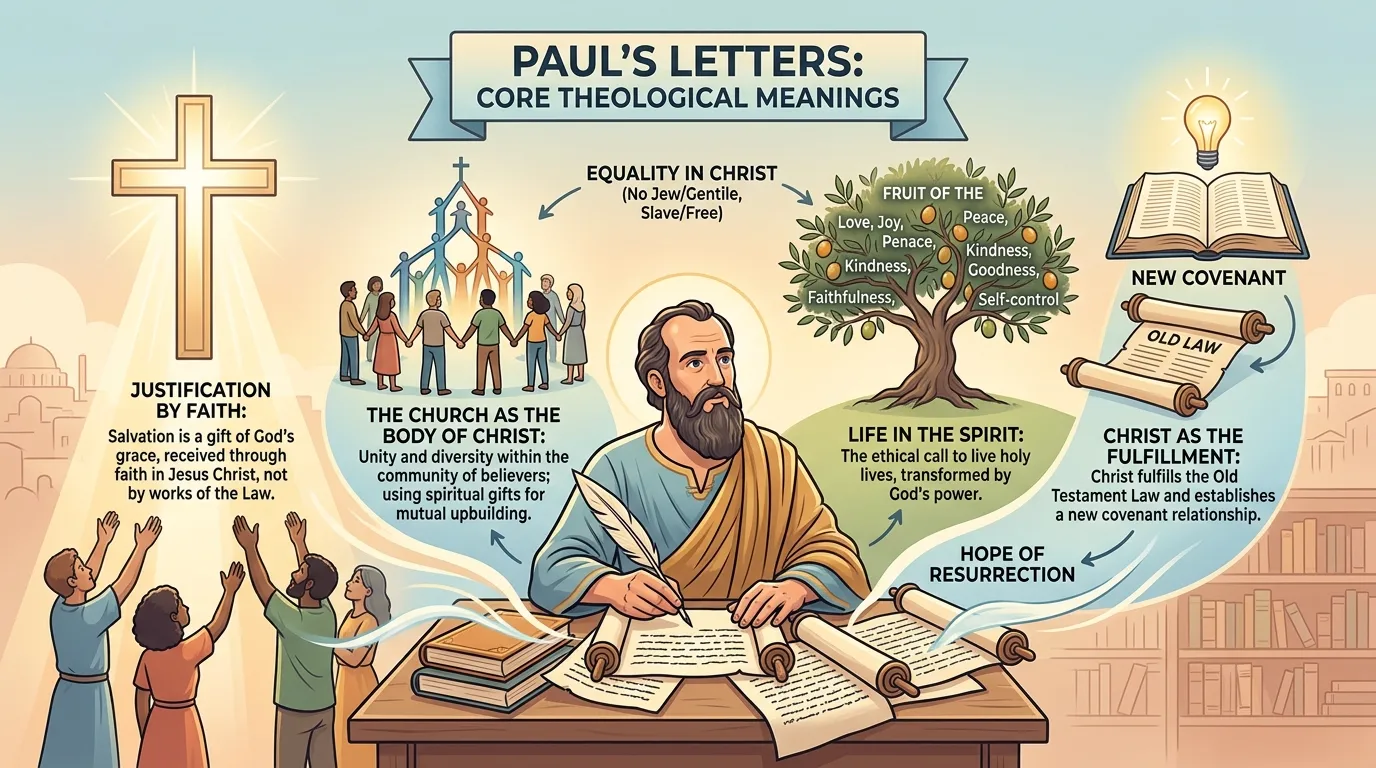
For example, in Romans 1:16, Paul says that he is not ashamed of the gospel because it is the power of God for salvation. This gives us a central theme found throughout his writings: salvation comes through God’s grace and faith in Jesus Christ.
In Ephesians 2:8–9, Paul explains that people are saved by grace through faith, not by their own works. His message points believers away from self-reliance and toward God’s mercy.
At the same time, Paul teaches that grace should produce a changed life. In Ephesians 2:10, he says believers are created in Christ Jesus for good works.
So, the basic meaning of Paul’s letters can be summarized this way:
- Jesus Christ is at the center of salvation.
- God saves by grace through faith.
- Believers are called to live holy lives.
- Christians should love and serve one another.
- Suffering does not mean God has abandoned His people.
- Believers have hope because of Christ’s resurrection and return.
Why Did Paul Write So Many Letters?
Paul wrote because churches and individuals needed guidance.
The early Christian communities lived in a world filled with different religions, cultures, moral beliefs, and political pressures. New believers needed to understand what following Jesus truly meant.
Paul addressed many practical issues.
In 1 Corinthians 1:10, he calls believers to unity because divisions had developed in the church. Later, in 1 Corinthians 13, he explains that love must guide Christian relationships and spiritual gifts.
In Galatians 5:13, Paul reminds believers not to use freedom as an opportunity for the flesh but to serve one another through love.
His letters therefore connect Christian doctrine with daily Christian living.
What Are the Main Themes in Paul’s Letters?
Grace and Salvation
Grace is one of the strongest themes in Paul’s writings.
Paul knew that human beings cannot earn salvation through good behavior. In Romans 3:23–24, he explains that all have sinned and that people are justified freely by God’s grace through Christ.
This is deeply encouraging. Your relationship with God does not begin with being perfect.
It begins with God’s grace.
Faith in Jesus Christ
Paul repeatedly teaches the importance of faith.
Romans 5:1 explains that believers are justified by faith and therefore have peace with God through Jesus Christ.
Faith does not mean pretending that life is easy. It means trusting God even when circumstances are difficult.
Love
Paul’s teaching about love is especially clear in 1 Corinthians 13.
He explains that spiritual gifts, knowledge, and impressive actions mean little without love. Christian maturity is therefore not measured only by what a person knows but also by how that person treats others.
Holy Living
Paul also calls Christians to live differently.
In Romans 12:1–2, believers are encouraged to offer themselves to God and allow their minds to be transformed.
This means Christianity affects choices, attitudes, relationships, words, work, and private behavior.
Hope in Suffering
Paul’s letters do not hide suffering.
Paul himself experienced imprisonment, rejection, persecution, danger, and hardship. Yet he continued to point believers toward hope.
In 2 Corinthians 4:8–9, he describes being troubled but not crushed, perplexed but not driven to despair, persecuted but not abandoned.
That message still speaks to Christians who are going through hard seasons.
Paul’s Letters and Their Spiritual Meaning
Christians often see Paul’s letters as more than historical documents. They are also a source of spiritual instruction and encouragement.
However, it is important to distinguish what Scripture clearly teaches from personal spiritual interpretation.
The Bible clearly teaches that Paul’s writings instruct Christians in faith and godly living. A person may also personally feel that a particular passage speaks to a season of life, but that personal application should not be treated as a new revelation equal to Scripture.
For example, someone struggling with anxiety may find comfort in Philippians 4:6–7, where Paul teaches believers to bring their requests to God with prayer and thanksgiving.
The passage can become deeply personal without changing its biblical meaning.
Paul’s Letters Meaning + Hebrew Meaning
There is an important language detail here. Paul’s letters were written in Greek, not Hebrew, so there is no single Hebrew translation that gives a special hidden meaning to the phrase “Paul’s letters.”
Paul’s Jewish name was Saul, from the Hebrew name Sha’ul (שָׁאוּל), commonly understood as meaning “asked for” or “prayed for.” In the New Testament, he is also called Paul, from the Greek Paulos (Παῦλος).
The Hebrew word commonly associated with a letter or written message is iggeret (אִגֶּרֶת), meaning a letter or epistle.
Therefore, from a biblical language perspective, “Paul’s letters” refers to Paul’s written apostolic messages preserved in the New Testament. It should not be interpreted as a secret Hebrew code or hidden prophecy.
The safest approach is to read Paul’s writings in their historical, literary, and biblical context.
Which Books of the Bible Are Paul’s Letters?
The New Testament traditionally includes 13 letters directly associated with Paul:
- Romans
- 1 Corinthians
- 2 Corinthians
- Galatians
- Ephesians
- Philippians
- Colossians
- 1 Thessalonians
- 2 Thessalonians
- 1 Timothy
- 2 Timothy
- Titus
- Philemon
Some Christians and scholars have historically discussed whether Paul wrote Hebrews. Because the authorship of Hebrews is not stated in the letter itself, it is best not to present Hebrews as definitely written by Paul.
Paul’s letters cover churches, individual believers, Christian leadership, doctrine, relationships, suffering, forgiveness, spiritual growth, and hope.
What Can Christians Learn From Paul’s Letters?
God’s Grace Is Greater Than Your Past
Paul’s own life is a powerful example.
Before becoming a follower of Christ, Paul persecuted Christians. Acts 9 describes his dramatic encounter with Jesus on the road to Damascus.
Later, Paul described himself as someone who had received mercy.
His story teaches an important truth: God’s grace can transform a person’s life.
Your past may explain where you have been, but through Christ it does not have to determine where you are going.
Christian Freedom Has Responsibility
Paul strongly defended Christian freedom, but he never presented freedom as permission to harm others.
In Galatians 5:13, he tells believers to use their freedom to serve one another in love.
This can apply to everyday life. A Christian may have freedom in a particular area, but love asks, “Will my choice help or hurt someone else?”
Christians Need One Another
Paul repeatedly uses the picture of the church as a body.
In 1 Corinthians 12:12–27, he explains that believers have different gifts and roles, yet they belong to one body.
This means no Christian needs to believe, “I have nothing to offer.”
God gives different gifts for the good of His people.
Prayer Should Be Part of Daily Life
Paul’s letters contain many calls to prayer.
1 Thessalonians 5:16–18 encourages believers to rejoice, pray continually, and give thanks in all circumstances.
This does not mean Christians must feel happy about every painful situation. Rather, it encourages a continuing relationship with God through every season.
Paul’s Letters in Dreams: What Could They Mean?
People sometimes dream about letters, apostles, books, writing, or Bible passages and wonder whether the dream has a spiritual meaning.
The Bible contains examples of God communicating through dreams, including Joseph’s dreams in Genesis 37 and Joseph’s dreams in Matthew 1–2. However, Scripture does not teach that every modern dream is a message from God.
Therefore, if someone dreams about Paul’s letters, it may personally remind them of ideas such as:
- a need for biblical instruction
- encouragement during hardship
- a call to examine one’s faith
- reconciliation or unity
- spiritual growth
- God’s grace and forgiveness
- a desire to understand Scripture more deeply
These are possible personal reflections, not guaranteed interpretations.
Every dream should be tested against Scripture. If an interpretation contradicts God’s revealed Word, it should not be accepted as biblical truth.
Prayer, wise Christian counsel, and careful reading of Scripture can help believers respond with humility rather than fear.
What Does It Mean to See a Letter in a Biblical Dream?
A letter can naturally represent communication or a message, but Scripture does not give one universal meaning for every dream symbol.
For example, in everyday life, receiving an important letter may represent news, instruction, an invitation, correction, or encouragement.
If a Christian dreams about receiving a biblical letter, the most helpful response may be to ask:
“What does Scripture already teach me about the issue I am facing?”
That question keeps the focus on God’s Word rather than speculation.
Bible Verses About Tile
The Bible does mention tile, although these references are not specifically connected to Paul’s letters.
One of the clearest examples appears in Ezekiel 4:1. God tells Ezekiel to take a brick or tile, place it before him, and portray Jerusalem upon it. This was part of a prophetic sign representing the coming judgment against Jerusalem.
The meaning comes from the larger passage, not from the word “tile” by itself.
Ezekiel 4:1: Ezekiel is instructed to use a brick or tile as a visual representation of Jerusalem.
Another relevant passage is Ezekiel 9:2, where judgment imagery is presented within Ezekiel’s prophetic vision. While the passage does not provide a general symbolic definition of tile, it belongs to the larger prophetic setting in which Ezekiel uses physical objects and actions to communicate God’s message.
This gives us an important biblical principle: objects in Scripture should be interpreted within their context rather than assigned a fixed spiritual meaning.
If someone dreams about a tile, brick, wall, or building, the Bible does not say that the object always means one particular thing. Personal circumstances and the broader biblical message matter.
How Paul’s Letters Apply to Everyday Christian Life
Paul’s teachings are practical because they speak to ordinary struggles.
A Christian who has been hurt by a friend can think about Paul’s teaching on forgiveness and love.
Someone worried about the future can meditate on Philippians 4:6–7 and bring those concerns to God in prayer.
A believer who feels spiritually weak can remember Paul’s words in 2 Corinthians 12:9, where Christ tells him, “My grace is sufficient for you, for my power is made perfect in weakness.”
A church experiencing disagreement can return to Paul’s teaching about unity, humility, and love.
In this way, Paul’s letters move from the pages of the Bible into daily life.
How Should You Read Paul’s Letters?
Paul’s writings can sometimes feel difficult because they address ancient cultures and complex questions. A simple approach can help.
First, read the entire section rather than taking one verse alone.
Next, ask who Paul was writing to and what problem or question he was addressing.
Then ask what the passage teaches about God, Jesus, salvation, people, sin, grace, and Christian living.
Finally, consider how the teaching applies to your life today.
Helpful questions include:
- What does this passage clearly say?
- What was happening when Paul wrote it?
- What does it teach about Jesus?
- Is Paul giving a command, encouragement, warning, or explanation?
- How can I apply this truth with humility and love?
This approach helps prevent Scripture from being reduced to isolated quotes.
Frequently Asked Questions
What is the main message of Paul’s letters?
The main message is centered on Jesus Christ, God’s grace, salvation through faith, transformed living, Christian love, and hope. Paul explains both what Christians believe and how that belief should shape their lives.
Why are Paul’s letters important to Christians?
They provide inspired New Testament teaching for understanding the gospel and living as followers of Christ. They also address practical issues such as relationships, suffering, church unity, prayer, leadership, and spiritual growth.
Did Paul write his letters in Hebrew?
No. Paul’s New Testament letters were written in Greek. Paul was Jewish and knew the Hebrew Scriptures, but the surviving letters in the New Testament are Greek writings.
What does Saul mean in Hebrew?
Saul, or Sha’ul (שָׁאוּל), is a Hebrew name commonly understood as “asked for” or “prayed for.” Paul is the name used for him in much of the New Testament.
Can Paul’s letters have a meaning in a dream?
A dream about Paul’s letters may prompt personal reflection, but Scripture does not provide a universal dream dictionary for such an image. Any spiritual interpretation should be tested against the Bible and should never contradict clear biblical teaching.
What does a letter symbolize in the Bible?
A letter can communicate instruction, encouragement, correction, or news. However, the meaning depends on the specific biblical context. Scripture does not teach that every letter seen in a dream has one fixed spiritual meaning.
Final Thoughts
The meaning of Paul’s letters reaches far beyond ancient church history. They continue to point believers toward Jesus, grace, truth, love, holiness, prayer, and hope.
Paul wrote to people who faced real struggles, just as Christians do today. They worried, disagreed, suffered, made mistakes, needed forgiveness, and had to learn how to trust God.
That is why his letters remain so powerful.
If you are walking through a difficult season, do not use Scripture merely to search for a secret sign. Instead, listen carefully to what God’s Word already says.
God’s grace is sufficient. Christ is faithful. Prayer matters. Love matters. And suffering does not mean God has abandoned you.
Take time to read Paul’s letters slowly. Pray over what you read. Ask God for wisdom, obey what Scripture clearly teaches, and bring your unanswered questions to Him.
Above all, remember the hope that stands behind Paul’s message: God is at work through Christ, and His grace is strong enough to carry His people through every season.