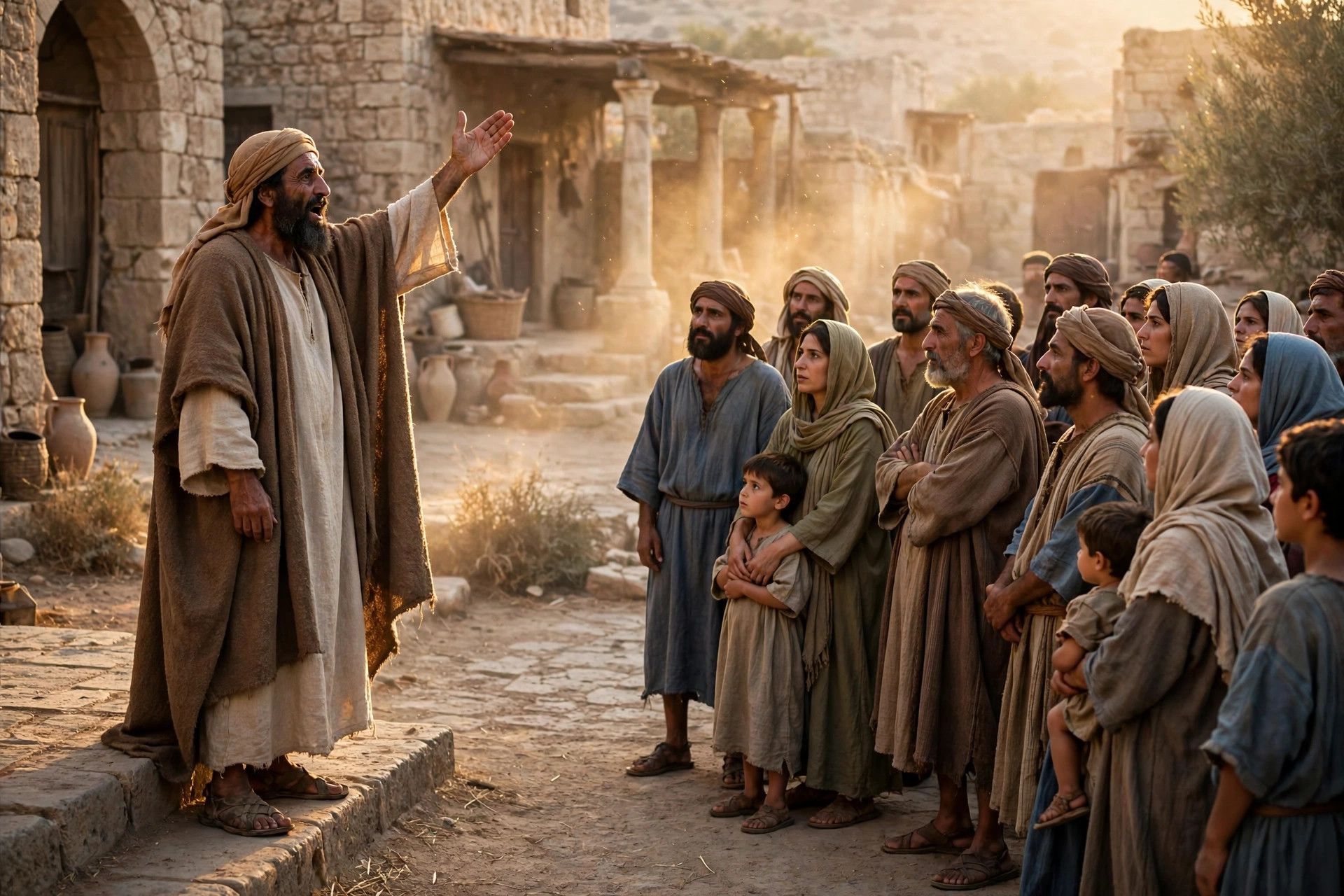
Two thousand years ago, a word left a battlefield and changed the world. When a Greek messenger ran from the plains of Marathon with news of victory, the shout was euangelion — good news. The early Christians picked up that battlefield word and filled it with heaven’s meaning: the victory announcement that God had won the war for the human soul. “Preach the gospel” is not church jargon. It is a victory cry — and it still needs heralds.
The Gospel, Defined by Scripture — Not by Us
Before we talk about preaching, we need the message straight, because the Bible defines the gospel with unusual precision. Paul delivers it like a creed: “Christ died for our sins according to the Scriptures, that he was buried, that he was raised on the third day according to the Scriptures” (1 Corinthians 15:3–4). Death, burial, resurrection — “according to the Scriptures.” That last phrase matters: the gospel is not Paul’s invention but the fulfillment of God’s ancient promise.
Paul is fierce about guarding the content: anyone preaching a different gospel stands under a curse — anathema (Galatians 1:9). The gospel is fixed content, not flexible advice. It is the announcement that opens Mark’s Gospel (Mark 1:1) and the mission statement Jesus read in Nazareth: “to proclaim good news to the poor… to set the oppressed free” (Luke 4:18–19). Notice what it is not: not self-improvement tips, not political strategy, not prosperity formulas, not a rulebook. It is news — the best news ever announced — about what God has done.
What “Preaching” Actually Meant to Them
The New Testament uses three great words for preaching, and each one corrects a modern misunderstanding. Kēryssō means to herald — like a king’s messenger proclaiming a royal decree in the town square (Mark 1:14; Romans 10:14–15). A herald doesn’t invent the message or soften it; he announces it. Euangelizō means to bring good news — God’s victory announcement (Luke 2:10; Acts 8:35). Martyreō means to testify — to tell what you have seen and heard (Acts 1:8; 1 John 1:3).
The common thread: announce, don’t invent. Witness, don’t perform. And notice — no pulpit required. Philip preached to one man in a chariot (Acts 8:35). The Samaritan woman evangelized her entire town between drawing water and dinner (John 4:29, 39).
The Hebrew Scriptures were already singing this song. Besorah is good news (Isaiah 52:7 — “How beautiful on the mountains are the feet of those who bring good news”), the very verse Paul quotes in Romans 10:15. Basar described the messenger bearing glad tidings from the battlefield (2 Samuel 18:26). Qara meant to call out like the prophets (Isaiah 40:2; Jonah 1:2) — the tradition John the Baptist inherited in the wilderness (Matthew 3:1). When euangelion carried the gospel to the nations, it carried all this Hebrew weight with it.
Who Carries the Message? (Hint: You)
The Great Commission was given to all disciples, not just the eleven (Matthew 28:19). Every believer is “Christ’s ambassador” (2 Corinthians 5:20). When persecution scattered the Jerusalem church, the ordinary Christians “preached the word wherever they went” (Acts 8:4) — the apostles stayed behind; the scattered saints did the preaching. Peter calls the whole church “a royal priesthood… that you may declare the praises of him who called you out of darkness” (1 Peter 2:9).
Yes, the pastor-teacher is a distinct office (Ephesians 4:11). But the office equips the saints for the work — and the work belongs to all of us. Wherever you stand — the office, the kitchen, the campus — is a place to speak of Christ.
The Non-Negotiable Content
Faithful gospel preaching always includes four elements. Who Jesus is: “Lord and Messiah” (Acts 2:36), “the Son of God” (Acts 9:20). What He did: lived sinlessly, died sacrificially, was buried, and rose bodily (1 Corinthians 15:3–4). Why it matters: the message first exposes sin — the Pentecost crowd was “cut to the heart” (Acts 2:37); Paul reasoned with Felix about “righteousness, self-control and the judgment to come” (Acts 24:25). A gospel that never mentions sin has skipped the diagnosis and jumped to the cure. How to respond: “Repent and believe the good news” (Mark 1:15; Acts 2:38).
And the foundation under it all is Scripture itself — Paul “reasoned with them from the Scriptures” (Acts 17:2–3), and the Bereans were noble for checking his message daily (Acts 17:11). A gospel detached from Scripture is, in Paul’s blunt phrase, “a different gospel” (Galatians 1:6–8).
What Preaching the Gospel Is Not
It is not arguing people into the kingdom — we speak “with gentleness and respect” (1 Peter 3:15) while the Spirit does the convicting (John 16:8). It is not only for the gifted — Moses stammered (Exodus 4:10) and Jeremiah felt too young (Jeremiah 1:6), and God used them both. It is not prosperity preaching or self-help therapy — a message with no sin, no cross, no repentance, and no lordship of Christ is not the biblical gospel, no matter how inspiring it sounds (Galatians 1:6–8). And it is never coercion — we persuade, never manipulate. The gospel invites; it doesn’t bully.
Do I have to become a street preacher?
No — preach where you are. Your family, your workplace, your friendships: that is your parish. The scattered church preached “wherever they went” (Acts 8:4), which for most of them meant ordinary life, not a soapbox.
What if I’m afraid to speak up?
Join the club — Timothy was timid (2 Timothy 1:7), and God didn’t remove the fear, He gave him power through it. Start small: one conversation, one verse, one invitation. Courage grows with use.
What if people reject the message?
They rejected it from Jesus Himself (John 1:11) — and He was a perfect preacher. Rejection of the message is not failure of the messenger. Some seed falls on hard soil (Matthew 13:19); sow anyway, and leave the harvest to God.
Why does any of this matter eternally? Because of the unbroken chain in Romans 10:14 — no preaching means no hearing, no hearing means no believing, no believing means no calling on the Lord. Preaching is God’s chosen method, and the message carries “the power of God that brings salvation” (Romans 1:16) — the power is in the message, not the messenger. Paul felt it as a sacred compulsion: “Woe to me if I do not preach the gospel!” (1 Corinthians 9:16). It is a trust committed to us (1 Thessalonians 2:4), and “knowing the terror of the Lord, we persuade men” (2 Corinthians 5:11).
So learn the simple outline and make it yours: God loves, we sinned, Christ died and rose, respond in repentance and faith (John 3:16; Romans 3:23; 6:23; 5:8; 10:9). Tell your story — “I was blind but now I see” (John 9:25). Ask, listen, then speak — Jesus asked hundreds of questions before giving answers. Live it before you speak it, because people will know us by our love (John 13:35). Then trust the results to God (1 Corinthians 3:6). The shepherds “spread the word” (Luke 2:17); the scattered church preached everywhere (Acts 8:4). Good news travels — go, and herald it well. If the word “evangelism” itself feels unfamiliar, the Wikipedia article on evangelism traces how Christians have understood and practiced it across history.










