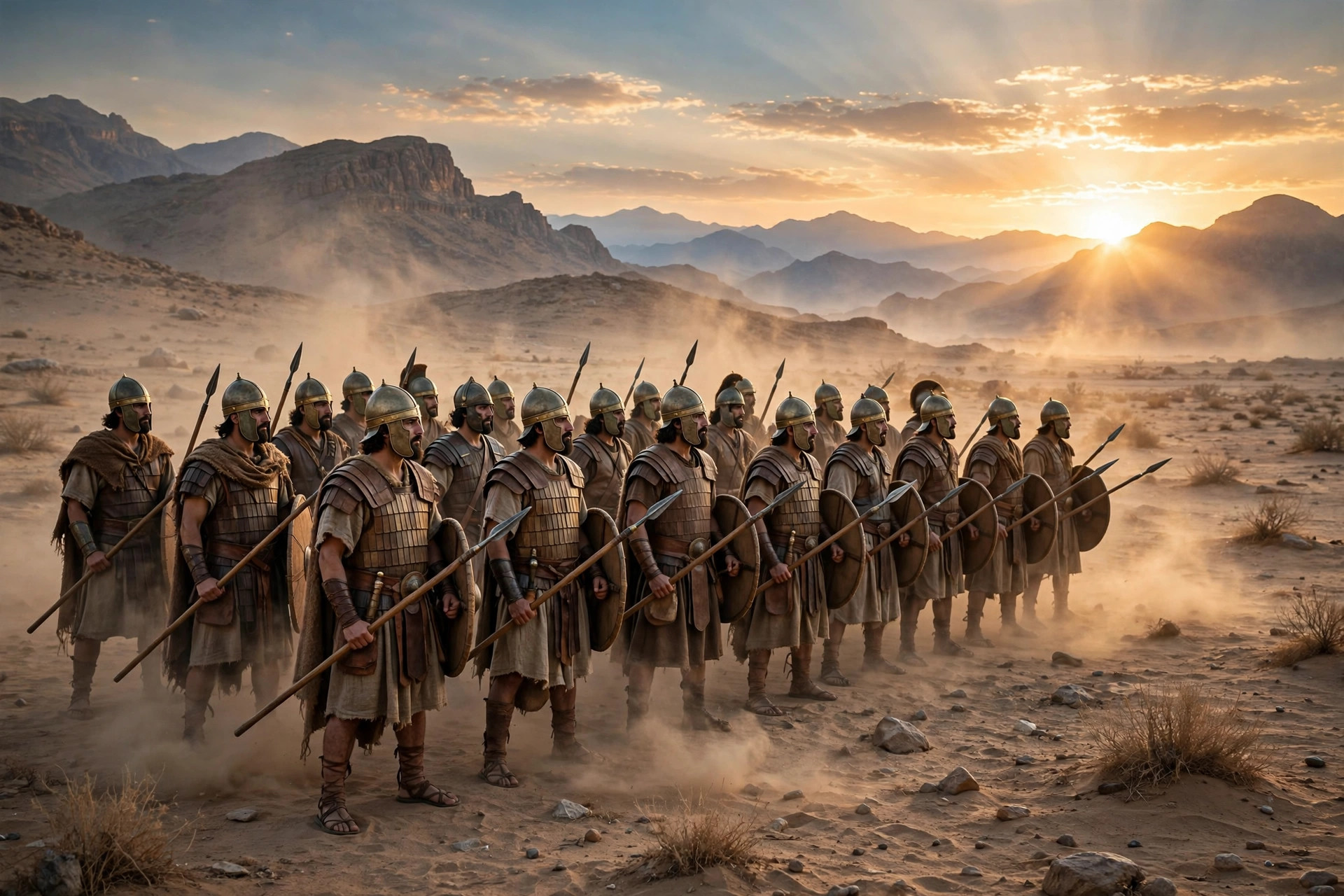
The strangest army in history marched with trumpets instead of swords, shrank its forces on purpose before the fight, and once sent the choir out ahead of the infantry. Israel’s battles read like military impossibilities — because they were. Again and again, Scripture shows us the same pattern: God wins through weakness, so that no one mistakes the victory for human achievement. Walk through the battlefields with me, and you’ll find they were never really about warfare. They were about worship.
The Sea That Fought for Them
Israel’s military history begins with God fighting while Israel watches. Trapped between Pharaoh’s chariots and the Red Sea, the people panicked — and Moses gave the most counterintuitive battle order ever issued: “The Lord will fight for you; you need only to be still” (Exodus 14:14). The sea parted. Israel walked through on dry ground. Egypt’s army drowned.
This is the founding pattern of every Israelite victory: divine power, not superior strength. After the first real battle — against Amalek — Moses built an altar and named it Yahweh Nissi, “The Lord is my banner” (Exodus 17:15). The Hebrew word for battle, milchamah (from lacham, to fight — the same root as lechem, bread), reminds us these were fights for survival itself. And the banner over them all was not a flag of their own courage. It was the Lord.
Trumpets, Torches, and Three Hundred Men
At Jericho, God ordered a week of marching, a blast of trumpets, and a shout — and the walls collapsed (Joshua 6). No siege works. No ladders. Just obedience that looked foolish until it looked miraculous.
With Gideon, God went further: He deliberately shrank the army from 32,000 to 300, explaining why — “lest Israel boast against me that her own strength has saved her” (Judges 7:2). Three hundred men with trumpets, jars, and torches routed the Midianites. And young Jonathan, with only his armor-bearer, climbed into a Philistine outpost trusting that “nothing can hinder the Lord from saving, whether by many or by few” (1 Samuel 14:6) — and God threw the enemy camp into panic.
The thread connecting them: God wins through weakness so His power gets the glory. Every impossible victory was a sermon — strength is not the strategy; surrender is.
The Shepherd Boy and the Giant
The most famous battle in the Bible needs little retelling: David, a shepherd boy with a sling, against Goliath, a nine-foot champion in full bronze (1 Samuel 17). But listen again to David’s battle cry, because it is the theology of every Israelite war in one sentence: “You come against me with sword and spear and javelin, but I come against you in the name of the Lord Almighty” (1 Samuel 17:45).
David understood what the armies of Israel kept forgetting: when God fights, the enemy’s size is irrelevant. The giant’s armor weighed more than the boy — and it didn’t matter at all.
The Choir That Won a War
King Jehoshaphat faced an invasion so vast that his response was honest terror — and then honest prayer (2 Chronicles 20). God’s answer came through a Levite: “Do not be afraid or discouraged… the battle is not yours, but God’s.” So Jehoshaphat did the unthinkable: he put the choir in front of the army, singing praise as they marched toward the enemy.
And as they began to sing, the Lord set ambushes against the invaders, and they destroyed each other. Worship was warfare. The battle was won before a single Israelite sword was drawn — because the real weapon was never in their hands.
From Ancient Battlefields to Your Monday Morning
These battles were real history — but they were also written for us. The Red Sea became Scripture’s great picture of salvation: God making a way where there is no way. The conquest of Canaan pictures possessing God’s promises by faith, step by step. David’s victories foreshadow the greater Son of David, who would defeat sin, death, and Satan Himself. And Israel’s physical armor points straight to the spiritual armor every believer must wear (Ephesians 6:10–18).
Because here is the New Testament’s translation of it all: “Our struggle is not against flesh and blood” (Ephesians 6:12) — the Greek word is polemos, war. Our battles today are spiritual, which means the ancient principles still apply. Stand still first (Exodus 14:14; Psalm 46:10) — panic is the enemy’s best weapon. Obey even when the orders look strange; Jericho fell to a parade. Remember past victories the way David remembered the lion and the bear (1 Samuel 17:37) — your history with God is ammunition. Worship in the waiting, like Jehoshaphat’s choir. And fight the real enemy: not people, not circumstances — put on truth and righteousness and stand.
One honest footnote: not every battle is a direct allegory for your personal life, and Scripture warns against flattening history into self-help. The conquest of Canaan, for instance, was God’s judgment on cultures practicing extreme evil — including child sacrifice — not a model for our ambitions. And when Israel lost, as at Ai, the cause was hidden sin in the camp (Joshua 7): defeat followed disobedience, every time.
But the headline of Israel’s wars has never changed: “The battle is the Lord’s.” The outcome rests on God’s power; our part is faithfulness and obedience. From the Red Sea to the empty tomb, God has never lost a battle — and He wins through weakness still. Stand still, obey, worship, and then watch the God of Israel’s battles fight for you. Scholars still debate what happened at those walls — the Wikipedia article on the Battle of Jericho collects the archaeological and historical discussion in one place.










