Let us start where honesty demands: the Bible never tells us what the number nine means. There is no verse that says “nine signifies X” the way there are verses calling seven the number of completeness or ten the number of the commandments. Anyone who tells you that nine means divine completion or spiritual fullness as a settled biblical doctrine is going beyond what Scripture actually says. That matters — because building spiritual expectations on meanings the Bible never gave is how superstition dresses up as faith.
But honesty cuts both ways. While the Bible never assigns nine a meaning, it does use nine in interesting places — and one of those places is among the most beloved passages in the New Testament. So instead of manufacturing a symbolism, let us do something better: look at where nine actually appears, notice what is genuinely there, and let the clearest instance — the ninefold fruit of the Spirit — carry the weight it deserves.
Nine’s Real Résumé
A tour of the actual appearances:
- The ninth hour. Jesus dies at “the ninth hour” (Mark 15:34) — 3 p.m., the hour of the evening sacrifice. Darkness covers the land from the sixth hour to the ninth; then “Jesus uttered a loud cry and breathed his last.” The ninth hour is the hour of atonement accomplished — the daily sacrifice’s hour becoming the final sacrifice’s hour.
- Nine fruits of the Spirit. “The fruit of the Spirit is love, joy, peace, patience, kindness, goodness, faithfulness, gentleness, self-control” (Galatians 5:22–23). Count them: nine. Against such things, Paul adds, there is no law.
- Nine lepers who did not return. Jesus heals ten lepers; “were not ten cleansed? Where are the nine?” (Luke 17:17). The nine become Scripture’s standing illustration of ingratitude — blessing received, thanks unreturned.
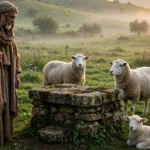
- Ninety-nine sheep. The shepherd leaves the ninety-nine to seek the one lost (Matthew 18:12; Luke 15:4) — nine-times-eleven as the picture of the secure majority, set against the pursued one.
- Nine months, nine plagues’ pattern, and the like. Various nines appear in genealogies, measurements, and narratives without any symbolic freight the text itself suggests.
Notice what is not here: no angelic announcement that nine means completion, no prophetic decoding, no “biblical numerology” table. The ninth hour’s significance comes from the event (the crucifixion at the sacrifice hour), not from the digit. The nine lepers teach gratitude, not numerology. Scripture uses nine the way it uses most numbers — as a count, embedded in a story whose meaning comes from the story.
The Fruit of the Spirit: Nine Graces, One Harvest
If nine has a biblical “home,” it is Galatians 5:22–23 — and the passage itself corrects a common misunderstanding. Paul says fruit — singular — then lists nine qualities. Not nine fruits but one fruit with nine facets, like a diamond catching light nine ways. The Spirit does not produce a Christian who is loving but joyless, or peaceful but unkind; he grows the whole cluster together, unevenly and gradually, but together.
The list’s order repays attention. It begins with love — the root from which the rest grow (compare 1 Corinthians 13) — and ends with self-control, the boundary that protects the rest. Between them: joy and peace (the inner life), patience, kindness, goodness (the life toward others), faithfulness and gentleness (the life under pressure). Nine graces, one character — the character of Christ, reproduced by the Spirit.
And the context is warfare: the fruit list follows the works of the flesh list (5:19–21) — fifteen ugly items against nine beautiful ones. Paul’s point is not arithmetic but allegiance: “those who belong to Christ Jesus have crucified the flesh with its passions and desires” (5:24). The nine are what grows when the fifteen are put to death. If you want to know whether the Spirit is at work in a life, do not count number sightings — count the fruit.
The Ninth Hour, Revisited: Prayer and Visions
The ninth hour keeps a remarkable company in Acts. Peter and John go up to the temple “at the hour of prayer, the ninth hour” (Acts 3:1) — and a lame man is healed at the Beautiful Gate. Cornelius receives his angelic vision “about the ninth hour of the day” (Acts 10:3) — the vision that cracks the gospel open to the Gentiles. The hour of Christ’s death becomes, in the church’s rhythm, an hour of prayer and breakthrough.
This is not numerology; it is liturgy. The early church prayed at set hours inherited from temple practice, and the ninth hour — mid-afternoon, the hour of the evening sacrifice, the hour Jesus died — became one of them. The association is devotional, not doctrinal: praying at the hour of the cross naturally turns the mind to the cross. There is a lesson here about holy habits. The church did not find magic in the hour; it found memory in it — a daily 3 p.m. reminder of the price paid and the victory won. Rhythms of remembrance are not superstition; they are wisdom.
What We Should Not Claim
A word of pastoral caution, because this is where number-teaching usually goes wrong. The internet is full of confident claims: nine means divine completeness, nine is the number of judgment, seeing 9:09 means God is speaking. None of this comes from Scripture. The Bible’s doctrine of guidance is clear — “your word is a lamp to my feet” (Psalm 119:105), the Spirit guides (John 16:13), counselors confirm (Proverbs 11:14) — and number-sightings appear nowhere in the list.
This does not mean God cannot use anything to get our attention; he once spoke through a donkey (Numbers 22:28). But the ordinary, promised, reliable means of divine guidance are word, Spirit, prayer, counsel, and providence — not patterns in digits. A faith built on number meanings is a faith built on sand that shifts with every clock and license plate. A faith built on the fruit of the Spirit is a faith built on rock.
“We walk by faith, not by sight” (2 Corinthians 5:7). The verse was written against those who demanded visible proofs; it applies equally to those who demand numerical ones. The ninefold fruit is visible enough — love you can observe, patience you can measure, self-control your family can verify. That is the Bible’s real “number nine” teaching: not a code, but a character.
Growing the Nine
If nine belongs anywhere in the Christian life, it belongs in the garden. A few biblical principles for fruit-growing:
- Fruit grows; it is not manufactured. “Abide in me… as the branch cannot bear fruit by itself” (John 15:4). The nine are produced by connection, not effort — though effort in connection (prayer, obedience, community) is how abiding happens.
- Fruit takes seasons. No orchard produces in a week. “Let us not grow weary of doing good, for in due season we will reap” (Galatians 6:9). The nine mature slowly, and that is normal.
- Fruit is for others’ nourishment. Orchards do not eat their own fruit. Love, kindness, gentleness — the nine exist to feed the people around you. A “spiritual” life that nourishes no one is a contradiction.
- The opposite list is the diagnostic. When the nine are thin, check the fifteen works of the flesh (Galatians 5:19–21). Envy chokes joy; strife strangles peace; impurity withers self-control. Weed first, then expect harvest.
So what does the number nine mean in the Bible? Less than the numerologists claim, and more than the skeptics allow. It means the hour the Savior died, the lepers who forgot to say thanks, and — most beautifully — the ninefold harvest the Spirit grows in yielded lives. That is plenty. You do not need a secret code when you have a living orchard.
The Ninth Fruit First: Starting With Self-Control
A practical observation about the list’s order: Paul ends with self-control — the guard at the gate. There is wisdom in starting there, especially for those who find the earlier fruits elusive. You cannot manufacture love or joy by effort, but you can practice self-control: the pause before the harsh reply, the closed tab, the walked-away argument. And self-control, exercised in the Spirit, clears the ground where the other eight grow.
Think of it as the trellis, not the vine. The vine is the Spirit’s life; the trellis is our Spirit-enabled discipline — the habits, boundaries, and practices that give the fruit room to grow. “For God gave us a spirit not of fear but of power and love and self-control” (2 Timothy 1:7). Self-control is itself a gift of the Spirit, not a triumph of the will — which means even the trellis is grace. Begin with the last fruit, and watch the first eight follow: love grows where lust is restrained, peace where anxiety is bounded, patience where reactivity is tamed. The nine are a package; pick up any corner and the whole cluster lifts.
For a fuller picture of the ninefold harvest itself — its history in Christian ethics, art, and devotion — the encyclopedia’s article on the fruit of the Holy Spirit offers useful background. But the list itself needs no supplement: love, joy, peace, patience, kindness, goodness, faithfulness, gentleness, self-control — nine graces, one Spirit, and a lifetime of growing.