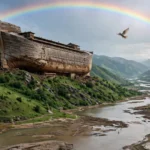
Noah steps out of the ark into a washed world. The ground is unfamiliar, the silence is enormous, and the first thing God does is not give a lecture or assign tasks — he hangs a bow in the sky. “I have set my bow in the cloud, and it shall be a sign of the covenant between me and the earth” (Genesis 9:13). The rainbow’s biblical meaning begins here, and it is richer and stranger than most of us were told as children. It is not merely a pretty promise. It is a warrior’s weapon, deliberately set aside.
The Bow Hung Up: A Warrior’s Weapon Retired
The Hebrew word in Genesis 9 is qeshet — and it means bow as in weapon, the archer’s bow, not the decorative ribbon-loop the English word “rainbow” suggests. Every ancient reader knew what a qeshet was: the instrument of war, drawn against enemies. God’s bow had just been drawn against the earth in the flood — judgment rained down like arrows.
Now God takes that same war-bow and sets it in the clouds — pointed upward, away from the earth, hung up like a soldier hanging his weapon on the wall when the war is over. The rainbow is God’s unilateral disarmament, displayed in the sky for all to see. Every time the clouds gather — the very weather that once meant death — the bow appears as heaven’s reminder: the war is over; I will not do that again.
“When the bow is in the clouds, I will see it and remember the everlasting covenant” (Genesis 9:16). Note the direction of the remembering: I will see it and remember. The sign is given as much for God’s sake as for ours — an anthropomorphic way of saying the promise is anchored in God’s own faithfulness, not in our performance. Covenants in the ancient world were sealed with signs both parties could see; God graciously gives a sign he will watch.
An Everlasting Covenant — With Whom?
The scope of the Noahic covenant is breathtaking: “between me and you and every living creature… for all future generations” (Genesis 9:12). This is not a covenant with Israel — Israel does not exist yet. It is not even a covenant only with humanity — it explicitly includes “every living creature of all flesh” (9:15). The rainbow is God’s promise to the whole created order: never again will water become the instrument of cosmic un-creation.
The terms are one-sided. God binds himself; he requires nothing in return. Noah is not asked to sign, sacrifice, or swear. This is pure grace in covenant form — the first of the great biblical covenants, and the template for all that follow: God commits, God keeps, creatures benefit. When later covenants add human obligations (Abraham’s circumcision, Sinai’s law), the rainbow remains in the background as the unconditional floor beneath them all.
The Rainbow at the Throne
The bow reappears twice more in Scripture, and both times it has moved from the clouds to the throne room. Ezekiel, exiled by the Chebar canal, sees “the appearance of the likeness of the glory of the Lord” — and around it, “like the appearance of the bow that is in the cloud on the day of rain, so was the appearance of the brightness all around” (Ezekiel 1:28). The prophet collapses face-down. The rainbow has become the radiance surrounding God’s glory: mercy encircling majesty.
John’s Revelation completes the picture: “behold, a throne stood in heaven… and around the throne… was a rainbow that had the appearance of an emerald” (Revelation 4:3). In the final vision of all things, at the center of the universe, encircling the throne of the Judge — a rainbow. Judgment is coming in Revelation, real and terrible; but it proceeds from a throne ringed with the sign that God keeps his promises. Even at the end, mercy has the last visual word.
The trajectory is worth tracing: the bow hangs in the clouds (Genesis), surrounds the glory (Ezekiel), and encircles the throne (Revelation). With each appearance it moves closer to the center — as if God’s mercy, once displayed at a distance, keeps drawing nearer until it rings the very seat of power.
Signs, Not Superstitions: How Covenant Signs Work
The rainbow belongs to a family of covenant signs in Scripture, and the family resemblance teaches something important. Circumcision is the sign of the Abrahamic covenant (Genesis 17:11). The Sabbath is the sign of the Mosaic covenant (Exodus 31:13). The rainbow is the sign of the Noahic covenant. In each case, the sign does not create the promise — it marks it, the way a wedding ring marks a marriage without creating it.
This matters because humans constantly reverse the order, treating the sign as the thing itself. But a rainbow has no power to hold back floods; circumcision never saved anyone (Romans 2:25–29); Sabbath-keeping never earned righteousness. The power is always in the Promiser, never in the sign. Signs are God’s gracious concession to forgetful creatures — visible anchors for invisible promises. “I have set my bow in the cloud” is God saying: I know you will fear the next storm, so I am giving your eyes something to hold onto when your faith wavers.
There is pastoral gold here for anxious believers. God does not rebuke Noah for needing a sign; he volunteers one. Divine grace anticipates human weakness and provides for it in advance. Baptism and the Lord’s Supper function the same way in the new covenant — visible, tangible signs of invisible grace, given because God knows we are dust and forget. The rainbow is the first sacrament of reassurance, and it is still administered after every storm.
What the Rainbow Still Preaches
Every rainbow since Noah has been preaching the same sermon to anyone willing to look up:
- God keeps his word. Thousands of storms have gathered since the flood; the bow has appeared in every age, and the waters have never again un-created the world. The sign’s track record is perfect.
- Judgment remembered is judgment restrained. The bow points away from the earth — God’s own reminder to himself, in human terms, that mercy tempers judgment. “Mercy triumphs over judgment” (James 2:13) is rainbow theology in a sentence.
- Beauty follows the storm. The rainbow only appears when sunlight meets rain — physics preaching theology. The most beautiful sight in the sky requires both storm and sun, judgment-water and mercy-light. God’s loveliest works often emerge from the collision of the two.
- Grace precedes law. The rainbow covenant comes before Abraham, before Moses, before every condition. God’s first word to the post-flood world is promise, not demand. That order never changes.
A Note on the Symbol Today
Christians sometimes feel a pang seeing the rainbow used as an emblem for causes Scripture does not endorse. The feeling is understandable — it is like watching a family heirloom used as a decoration by strangers. But the biblical response is not anxiety; it is confidence. No human usage can unwrite Genesis 9. The rainbow’s meaning was fixed by God before any movement adopted it, and it will outlast every movement that does. Symbols borrowed by cultures come and go; the covenant sign remains, preaching its ancient sermon every time light strikes rain.
The right response is not to surrender the symbol but to reclaim its story — to tell children, neighbors, and anyone who will listen what the bow in the cloud actually means: a warrior’s weapon hung up, a promise that outlasts every storm, and a throne at the center of the universe ringed with mercy. That story is bigger than any modern usage, and it was God’s idea first.
The Bow and the Storm: Reading Providence in the Sky
There is a detail in Genesis 9 worth lingering on: the bow appears in the cloud — in the very weather system that once delivered judgment. God does not place his reminder in clear blue skies, where no reminder is needed. He places it in the storm’s aftermath, where fear lives. The theology is precise: God’s reassurances come where the dread is, not where it isn’t.
This is how providence works throughout Scripture. The burning bush appears in Moses’ exile. The still small voice comes to Elijah in his despair (1 Kings 19:12). The angel meets Hagar in the wilderness (Genesis 16:7). God specializes in showing up inside the cloud, not merely after it. So when the next storm gathers — and it will — look for the bow. It may not be in the sky; it may be in a verse that finds you, a friend who calls, a provision that arrives at the last hour. But the pattern holds: in the cloud is where God hangs his promises, because in the cloud is where his people need to see them.
The physics behind the beauty — refraction, reflection, and the optics of sunlight through water — is a marvel in its own right, and the encyclopedia’s article on rainbows explains the science clearly. But the meaning behind the physics was settled long before optics existed: a bow in the clouds, pointed away from the earth, and a God who remembers his covenant every time it appears.