They worked the night shift. Shepherds in first-century Judea were not the storybook figures of stained-glass windows — they were hired hands and poor laborers who slept outdoors, guarded other people’s animals, and ranked low on everyone’s social ladder. They were also, by the standards of religious law, ritually unclean: their work kept them from the synagogue, from the festivals, from the respectability of the observant. When God decided to announce the birth of His Son, He sent the announcement to them first. That choice is the key to everything the Shepherds’ Fields of Bethlehem mean in the Bible.
The fields outside Bethlehem
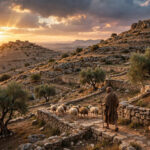
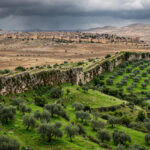
Bethlehem sits about eight kilometers south of Jerusalem, on a ridge in the Judean hills. Its surrounding fields were grazing land, and Luke tells us that on the night Jesus was born, “there were shepherds living out in the fields nearby, keeping watch over their flocks at night” (Luke 2:8). Tradition has identified a particular spot east of the town — the fields near Beit Sahour, where the Church of the Shepherds’ Fields stands today — but Luke gives no precise location. He gives something more important: the time, the workers, and the message.
The timing is worth noting. Shepherds kept their flocks in the open fields during the warmer months, which has led many to conclude that Jesus was probably not born in December. The Bible does not date the birth, and Christians should not be dogmatic about the season. What Luke emphasizes is not the calendar but the contrast: while the town slept and the inn was full, heaven’s announcement went to the fields.
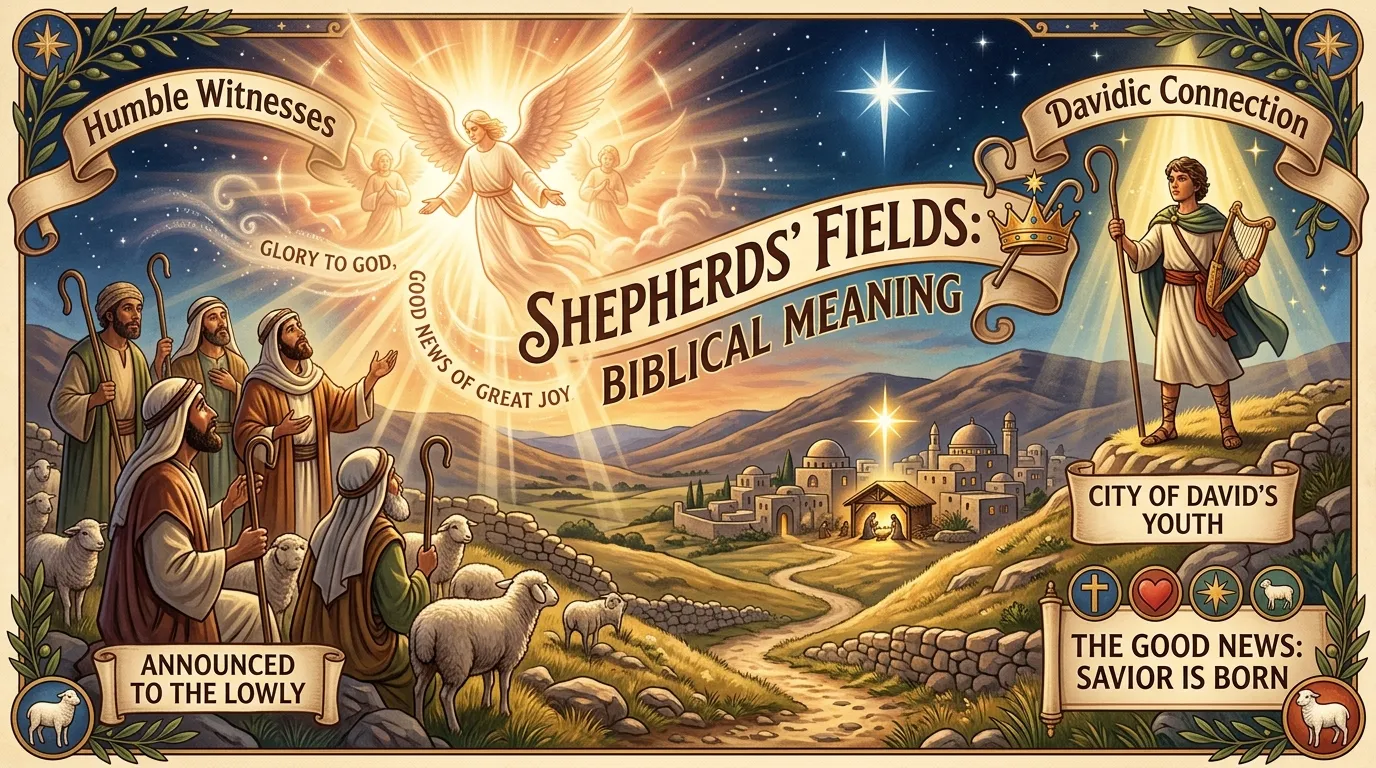
Bethlehem itself carried deep memories. It was the home of Ruth and Boaz, and the birthplace of David, Israel’s shepherd-king. The prophet Micah had foretold that from Bethlehem would come a ruler “whose origins are from of old, from ancient times” (Micah 5:2). The shepherds watching their flocks were working in the pastures of David’s own hometown, in the region where the boy David had once guarded his father’s sheep. The new Shepherd-King was being born in the town of the old one.
Why shepherds? Why not priests or kings?
Luke’s Gospel is built on reversals. The mighty are brought down and the humble are lifted up (Luke 1:52). The announcement to the shepherds is the first of many. God could have sent the angel to the high priest in Jerusalem, to the scholars of the law, or to the palace of Herod. He sent it to men who would have been turned away from the temple courts as unclean.
There is also a practical reason the shepherds mattered. In Jewish law, testimony required witnesses, and the shepherds became the first human witnesses to the incarnation. They saw, they went, and they told. Luke stresses their response: they hurried to Bethlehem, found Mary and Joseph and the baby lying in a manger, and then “spread the word concerning what had been told them about this child” (Luke 2:17). The first evangelists were not apostles or scholars. They were night-shift workers who could not keep good news to themselves.
The shepherds also fit the picture of the Savior they were announcing. Jesus would later call Himself the Good Shepherd who lays down His life for the sheep (John 10:11). The image runs through Scripture: Abel the shepherd, Abraham’s flocks, Moses tending sheep in Midian, David the shepherd-king, and Psalm 23, “The LORD is my shepherd.” When the angels appeared to shepherds, God was quietly declaring what kind of king this child would be — not a king who drives sheep, but one who feeds, guides, and dies for them.
The announcement: glory, fear, and joy
Luke describes the scene with characteristic drama. “An angel of the Lord appeared to them, and the glory of the Lord shone around them, and they were terrified” (Luke 2:9). Fear is the standard human response to glory in the Bible. The angel’s first word is the standard divine answer: “Do not be afraid.” Then comes the message: “I bring you good news that will cause great joy for all the people. Today in the town of David a Savior has been born to you; he is the Messiah, the Lord” (Luke 2:10–11).
Every word of that announcement carries weight. “Good news” is the word from which we get “gospel.” “For all the people” signals that this birth is not for Israel alone, and not for the respectable alone. “Savior” names what the child will do. “Messiah” names who He is in Israel’s story — the anointed King. “The Lord” names His divine identity. In two sentences, the angel gives the whole gospel in miniature.
Then comes the sign: “You will find a baby wrapped in cloths and lying in a manger” (Luke 2:12). The sign is not a palace or a throne. It is poverty. A manger is a feeding trough. The King of kings begins His life in the place where animals eat. And suddenly the single angel is joined by “a great company of the heavenly host,” praising God: “Glory to God in the highest heaven, and on earth peace to those on whom his favor rests” (Luke 2:13–14). Heaven sings over the fields of Bethlehem, and the only audience is a group of shepherds.
The shepherds’ response: hurry, see, tell
The shepherds’ response is a model of faith in three movements. First, they hurry. “Let’s go to Bethlehem and see this thing that has happened, which the Lord has told us about” (Luke 2:15). They do not debate the angel’s theology or wait for a committee. They go. Second, they see. They find things “just as they had been told” — Mary, Joseph, and the baby in the manger. God’s word proved true in the details. Third, they tell. They spread the word, and “all who heard it were amazed” (Luke 2:18).
Then they return, “glorifying and praising God for all the things they had heard and seen” (Luke 2:20). They go back to the same fields, the same flocks, the same night shift. Nothing in their circumstances changes, but everything about their worship does. That is a picture of ordinary Christian life: most believers return to ordinary work after encountering Christ, but they return praising.
The shepherds and the Magi: two kinds of witnesses
Luke’s shepherds are often paired with Matthew’s Magi, and the contrast is instructive. The shepherds were local, poor, and Jewish. The Magi were foreign, wealthy, and Gentile. The shepherds came at night by angelic announcement; the Magi came over months by following a star. The shepherds found a baby in a manger; the Magi found a child in a house and offered gold, frankincense, and myrrh. Together they form the first two witnesses of the incarnation: the lowly and the learned, the near and the far, Israel and the nations. The gospel was never meant for one class or one country. From the first night, it belonged to everyone.
There is also a warning in the pairing. The shepherds hurried and believed. Herod, who also heard the news, tried to kill the child. The same announcement produces worship in some and hostility in others. Luke and Matthew both show that the birth of Jesus divides the world from the very beginning — not between good and bad people, but between those who receive the King and those who resist Him.
Mary’s song and the fields
Before the shepherds ever heard the angel, Mary had already sung the meaning of her child’s birth. In the Magnificat she declares that God “has brought down rulers from their thrones but has lifted up the humble” and “has filled the hungry with good things” (Luke 1:52–53). The announcement in the fields is the Magnificat coming true. The humble are lifted — shepherds become the first heralds. The hungry are filled — the bread of life lies in a feeding trough. Luke wants us to see the shepherds’ story not as a charming detail but as the proof that God does what Mary sang He would do.
What the fields teach Christians today
The Shepherds’ Fields teach that God’s grace moves toward the overlooked. If you feel unnoticed, unqualified, or too ordinary for God to use, you are exactly the kind of person the first Christmas announcement was made for. God did not wait for the shepherds to become respectable. He came to them in the fields, in the dark, in the middle of their work.
The fields also teach that the gospel is for sharing. The shepherds were not theologians, but they told what they had seen. Christians do not need a platform or a title to bear witness; they need a true encounter and a willingness to speak. The shepherds’ testimony was simple — “we saw a baby, just as the angel said” — and it amazed everyone who heard it.
Finally, the fields remind us that the King came in humility. The baby in the manger would grow up to be the Good Shepherd, and the Good Shepherd would lay down His life for the sheep. The glory that shone around the shepherds that night would one day shine from an empty tomb. The announcement in the fields was the beginning of the rescue.
For the geography and history of the town where these events unfolded, readers can consult the Wikipedia article on Bethlehem.