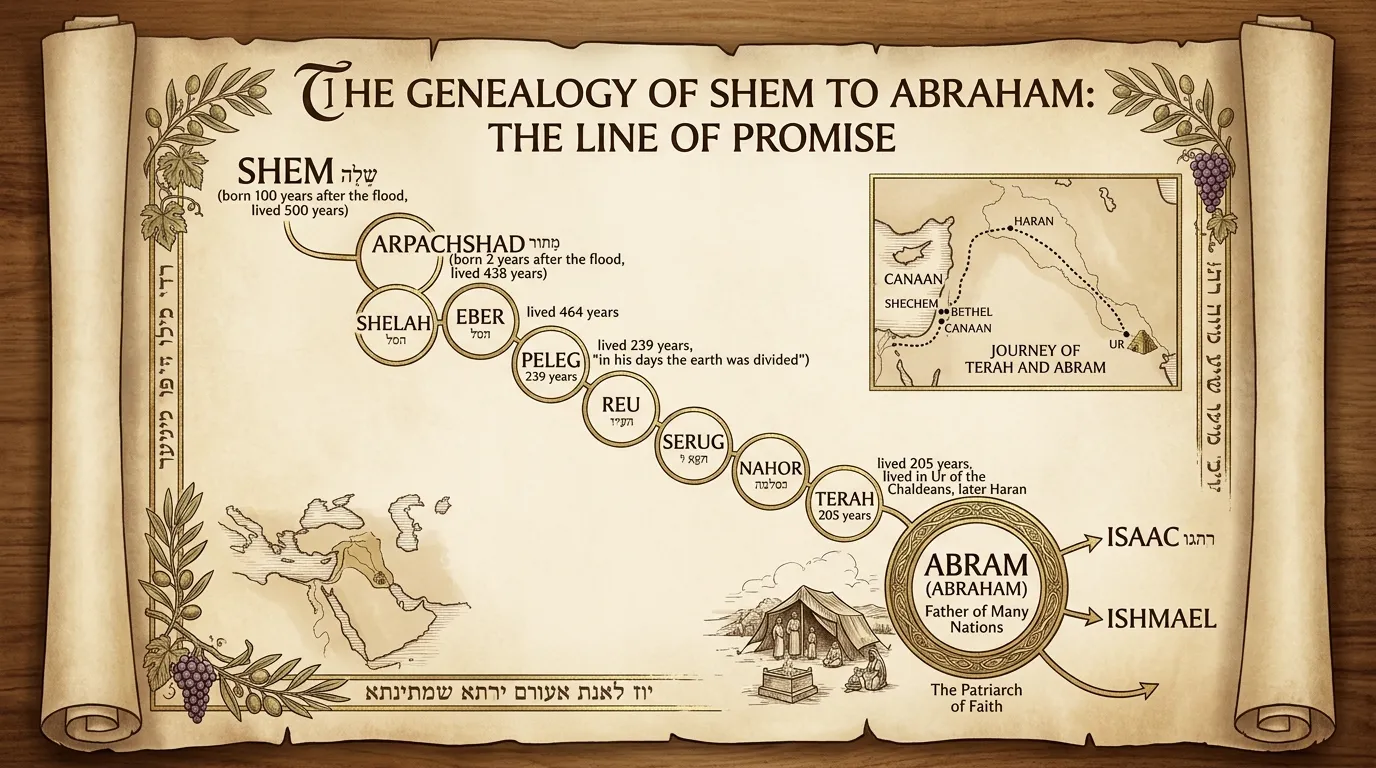
Have you ever looked at a family tree and wondered why certain names are recorded while others are left out? The Bible gives us several family lines like this. One of the most important is the genealogy from Shem to Abraham.
At first, this list of names may seem like a simple record of ancestors. But it carries a deeper message. The Shem to Abraham genealogy meaning in the Bible points to God’s faithfulness, His plan for humanity, and the beginning of the family through which He would continue His covenant promises.
After the flood, the Bible follows the family of Noah’s son Shem. It then moves through several generations until it reaches Abram, who was later called Abraham. This genealogy helps connect the story of Noah with the story of Abraham.
Why does this matter to Christians today?
It reminds us that God often works through generations, families, time, and ordinary people. His promises do not always happen quickly. Sometimes many years pass before we see what God is doing.
The genealogy from Shem to Abraham teaches us that God is faithful to His purposes, even when His plan unfolds slowly.
Let us look at this family line and discover its biblical and spiritual meaning.
Biblical Meaning of Shem to Abraham Genealogy in the Bible

The genealogy from Shem to Abraham is found mainly in Genesis 11:10–26. It comes after the account of the Tower of Babel and before the story of Abram begins.
The basic line is:
Shem → Arpachshad → Shelah → Eber → Peleg → Reu → Serug → Nahor → Terah → Abram
Genesis 11:10 begins with Shem and tells us that Shem was 100 years old when he became the father of Arpachshad, two years after the flood. The genealogy then continues from one generation to another.
Genesis 11:26 says:
“Terah lived seventy years, and fathered Abram, Nahor, and Haran.” — Genesis 11:26
The next chapter begins the story of Abram, whom God later calls Abraham.
Why does the Bible record this genealogy?
The genealogy serves an important purpose. It connects major parts of the biblical story.
Before this family line, we read about:
- Adam and creation
- Noah and the flood
- Shem and his descendants
- The nations after the flood
- The Tower of Babel
Then the story narrows toward one man: Abram.
God tells Abram:
“Go from your country and your kindred and your father’s house to the land that I will show you.” — Genesis 12:1
God then gives Abram a great promise:
“I will make of you a great nation, and I will bless you and make your name great.” — Genesis 12:2
So the genealogy is not just a list of names. It prepares the reader for the calling of Abraham.
Shem and the continuation of God’s plan
Shem was one of Noah’s three sons. After the flood, Noah blessed Shem.
Genesis 9:26 says:
“Blessed be the LORD, the God of Shem.”
The Bible later follows Shem’s family line toward Abraham.
This does not mean that every person in the genealogy was perfect. They were ordinary human beings. The importance of the genealogy is that God was working through their history.
A picture of God’s faithfulness
The Shem-to-Abraham genealogy can also remind Christians that God’s work often happens over a long period.
Shem did not immediately become the father of a great nation. Many generations passed before Abram received God’s covenant promise.
This gives a powerful lesson about patience and faith.
You may pray for something today and not see an answer tomorrow. You may wonder why your life seems to move slowly. The genealogy reminds us that God’s purposes can unfold across time.
Delay does not mean God has forgotten.
From Noah to Abraham
The genealogy also links Noah’s world with Abraham’s world.
Noah lived through the flood and became part of a new beginning for humanity. Shem’s family continued through the generations. Eventually, God called Abram and began a major new chapter in biblical history.
This shows a repeated biblical pattern:
God preserves, God calls, and God fulfills His purposes.
The genealogy therefore has a strong message of hope, continuity, and divine guidance.
Shem to Abraham Genealogy Hebrew Meaning
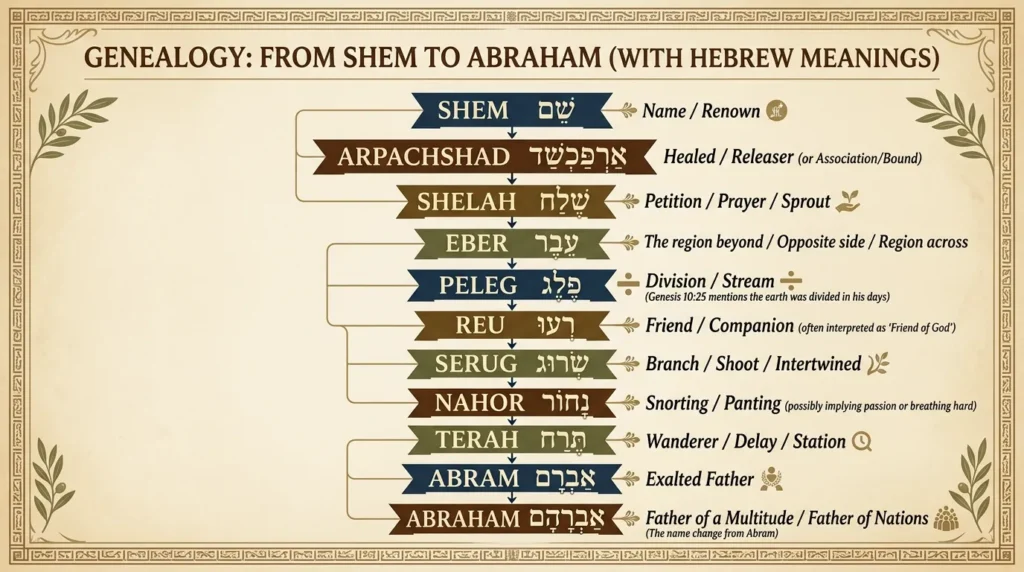
There is no single Hebrew phrase meaning “Shem to Abraham genealogy.” The phrase is a modern description of the biblical family line. However, several names in the genealogy have important Hebrew meanings.
Shem — שֵׁם (Shem)
The Hebrew name Shem is written שֵׁם and generally means “name,” “reputation,” or “renown.”
Shem was one of Noah’s sons.
His name is especially meaningful because the biblical story later focuses on a person whose name would become famous throughout Scripture: Abraham.
Arpachshad — אַרְפַּכְשַׁד (Arpakhshad)
The Hebrew name is commonly transliterated Arpachshad or Arphaxad.
Its exact meaning is uncertain. Bible scholars do not have complete agreement about the origin and meaning of this name.
It is best not to force a spiritual meaning onto a name when Scripture does not clearly provide one.
Shelah — שֶׁלַח (Shelah)
Shelah is another ancestor in the line. The exact meaning of the name is discussed by Hebrew scholars, and its connection to the genealogy is more important than assigning it a symbolic meaning that Scripture does not explicitly give.
Eber — עֵבֶר (Eber)
Eber is written עֵבֶר in Hebrew.
The name is associated with the idea of crossing over or being “beyond,” although the precise relationship between the name and the root is discussed by scholars.
Eber is important because the Hebrew word for Hebrew, ʿIvri (עִבְרִי), is traditionally connected with Eber, although the exact etymology is debated.
Peleg — פֶּלֶג (Peleg)
Peleg’s name has a clearer biblical explanation.
Genesis 10:25 says:
“In his days the earth was divided.”
The name Peleg is related to a Hebrew root connected with division or dividing.
Abram — אַבְרָם (Avram)
Abram’s Hebrew name is אַבְרָם, commonly transliterated Avram.
It is generally understood as meaning “exalted father” or “father is exalted.”
Later, God changes Abram’s name to Abraham:
“No longer shall your name be called Abram, but your name shall be Abraham, for I have made you the father of a multitude of nations.” — Genesis 17:5
The name Abraham is written אַבְרָהָם.
The Bible itself connects the new name with God’s promise to make Abraham the father of many nations.
This name change is a beautiful picture of identity, covenant, and transformation.
The Spiritual Significance and Symbolism of the Genealogy
The spiritual meaning of the Shem to Abraham genealogy is not that every name carries a secret message. Scripture does not tell Christians to use genealogies as codes for predicting the future.
Instead, the genealogy gives several clear spiritual lessons.
God works through generations
The genealogy shows that God’s work is not limited to one lifetime.
One generation follows another. People are born, live, and die, but God’s purposes continue.
This can encourage you when you feel that your own work is small.
You may not see the full result of your faithfulness. But God can use your prayers, choices, kindness, and obedience in ways that reach beyond your lifetime.
God keeps His promises
The story eventually leads to God’s covenant with Abraham.
God promised to bless Abraham and make him a blessing to others.
This promise became central to the biblical story. Abraham became the father of Isaac, Isaac became the father of Jacob, and Jacob’s family became the nation of Israel.
For Christians, Abraham’s story also points toward the wider biblical story of salvation.
Galatians 3:8 says:
“And the Scripture, foreseeing that God would justify the Gentiles by faith, preached the gospel beforehand to Abraham.”
The genealogy is therefore part of the larger story of God’s redemptive plan.
God can begin something new
Abram appears after generations of family history, yet his calling marks a major change.
God tells him to leave his homeland and trust Him.
This teaches an important lesson: sometimes faith means stepping into something new.
You may not know every detail of what comes next. Like Abraham, you can learn to trust God’s direction one step at a time.
Biblical Interpretations in Dreams or Real Life
Some people may see a genealogy, the name Shem, Abraham, or a family tree in a dream and wonder about its biblical meaning.
The Bible does contain dreams through which God sometimes communicated with people. However, Scripture does not say that every modern dream is a divine message.
If you dream about the Shem to Abraham genealogy, a careful Christian approach is to consider themes found clearly in Scripture.
The dream may remind you of:
- Family and heritage
- God’s faithfulness across generations
- A new season of life
- The importance of trusting God’s timing
- Your spiritual roots
- A calling to remember God’s promises
These are possible personal reflections, not guaranteed interpretations.
Do not build major life decisions on a dream alone. Test everything against Scripture, pray for wisdom, and seek mature Christian counsel when needed.
Important Bible Verses About Shem and Abraham
Several passages help explain this genealogy and its importance.
Genesis 9:26 — Noah blesses the Lord, the God of Shem.
Genesis 10:21–31 — The descendants of Shem are listed.
Genesis 11:10–26 — The genealogy from Shem to Abram is given.
Genesis 12:1–3 — God calls Abram and promises to bless him.
Genesis 17:5 — Abram’s name is changed to Abraham.
Matthew 1:1 — Jesus’ genealogy begins by connecting Him with Abraham.
Luke 3:34–36 — Luke’s genealogy traces Jesus’ ancestry through Abraham and earlier generations, including Shem.
Together, these passages show that the genealogy belongs to a much larger biblical story.
A Note About the Genealogy in Genesis and Luke
Readers sometimes notice a difference between the genealogy in Genesis 11 and the genealogy in Luke 3.
Genesis 11:12 moves from Arpachshad to Shelah. Luke 3:36 includes Cainan between Arpachshad and Shelah.
This difference is connected to ancient textual traditions. The Greek Old Testament, known as the Septuagint, includes Cainan in this section, while the traditional Hebrew Masoretic Text does not.
This is worth knowing because it prevents confusion when comparing translations and biblical genealogies.
The main point remains clear: both genealogical traditions connect Shem’s family line with Abraham and place Abraham within the larger history of God’s people.
What the Shem to Abraham Genealogy Teaches Christians Today
The genealogy may seem distant from modern life, but its lessons are surprisingly personal.
Trust God’s timing
The genealogy covers many generations. God’s plan did not unfold in a hurry.
If you are waiting for an answer, remember that God’s timing may be longer than your timeline.
Honor your spiritual heritage
Family history can remind us where we came from. For Christians, Scripture also gives us a spiritual heritage of faith.
Learn from faithful people who came before you, but keep your eyes on God rather than people.
Be faithful in your own generation
You do not need to know what future generations will do.
Your calling is to be faithful today.
Pray. Love others. Read Scripture. Forgive. Serve. Trust God.
Small acts of faith can become part of a much larger story.
Remember that God sees the whole story
We usually see only one part of our lives.
God sees the beginning, middle, and end.
The genealogy from Shem to Abraham reminds us that God sees beyond one moment. What feels ordinary today may have a place in His larger purpose.
Shem to Abraham Genealogy: Key Takeaways
The Shem to Abraham genealogy meaning in the Bible can be summarized in a few simple truths:
- Shem’s family line leads to Abraham.
- The genealogy appears mainly in Genesis 11:10–26.
- It connects the story of Noah with the calling of Abraham.
- It shows the importance of generations and God’s covenant plan.
- The names have Hebrew backgrounds, but not every name has a clearly stated symbolic meaning.
- Abraham’s name change points to identity and God’s promise.
- The genealogy teaches patience, faith, continuity, and hope.
- Modern dream interpretations should remain grounded in Scripture and prayer.
Conclusion
The Shem to Abraham genealogy in the Bible is more than a list of ancient names. It shows how God continued His work through generations until He called Abraham and made a covenant with him.
Its message is simple but powerful: God is faithful, even when His plan takes time.
If you are waiting, growing, or entering a new season, let this genealogy remind you that God sees the whole story. Stay close to Scripture, pray for wisdom, and trust Him one step at a time. His presence can bring hope, peace, and strength even when you cannot yet see what lies ahead.