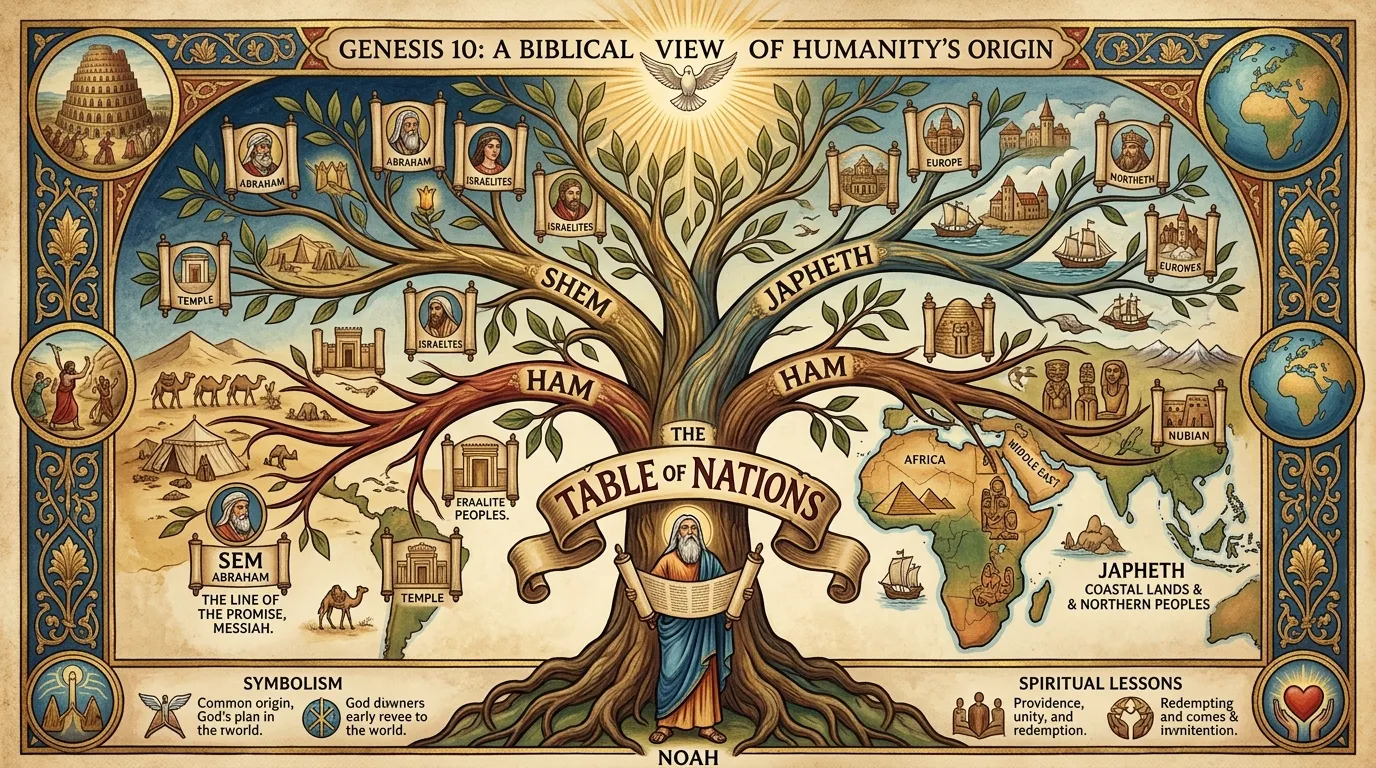
Have you ever looked at a family tree and wondered how many people, places, and stories came before you? The Bible gives us something similar on a much larger scale. In Genesis 10, we find a record of peoples and nations that came from the sons of Noah after the flood.
This passage is often called the Table of Nations. It may look like a long list of names at first, but it carries a deep message about God, humanity, history, and His purpose for the nations.
So, what is the Table of Nations meaning in the Bible?
The Table of Nations shows how the human family spread across the earth after the flood. It traces nations and peoples through Noah’s sons—Shem, Ham, and Japheth. It reminds us that many different nations have a shared human beginning.
More than a genealogy, Genesis 10 helps readers see that God is Lord over every nation. It also prepares the way for the story of Babel in Genesis 11 and later for God’s promise to bless all nations through Abraham.
The passage can therefore teach us about unity, diversity, God’s sovereignty, human pride, and God’s plan of redemption.
Let us look at what this important biblical passage means.
Biblical Meaning of the Table of Nations
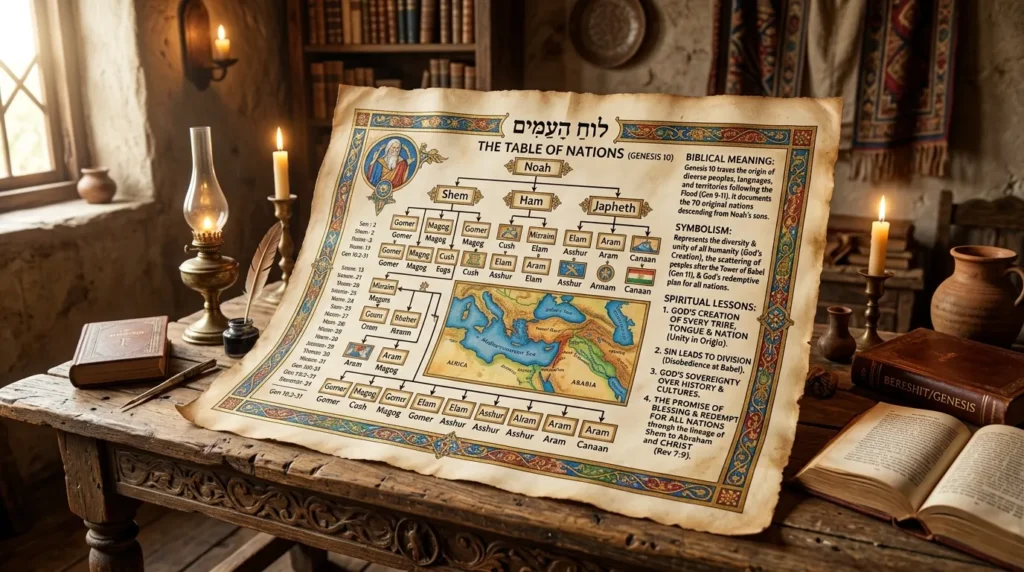
The Table of Nations refers mainly to Genesis 10, where the Bible lists peoples and nations connected to the three sons of Noah: Japheth, Ham, and Shem.
Genesis 10:1 introduces the section:
“Now these are the generations of the sons of Noah, Shem, Ham, and Japheth: and unto them were sons born after the flood.”
The chapter then gives family lines and names connected with different peoples and territories.
The Bible does not use the exact phrase Table of Nations as the title of Genesis 10. It is a traditional name used to describe this chapter.
The three family lines
Genesis 10 organizes the nations through Noah’s three sons.
Japheth is listed first. His descendants are associated with various peoples and lands.
Ham is listed next. His descendants include peoples connected with places such as Egypt, Canaan, and other ancient regions.
Shem appears last. His family line becomes especially important because the genealogy eventually leads toward Abraham, and through Abraham comes the biblical story of Israel and, ultimately, Jesus Christ.
Genesis 10:32 gives an important summary:
“These are the families of the sons of Noah, after their generations, in their nations: and by these were the nations divided in the earth after the flood.”
This verse helps explain the main purpose of the chapter.
It shows the spread of humanity
One important meaning of the Table of Nations is the growth and spread of human communities.
After the flood, Noah’s descendants multiplied. Families became clans. Clans became peoples. Peoples became nations.
The chapter gives us a picture of humanity spreading into different parts of the world.
This reminds Christians that the Bible cares about people groups and nations, not only individual stories.
It shows God’s sovereignty over nations
The Table of Nations also points to God’s authority over human history.
The names in Genesis 10 are not random. They form part of the Bible’s larger story.
God sees nations, families, rulers, migrations, and generations. Human history may seem chaotic, but Scripture repeatedly presents God as sovereign over it.
Acts 17:26 later says that God made every nation of humanity and determined their allotted times and the boundaries of their dwelling places.
This gives the Table of Nations a powerful spiritual lesson:
God is not limited to one family, tribe, or nation. He is Lord over all humanity.
It shows both diversity and common origin
The nations became different from one another, but they shared a common human ancestry through Noah.
This gives the passage an important message about human dignity.
People may have different languages, cultures, lands, and traditions, but the biblical story presents humanity as one human family.
That truth becomes even more meaningful when we read the New Testament.
Revelation 7:9 describes people from:
“all nations, and kindreds, and people, and tongues”
standing before God.
The Bible begins with humanity spreading among nations and ends with people from all nations worshiping God.
It prepares the story of Babel
Genesis 10 is closely connected with Genesis 11.
Genesis 10 describes nations and their families. Genesis 11 then tells the story of the Tower of Babel, where people united around human pride and tried to make a name for themselves.
Genesis 11:4 says:
“Let us build us a city and a tower, whose top may reach unto heaven; and let us make us a name.”
God judged their pride and confused their language.
This does not mean that every nation is evil. Rather, the Babel story warns about human pride and independence from God.
The Table of Nations helps set the stage for this important lesson.
Table of Nations Hebrew Meaning
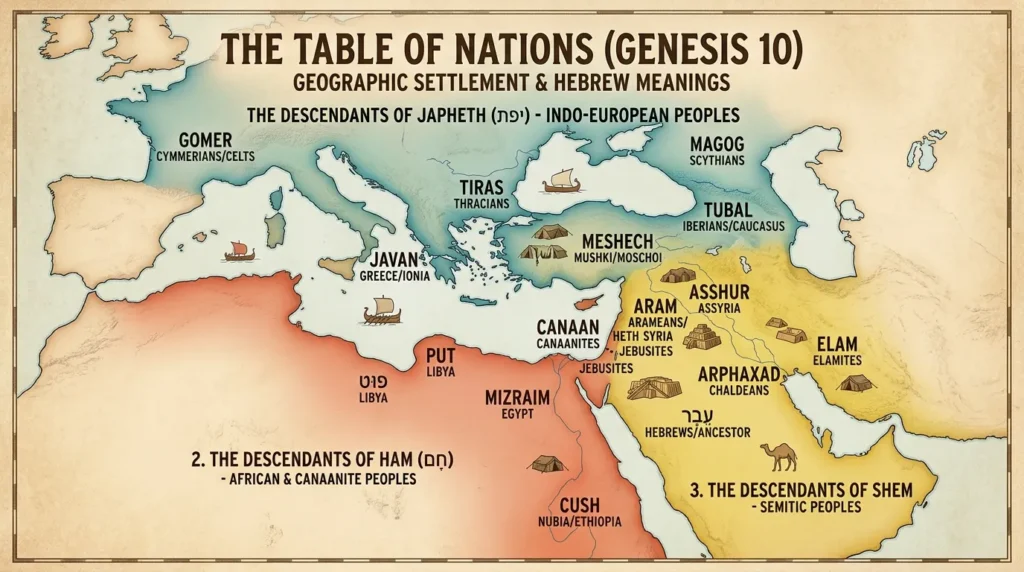
The Table of Nations Hebrew meaning needs a small clarification.
“Table of Nations” is not a direct Hebrew phrase found as the title of Genesis 10. It is an English name given to the chapter because it lists the nations and peoples connected with Noah’s descendants.
One important Hebrew word in Genesis 10 is גּוֹיִם (goyim), usually translated as nations or peoples.
The singular form is גּוֹי (goy), meaning a nation or people.
For example, Genesis 10:5 says:
“By these were the isles of the Gentiles divided in their lands; every one after his tongue, after their families, in their nations.”
The Hebrew concept of goyim is important throughout the Old Testament. It can refer to nations other than Israel, but the word itself does not automatically mean that those people are worthless or rejected by God.
Another important Hebrew term is תּוֹלְדוֹת (toledot), often translated as generations, family history, or descendants.
Genesis 10:1 begins with the familiar biblical formula:
“These are the generations of the sons of Noah…”
The word toledot connects the passage with the larger genealogical structure of Genesis.
So, the Hebrew language of Genesis 10 emphasizes families, generations, peoples, and nations.
That is important because the chapter is not simply a list of countries. It is a record of human family lines and their development into nations.
Spiritual Significance and Symbolism of the Table of Nations
The spiritual meaning of the Table of Nations goes beyond geography and genealogy.
It gives Christians several lessons about God and humanity.
God sees every nation
Sometimes we can feel that our lives are small.
We may wonder whether God notices our family, our struggles, or our future.
Genesis 10 reminds us that God sees the movement of families and nations across generations.
Nothing is outside His knowledge.
Diversity is part of human history
Different nations have different cultures, languages, traditions, and histories.
The Table of Nations shows that this diversity is part of the biblical story.
Christian faith does not require every person to have the same culture. Instead, Scripture points toward people from many nations being united in worship of God.
Human pride can divide
Genesis 11 follows the Table of Nations with Babel.
The warning is clear: humanity can use its abilities for pride instead of obedience.
The desire to build, achieve, and become successful is not automatically wrong. The problem comes when people try to live as though they do not need God.
God’s plan reaches all nations
One of the most beautiful themes connected to the Table of Nations is God’s desire to bless the nations.
God told Abraham:
“In thee shall all families of the earth be blessed.”
— Genesis 12:3
This promise becomes central to the Bible.
The story moves from one human family to many nations, and then toward God’s redemptive work reaching all peoples.
For Christians, this ultimately points toward Jesus Christ and the Great Commission.
Jesus told His followers to:
“Go ye therefore, and teach all nations”
— Matthew 28:19
The biblical story does not end with nations being separated. It moves toward redemption among the nations.
Table of Nations in Dreams or Real Life
Some people may search for the Table of Nations meaning in the Bible because they saw a family tree, many nations, maps, different cultures, or large groups of people in a dream.
The Bible does not give a specific dream interpretation for seeing the Table of Nations.
Therefore, Christians should be careful about claiming that such a dream is definitely a divine message.
A dream about many people or nations could simply reflect things you have recently seen, studied, or thought about.
Still, you can use Scripture as a guide for reflection.
If you dream about many nations, you might prayerfully consider themes such as:
- Unity — Are you being reminded to love people who are different from you?
- Calling — Is God placing concern for others on your heart?
- Family — Are you thinking about your roots or generations?
- Purpose — Are you asking where your life fits into God’s larger plan?
- Pride — Is there an area where you are trying to control everything yourself?
These are personal reflections, not guaranteed biblical interpretations.
The safest approach is to test spiritual impressions against Scripture, pray for wisdom, and avoid building major beliefs on a dream alone.
Bible Verses Connected to the Table of Nations
Several Scriptures help us understand the larger message behind Genesis 10.
Genesis 10:32 shows the nations developing from Noah’s descendants.
“These are the families of the sons of Noah, after their generations, in their nations…”
Genesis 12:3 points toward God’s blessing reaching all families of the earth.
“In thee shall all families of the earth be blessed.”
Acts 17:26 emphasizes God’s sovereignty over humanity:
“And hath made of one blood all nations of men for to dwell on all the face of the earth…”
Matthew 28:19 gives the Christian mission:
“Go ye therefore, and teach all nations…”
Revelation 7:9 gives a beautiful picture of God’s redeemed people:
“Of all nations, and kindreds, and people, and tongues…”
Together, these verses show a powerful biblical movement: one human family, many nations, God’s redemptive promise, and people from every nation coming to Him.
What the Table of Nations Teaches Christians Today
The Table of Nations may seem like an ancient list, but its lessons still matter.
First, it teaches us to value every human life. People come from different backgrounds, but humanity shares a common origin.
Second, it teaches humility. Human achievement is never greater than God.
Third, it teaches hope. God’s plan is bigger than one generation.
Your life is also part of a story that reaches beyond you.
You may not understand everything God is doing today. But Scripture reminds you that God works across generations, families, and nations.
When life feels confusing, pray, read Scripture, and trust God’s timing.
Conclusion
The Table of Nations meaning in the Bible is about much more than a list of ancient names. Genesis 10 shows the spread of humanity through the descendants of Noah and reminds us that God is sovereign over every nation and generation.
It also points toward unity, humility, human diversity, and God’s desire to bless all peoples.
For Christians, this passage fits into the greater story of redemption that leads to Christ and ultimately reaches people from every nation.
If you are searching for guidance today, remember this: your story is known by God. Pray, seek His Word, and trust Him with the generations and the future.