Imagine opening your Bible and finding a long list of names. At first, a genealogy may seem hard to read. You may wonder, “Why does the Bible give so much space to names and family lines?”
The Judah to David genealogy meaning in the Bible is much deeper than a list of ancestors. It tells the story of how God worked through generations to bring His promises forward. From Judah came a family line that led to King David, one of the most important people in the Bible.
This genealogy connects family, promise, faith, leadership, and God’s plan. It also helps explain why David became so important in biblical history and why the New Testament gives special attention to his family line.
The story begins with Judah, one of Jacob’s sons. It moves through Perez and several generations until it reaches David, the shepherd who became king of Israel.
The genealogy teaches a simple but powerful truth: God can work through many generations to fulfill His purpose. What begins with one family member may become part of a much larger story.
Let us look at this family line and discover what the Bible teaches through it.
Biblical Meaning of Judah to David Genealogy in the Bible
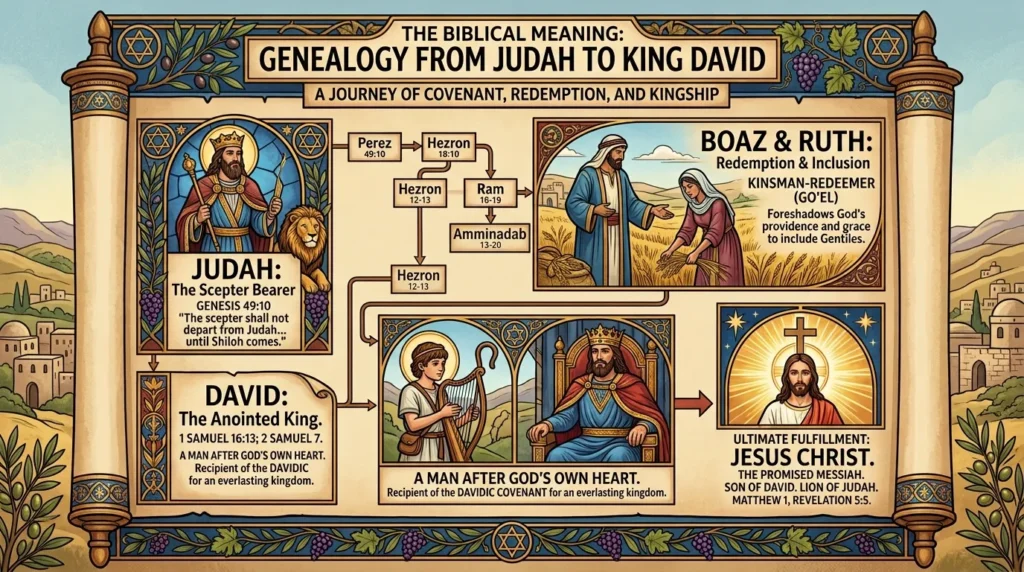
The Judah to David genealogy in the Bible shows a family line that carries great importance in God’s unfolding plan.
A key genealogy appears in Ruth 4:18–22:
“Now these are the generations of Perez: Perez was the father of Hezron, Hezron was the father of Ram, Ram was the father of Amminadab, Amminadab was the father of Nahshon, Nahshon was the father of Salmon, Salmon was the father of Boaz, Boaz was the father of Obed, Obed was the father of Jesse, and Jesse was the father of David.”
This gives the basic line:
Judah → Perez → Hezron → Ram → Amminadab → Nahshon → Salmon → Boaz → Obed → Jesse → David
The story begins with Judah, the fourth son of Jacob and Leah. Judah became the father of the tribe of Judah. Genesis 49:10 speaks of Judah in a way that points to future royal authority:
“The scepter shall not depart from Judah.”
This is important because David later comes from the tribe of Judah.
Judah and the Promise
Judah’s story is not perfect. In Genesis 38, we read about Judah and Tamar. Their son Perez became part of the family line that eventually led to David.
This reminds us that God’s work is not limited to people with perfect pasts. God can bring His purpose through complicated human stories.
Perez became the father of Hezron. The family continued through several generations until it reached David.
From Perez to David
The genealogy in Ruth shows how God’s work continued quietly through ordinary people.
Boaz is especially important. He married Ruth, a Moabite woman who chose to follow the God of Israel. Their son was Obed, who became the father of Jesse. Jesse became the father of David.
This part of the story gives a beautiful message about faith, redemption, and belonging.
Ruth was not born an Israelite, yet she became part of the family line leading to David. Her story shows that God’s grace can reach people from unexpected backgrounds.
David and the Royal Line
David was the youngest son of Jesse. He began as a shepherd but became king of Israel.
The Bible describes David as a man after God’s own heart in Acts 13:22, referring back to the biblical story of David’s relationship with God.
David’s importance goes beyond his own life. God made a covenant with David.
In 2 Samuel 7:12–16, God promised that David’s house and kingdom would have a lasting place in God’s plan.
This makes the genealogy more than a family record. It becomes a record of God’s faithfulness across generations.
The Genealogy Points Toward Jesus
The connection becomes even more important in the New Testament.
Matthew 1:1 begins by calling Jesus:
“the son of David, the son of Abraham.”
Matthew then traces Jesus’ genealogy through David.
Luke also connects Jesus with David’s family line in Luke 3:23–38.
The Bible therefore presents David as an important part of the story leading to Christ. Jesus is repeatedly called the Son of David in the Gospels.
So the biblical meaning of this genealogy includes promise, kingship, covenant, redemption, and God’s long-term plan.
Judah to David Genealogy Chart
The family line can be understood simply:
| Generation | Name | Biblical Significance |
|---|---|---|
| 1 | Judah | Son of Jacob and ancestor of the tribe of Judah |
| 2 | Perez | Son of Judah and Tamar |
| 3 | Hezron | Descendant of Perez |
| 4 | Ram | Ancestor in the Davidic family line |
| 5 | Amminadab | Ancestor of the royal line |
| 6 | Nahshon | Leader of the tribe of Judah |
| 7 | Salmon | Ancestor of David |
| 8 | Boaz | Husband of Ruth |
| 9 | Obed | Son of Boaz and Ruth |
| 10 | Jesse | Father of David |
| 11 | David | King of Israel |
This simple list carries a large spiritual message: God’s purposes can unfold slowly, one generation at a time.
Judah to David Genealogy Hebrew Meaning
There is no single Hebrew phrase that directly means “Judah to David genealogy.” The expression describes a biblical family line. However, the Hebrew meanings of several important names add depth to the story.
Judah
The Hebrew name for Judah is יְהוּדָה (Yehudah).
It is connected with the Hebrew root ידה (yadah), associated with praise, thanksgiving, or giving thanks.
Genesis 29:35 connects Judah’s name with Leah’s declaration of praise to the Lord.
This makes Judah’s name especially meaningful. The family line that eventually reaches David begins with a name associated with praise.
Perez
Perez is written פֶּרֶץ (Perets).
The name is related to the idea of breaking through or making a breach.
Genesis 38:29 explains the name in connection with the unusual circumstances of his birth.
The idea of a breakthrough can provide a useful biblical picture, but we should not turn the name into a personal prophecy. The Bible’s main message is found in the actual story and Scripture.
David
David is written דָּוִד (Dawid).
The name is commonly understood as meaning “beloved.”
David’s name becomes important because he was chosen by God to serve as king. His life included great victories, deep worship, serious failures, repentance, and God’s continued work in his life.
The Hebrew meanings of these names can enrich our reading, but the main biblical meaning comes from the context of Scripture, not from trying to create hidden messages from every name.
Spiritual Significance and Symbolism
The spiritual meaning of Judah to David genealogy centers on God’s faithfulness.
A genealogy teaches us that God’s work often takes time.
We may want quick answers. We may pray today and expect something to change tomorrow. But the genealogy from Judah to David covers many generations.
God Works Through Generations
One of the strongest lessons is patience.
Judah did not see everything that would happen through his descendants. Perez did not see David. Jesse did not know all that David’s life would mean for future generations.
Yet God continued His work.
Your life may also be one part of a story that is bigger than you can see.
God Uses Ordinary People
Many names in the genealogy are not people whose stories receive much attention.
This reminds us that every generation matters.
You do not need to become famous for your life to have meaning before God.
Faithfulness in small things can matter greatly.
God Brings Hope From Difficult Stories
The genealogy also contains difficult family history.
Judah’s story with Tamar was complicated. Ruth came from Moab. David himself had serious failures.
Yet God continued His redemptive work.
This does not mean that sin is unimportant. Scripture takes sin seriously. It means that human failure does not make God powerless.
God can bring redemption where people see only brokenness.
God Keeps His Promises
The journey from Judah to David also points toward God’s covenant promises.
David’s royal line becomes part of the biblical expectation of a coming king. The New Testament identifies Jesus as the Son of David.
This gives the genealogy a message of hope.
God’s promises may take longer than we expect, but Scripture repeatedly calls believers to trust His faithfulness.
Biblical Interpretations in Dreams or Real Life
Some people may see the names Judah, David, or a genealogy in a dream and wonder about the biblical meaning.
The Bible does contain dreams that God used to communicate with people. However, not every dream is a divine message.
If you dream about a family tree, Judah, David, or a long line of ancestors, you can reflect on biblical themes such as heritage, faith, purpose, leadership, promise, and spiritual growth.
For example, a family tree might remind you to pray for your family. A dream about David might bring thoughts of courage, worship, repentance, or leadership. Judah may remind you of praise and God’s faithfulness.
Still, these are personal reflections, not guaranteed biblical interpretations.
The safest approach is to compare any spiritual impression with Scripture, pray for wisdom, and avoid making major decisions based only on a dream.
As 1 Thessalonians 5:21 teaches, believers should test things carefully.
Practical Lessons and Faith Insights
The Judah to David genealogy gives us simple lessons for daily life.
Be patient with God’s timing. His work may take longer than you expect.
Stay faithful in your generation. You may not see the full result of your obedience.
Remember God’s grace. Your past does not have to be the end of your story.
Read Scripture carefully. Biblical genealogy is not just a list of names. It can reveal God’s covenant, faithfulness, and redemptive plan.
Above all, pray for guidance and trust God rather than searching for hidden meanings everywhere.
Bible Verses About Judah, David, and Their Genealogy
Several passages help explain this family line and its importance:
- Genesis 49:10 — Judah is connected with royal authority.
- Ruth 4:18–22 — Gives the genealogy from Perez to David.
- 1 Chronicles 2:3–15 — Provides an important genealogy leading to David.
- 1 Samuel 16:1–13 — Describes David’s anointing.
- 2 Samuel 7:12–16 — Records God’s covenant with David.
- Psalm 89:3–4 — Speaks about God’s covenant with David.
- Matthew 1:1–17 — Connects Jesus with Abraham and David.
- Luke 3:23–38 — Gives the genealogy of Jesus.
- Acts 13:22–23 — Connects David’s line with God’s promise concerning Jesus.
These passages show why the Judah to David genealogy in the Bible matters within the larger biblical story.
What Does the Judah to David Genealogy Teach Christians Today?
The genealogy teaches that God’s plan is bigger than one moment.
Judah could not see David. David could not see the full story of Christ’s coming. Yet each generation had a place in the story recorded in Scripture.
This can give Christians hope.
You may not understand everything happening in your life today. You may not see how your prayers, choices, struggles, or acts of faith will affect tomorrow.
But Scripture reminds us that God sees the whole story.
The genealogy also teaches us not to judge a person’s entire story by one chapter. The Bible includes people with weakness, mistakes, and difficult histories. Yet God still calls people to repentance, faith, and faithful living.
There is hope in God’s ability to redeem.
Final Thoughts
The Judah to David genealogy meaning in the Bible is a message of faithfulness, promise, grace, and hope. It begins with Judah, passes through Perez and many generations, and reaches David, Israel’s great king.
The story reminds us that God often works quietly over time. His purposes may pass through generations before their full meaning becomes clear.
If you are waiting for God today, do not lose heart. Trust His timing, stay close to Scripture, and keep praying. The God who remained faithful through the generations is still worthy of your faith and hope.