Imagine waking up one morning with a strong feeling that something important is coming. You may have heard a sermon about the end times, read a Bible prophecy, or even had a dream that made you think about the future. Your heart may feel both curious and uneasy.
You may then ask, What does end times fulfillment mean in the Bible?
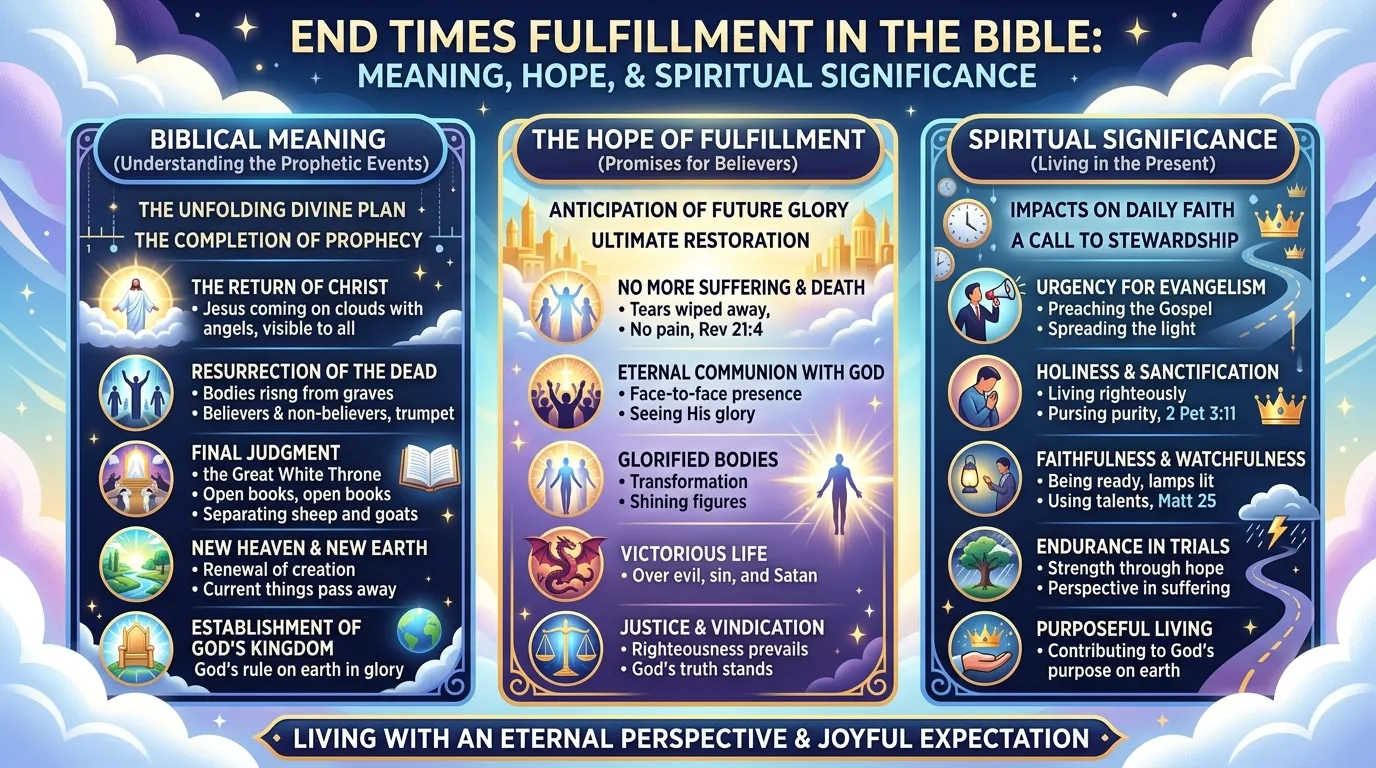
The Bible speaks often about the return of Christ, the fulfillment of prophecy, God’s judgment, the resurrection, and the final restoration of creation. These teachings are not meant only to make people think about frightening events. They also point to hope, God’s faithfulness, justice, and the promise of eternal life.
The phrase end times fulfillment meaning in the Bible refers to the way God’s prophetic promises reach their intended completion in His plan for humanity and creation. Some prophecies have already been fulfilled, while other promises point toward events still to come.
Understanding this subject can help Christians look beyond fear and focus on faith, readiness, prayer, and hope. To understand it clearly, we must begin with what Scripture actually teaches.
Biblical Meaning of End Times Fulfillment

In the Bible, end times fulfillment is connected with the completion of God’s purposes. Scripture describes a time when God’s promises, prophetic words, judgment, salvation, and restoration will reach their appointed conclusion.
The Bible does not present the end as simply the destruction of everything. It presents the future as a time when God’s authority and justice will be fully revealed.
Jesus spoke about the end of the age in Matthew 24. He warned His followers about deception, wars, suffering, persecution, and spiritual danger. Yet He also told them to remain faithful. In Matthew 24:44, Jesus teaches His followers to be ready because the Son of Man will come at an unexpected time.
This gives an important lesson about biblical fulfillment. The purpose of prophecy is not to create panic. It is to call people to faithfulness.
Fulfilled Prophecy and Future Fulfillment
Some biblical prophecies have already been fulfilled.
For Christians, one of the clearest examples is the coming of Jesus Christ. The Old Testament contains promises about the Messiah, and the New Testament presents Jesus as their fulfillment. His birth, ministry, suffering, death, and resurrection are understood by Christians as part of God’s prophetic plan.
Luke 24:44 records Jesus explaining that the things written about Him in the Law of Moses, the Prophets, and the Psalms had to be fulfilled.
Other biblical passages point toward future events. These include the return of Christ, resurrection, final judgment, and restoration of creation.
Revelation 21:1 describes a new heaven and a new earth. This gives Christians a powerful picture of God’s final restoration.
The Meaning of Fulfillment
Biblical fulfillment means more than an event simply happening.
It means that God completes what He has promised.
For example, Philippians 1:6 teaches that God, who began a good work in His people, will carry it on to completion. This principle reflects God’s faithfulness.
End times fulfillment therefore reminds believers that history is not meaningless. Scripture presents God as working toward a final purpose.
Hope Instead of Fear
End times passages can sound frightening. The Bible does speak about judgment and difficult events. However, the Christian message does not end with fear.
For believers, the return of Christ is also a message of hope.
Titus 2:13 describes the Christian expectation as the “blessed hope” of the appearing of Jesus Christ. First Thessalonians 4:16–18 describes Christ’s return and ends with an encouragement to comfort one another with these words.
The biblical meaning of end times fulfillment is therefore closely connected with hope, faith, perseverance, justice, salvation, and God’s presence.
God’s Timing Matters
Another important lesson is that Christians are not given permission to set exact dates for Christ’s return.
Jesus said in Matthew 24:36 that no one knows the day or hour.
This means Christians should be careful with predictions about specific dates, political events, or modern headlines. Scripture calls believers to watchfulness without fear.
The focus should not be, “Can I predict the exact day?”
The better question is, “Am I living faithfully before God today?”
End Times Fulfillment Hebrew Meaning

The phrase end times fulfillment does not have one single Hebrew word or phrase in the Old Testament. It is a modern English expression that combines two ideas: the end times and the completion of God’s prophetic purposes.
However, an important Hebrew expression connected with the end times is אַחֲרִית הַיָּמִים (acharit hayyamim).
The phrase acharit hayyamim is commonly translated as “latter days,” “last days,” or “days to come,” depending on the context.
The Hebrew word אַחֲרִית (acharit) can refer to the end, latter part, outcome, or final stage. יָמִים (yamim) means “days.”
This expression appears in passages such as Genesis 49:1, Isaiah 2:2, and Micah 4:1.
Isaiah 2:2 speaks of something that will happen “in the latter days.” Micah 4:1 uses similar language when describing the future exaltation of the mountain of the Lord.
These passages show that the biblical idea of the end times is connected with God’s future work and His ultimate purposes.
Another important passage is Daniel 12. Daniel receives a vision about events connected with the end and is told about a future resurrection and a time of great trouble.
The Hebrew Bible therefore gives us the foundation for understanding the last days, even though the exact English phrase “end times fulfillment” is not a direct Hebrew expression.
It is important not to force a Hebrew meaning onto the phrase. The safest approach is to study the actual biblical words and their contexts.
Spiritual Significance and Symbolism
The spiritual meaning of end times fulfillment goes beyond studying future events. It teaches Christians how to live in the present.
Faithfulness
End times teaching calls believers to remain faithful.
Jesus repeatedly warned His followers about deception. This means Christians should know Scripture and avoid accepting every spiritual claim they hear.
Faith grows through truth.
Spiritual Awakening
Thinking about Christ’s return can awaken a person spiritually.
Someone may begin asking:
Am I close to God?
Am I forgiving others?
Am I living according to Scripture?
Am I trusting God with my future?
These questions can lead to healthy spiritual growth when they move a person toward prayer, repentance, love, and obedience rather than fear.
Hope
The end times point toward the hope of God’s final victory.
Revelation 21:4 gives a beautiful picture of a future in which God wipes away every tear and death, mourning, crying, and pain are no more.
This is one of the strongest reasons Christians should view biblical prophecy through the lens of hope.
The story does not end with suffering.
It ends with God’s restoration.
God’s Justice
End times fulfillment also points to divine justice.
Many people experience unfairness in this world. Some suffer without seeing justice. Biblical teaching about final judgment reminds Christians that God sees what people cannot see.
Romans 12:19 teaches believers not to take revenge but to leave room for God’s judgment.
This can bring peace to a wounded heart.
Transformation
The end times also remind believers that God is working toward transformation.
Second Peter 3:13 speaks of looking forward to a new heaven and a new earth where righteousness dwells.
The Christian hope is not simply escaping the world. It includes God’s ultimate renewal and restoration.
Biblical Interpretations in Dreams or Real Life
Sometimes people encounter end times themes in dreams. They may dream about earthquakes, darkness, trumpets, fire, judgment, the return of Jesus, or a world-changing event.
A dream about the end of the world does not automatically mean that a specific biblical prophecy is about to happen.
The Bible contains examples of meaningful dreams and visions, but it also teaches believers to test spiritual claims carefully. First John 4:1 says to test the spirits to see whether they are from God.
If someone dreams about end times events, the experience may lead them to reflect on fear, change, uncertainty, spiritual growth, or their relationship with God. From a Christian perspective, the safest response is prayer and Scripture rather than immediate prediction.
For example, a dream about judgment might encourage personal reflection. A dream about light after darkness might remind someone of God’s hope. A dream about Christ’s return might encourage readiness and faith.
These are personal interpretations, not guaranteed messages from God.
Scripture remains the final foundation for Christian belief.
Practical Lessons and Faith Insights
If the subject of end times fulfillment makes you anxious, return to simple biblical truths.
Pray regularly.
Read Scripture in context.
Stay close to Christ.
Do not chase predictions or sensational claims.
Practice love, forgiveness, and obedience.
Trust God’s timing.
Most importantly, remember that Christian readiness is not about knowing every detail of the future. It is about faithfully following God today.
Important Bible Verses About End Times Fulfillment
Several passages can help you study this subject more deeply.
Matthew 24:44
Jesus teaches His followers to be ready because the Son of Man will come at an unexpected time.
Lesson: Live with faithful readiness rather than fear.
1 Thessalonians 4:16–18
Paul describes the return of Christ and encourages believers to comfort one another.
Lesson: Christ’s return is a source of Christian hope.
Titus 2:13
Paul calls believers to wait for the blessed hope connected with the appearing of Jesus Christ.
Lesson: The future should strengthen hope.
Daniel 12:2
Daniel speaks about resurrection and a future time connected with God’s final purposes.
Lesson: Biblical prophecy includes the hope of resurrection and God’s final justice.
Revelation 21:1–4
John describes a new heaven and a new earth and a future without death, mourning, crying, or pain.
Lesson: God’s final purpose includes restoration and peace.
2 Peter 3:13
Peter points believers toward the promise of a new heaven and new earth where righteousness dwells.
Lesson: Christians can look forward to God’s righteous renewal.
End Times Fulfillment and Christian Belief
Different Christian traditions understand some end times passages in different ways.
Some Christians interpret certain prophecies more literally. Others understand parts of prophetic literature symbolically. Some see certain passages as having both an earlier fulfillment and a future fulfillment.
These differences are important to recognize.
The Bible is clear about central Christian hope: Jesus Christ will return, God will judge with justice, the dead will be raised, and God will bring His purposes to completion.
However, Christians may disagree about the exact order or timing of certain events.
This is why humility matters.
A believer does not need to understand every detail of Revelation to trust God.
The heart of Christian faith is not a perfect end times chart.
It is faith in Jesus Christ.
What Does End Times Fulfillment Mean for Your Life?
The subject becomes meaningful when it changes how we live today.
If you believe Christ will return, you can choose to live with greater love and faithfulness.
If you believe God will bring justice, you can resist the desire for revenge.
If you believe God will restore creation, you can hold onto hope during difficult seasons.
If you believe God’s promises will be fulfilled, you can trust Him even when you cannot see what He is doing.
The end times are not only about what will happen someday.
They also ask us how we will live today.
Jesus calls His followers to remain watchful, faithful, loving, and ready.
That is a message of spiritual growth, not constant fear.
Conclusion
The end times fulfillment meaning in the Bible points to God’s faithfulness and His final purpose for creation. Scripture speaks about the return of Christ, resurrection, judgment, restoration, and eternal hope. The Hebrew expression acharit hayyamim, or “latter days,” helps explain the biblical language behind the idea of the end times.
While some details remain debated, the central message is clear: God keeps His promises.
If end times passages make you afraid, return to Scripture and prayer. Trust God’s timing, keep your faith strong, and remember the hope found in Christ. The future belongs to God, and His final word is not fear but hope, restoration, and His presence with His people.