Imagine being asked to do something deeply personal—not because you have to earn God’s love, but because you want to help others hear the truth. That is part of the story behind the circumcision of Timothy meaning in the Bible.
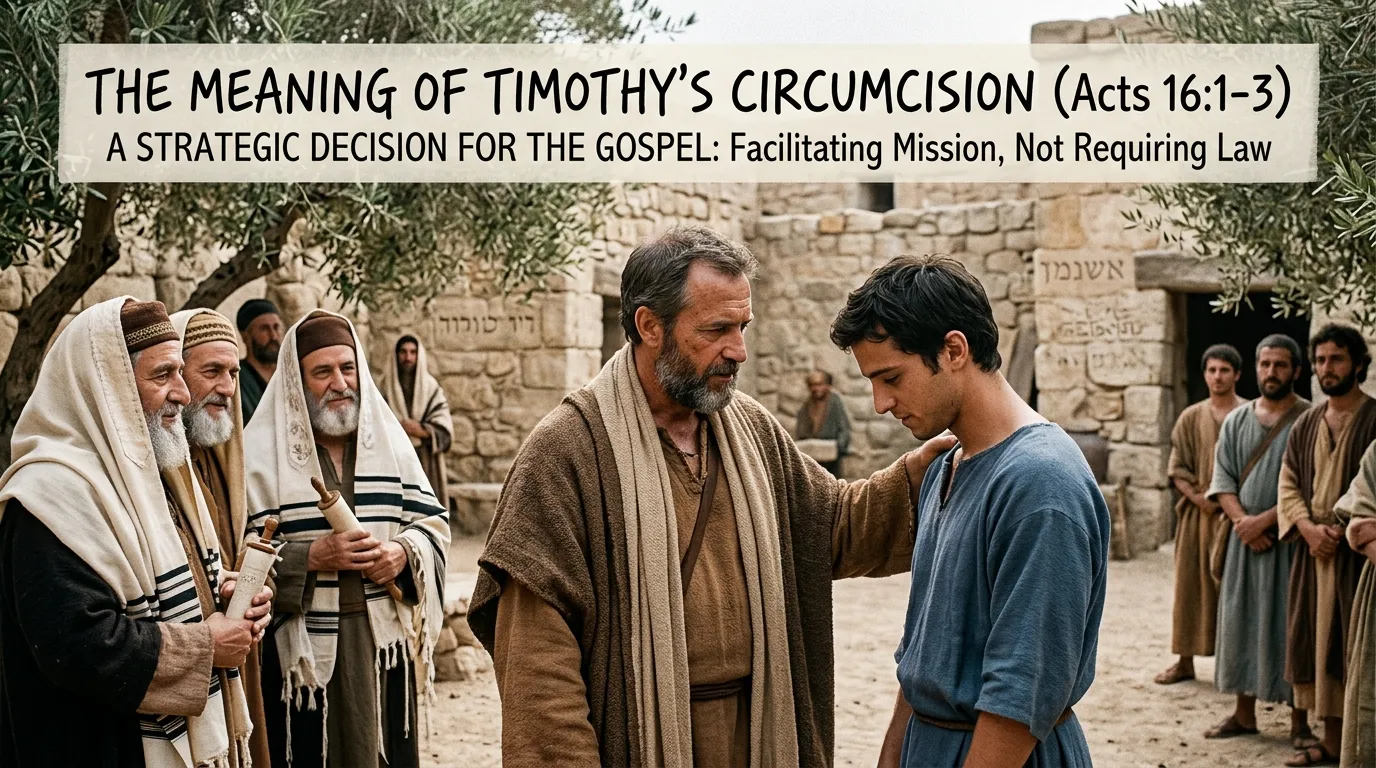
In Acts 16, Timothy joined Paul and Silas on a mission to share the gospel. Timothy already believed in Christ, yet Paul had him circumcised because of the Jewish people in the places where they would minister. At first, this may seem strange. If salvation comes through faith in Jesus, why was circumcision necessary?
The answer teaches an important lesson about faith, wisdom, Christian freedom, love, and serving others.
The Bible does not say Timothy was circumcised to become saved. Instead, the passage shows how Paul removed a cultural barrier so Timothy could serve among Jewish people more effectively. His story also helps Christians understand the difference between doing something for the sake of ministry and doing something because we think God requires it for salvation.
What Is the Circumcision of Timothy in the Bible?
The story appears in Acts 16:1–3. Paul came to the region of Derbe and Lystra, where he met a young disciple named Timothy.
Timothy had a Jewish mother who was a believer and a Greek father. The believers in the area spoke well of Timothy, and Paul wanted him to travel with him.
Acts 16:3 says that Paul circumcised Timothy because of the Jews who lived in those areas, since they all knew that Timothy’s father was Greek.
This detail is very important.
The text does not say that Timothy needed circumcision to receive salvation. Timothy was already a disciple. His circumcision was connected with his ministry among Jewish people.
Paul understood that Timothy’s family background could create questions or suspicion among Jews who knew him. By being circumcised, Timothy removed a possible obstacle to the work of the gospel.
Timothy Was Already a Believer
Acts 16 introduces Timothy as a disciple. This means the circumcision happened after Timothy had become a follower of Christ.
This gives us an important biblical distinction:
Timothy was not circumcised so that God would accept him. He was circumcised so that his ministry would not create an unnecessary barrier among the people he was trying to reach.
This fits Paul’s wider teaching about salvation.
Galatians 5:6 teaches that in Christ, what matters is faith working through love. Physical circumcision does not give a person spiritual righteousness.
Paul strongly opposed the idea that Gentile Christians had to be circumcised in order to be saved. Galatians 5:2–4 makes this especially clear.
Therefore, Timothy’s circumcision should not be used to teach that Christians today must be circumcised for salvation.
Why Did Paul Circumcise Timothy?
The simple answer is for the sake of ministry.
Timothy’s mother was Jewish, while his father was Greek. Because of his family background, Jewish people knew that Timothy’s father was a Greek.
Paul knew that this could become a stumbling block when Timothy entered Jewish communities to preach about Jesus.
Paul himself explained this kind of ministry wisdom in 1 Corinthians 9:19–23. He described becoming like a Jew to those under the law and like one outside the law to those outside the law—not because he changed the gospel, but because he wanted to reach people.
Paul’s goal was not to please everyone at the cost of truth.
His goal was to remove unnecessary barriers while keeping the truth of the gospel intact.
Timothy’s Circumcision Was Not About Earning Salvation
This is one of the most important points in the story.
The New Testament teaches that people are saved by God’s grace through faith in Jesus Christ, not by religious rituals.
Ephesians 2:8–9 explains that salvation is God’s gift and is not something we earn through works.
So Timothy’s circumcision should never be understood as a payment for salvation.
It was a practical choice connected with his mission.
This distinction protects us from two opposite errors:
- Thinking religious actions can earn God’s love.
- Thinking Christian freedom means we never need to sacrifice our preferences for others.
Timothy’s story shows a better way: grace gives us freedom, and love teaches us how to use that freedom wisely.
Circumcision of Timothy Meaning in the Bible: The Main Spiritual Lesson
The story of Timothy carries several spiritual lessons for Christians today.
Love Sometimes Requires Personal Sacrifice
Timothy was willing to experience something personal for the sake of his ministry.
The Bible does not tell us that Timothy complained about this decision. Instead, the story presents him as someone prepared to serve alongside Paul.
This reminds Christians that serving God may sometimes require giving up a personal preference.
Maybe it means changing your plans to help someone.
Maybe it means listening patiently when you would rather speak.
Maybe it means giving up a freedom because your choice could unnecessarily hurt or confuse another believer.
Christian maturity asks not only, What am I allowed to do? but also, How can I love others well?
Christian Freedom Should Be Guided by Love
Paul taught Christian freedom clearly, but he also taught Christians to consider others.
In 1 Corinthians 10:23–24, Paul explains that not everything permissible is necessarily helpful. He tells believers to seek the good of others rather than simply their own advantage.
Timothy’s story gives us a real-life example of this principle.
His circumcision did not make him more saved. It helped him serve people in his mission.
That is an important difference.
Wisdom Removes Unnecessary Obstacles
The gospel itself should never be changed to make people comfortable.
However, Christians can remove unnecessary obstacles that have nothing to do with the truth of Scripture.
For example, a Christian may choose to learn another person’s culture before sharing the gospel. Another believer may change a communication style so that people can understand the message more clearly.
These choices do not weaken biblical truth.
They can show wisdom, humility, and love.
Timothy’s Circumcision and the Jerusalem Council
To understand Acts 16 better, it helps to look at the events of Acts 15.
The early church faced a major question: Did Gentile believers have to be circumcised and keep the Law of Moses to be saved?
The apostles and church leaders gathered in Jerusalem to discuss this issue.
Acts 15:10 warns against placing a yoke on believers that they could not bear. In Acts 15:11, Peter declares that both Jews and Gentiles are saved through the grace of the Lord Jesus.
The council did not require Gentile Christians to be circumcised for salvation.
This makes Timothy’s situation even clearer.
Timothy and Titus Give an Important Contrast
Another helpful comparison is Titus.
Galatians 2:3 says that Titus, a Greek believer, was not forced to be circumcised. Paul refused to allow circumcision to become a requirement for salvation and Christian freedom.
So why was Timothy circumcised?
Because Timothy’s situation was different.
Timothy was entering Jewish communities where his family background was known. His circumcision helped prevent an unnecessary cultural barrier.
Titus’s situation involved people trying to make circumcision a requirement for salvation.
The principle is powerful:
Paul could accept circumcision as a voluntary ministry choice, but he rejected circumcision as a requirement for salvation.
Circumcision of Timothy Meaning in the Bible + Hebrew Meaning
The Old Testament background of circumcision is important because it helps explain why the practice carried such deep meaning among Jewish people.
The common Hebrew word connected with circumcision is מול (mul), meaning to circumcise. The noun מילה (milah) is also associated with circumcision. The well-known expression brit milah means covenant of circumcision.
God first commanded circumcision as a covenant sign to Abraham in Genesis 17.
Genesis 17:10–11 describes circumcision as a sign of the covenant between God and Abraham and his descendants.
This was more than a physical practice. It marked membership in the covenant community of Israel.
Circumcision as a Covenant Sign
In Genesis 17, God promised Abraham that He would establish His covenant with him and his descendants.
Circumcision became the physical sign associated with that covenant.
The practice continued throughout Israel’s history and became closely connected with Jewish identity.
This explains why Timothy’s physical circumcision mattered culturally.
His Jewish mother gave him a Jewish family connection, but his Greek father meant his background was mixed. Among Jewish communities, his circumcision could remove a question that might otherwise distract from his ministry.
The Bible Also Speaks of Circumcision of the Heart
The Old Testament moves beyond physical circumcision and uses the idea of circumcision in a spiritual way.
Deuteronomy 10:16 calls God’s people to circumcise their hearts and stop being stubborn toward God.
Jeremiah 4:4 similarly calls God’s people to circumcise themselves to the Lord and remove the evil of their hearts.
These passages show that God has always cared about more than an outward sign.
He wants an obedient and faithful heart.
The New Testament continues this theme. Romans 2:28–29 explains that true spiritual identity is not merely outward. Paul points to the work of the Spirit in the heart.
Therefore, the deeper biblical lesson is not simply about the body.
It is about belonging to God, trusting Him, and allowing Him to change the heart.
What Does Timothy’s Circumcision Teach About God’s Grace?
Timothy’s story helps us see that God’s grace does not make obedience meaningless.
Instead, grace changes why we obey.
A person who believes that religious actions earn salvation may obey because of fear or pride.
A person who understands grace can obey from love and gratitude.
Timothy did not need circumcision to make Jesus love him.
He was already a disciple.
His choice was connected with his calling to serve.
That distinction can bring freedom to Christians today.
You do not have to earn God’s love. You respond to God’s love through faithful living.
What Can Christians Learn From Timothy’s Example?
Timothy’s experience offers practical lessons for everyday Christian life.
Put the Gospel Above Personal Preference
There are times when our preferences are not the most important thing.
A Christian may prefer one style of worship, one type of music, or one way of communicating. Yet serving others may require flexibility.
Romans 14:19 encourages believers to pursue things that promote peace and build others up.
The question becomes:
Will my choice help people come closer to Christ, or will it create an unnecessary wall?
Do Not Confuse Culture With the Gospel
The gospel does not depend on one culture.
Jesus came for people from every nation and background.
Acts 16 itself shows the early church crossing cultural lines.
Timothy’s story reminds us that Christians can adapt to cultural settings without changing biblical truth.
That takes both wisdom and humility.
Let Love Guide Your Freedom
Christian freedom is not permission to ignore everyone else.
Paul’s teaching in 1 Corinthians shows that love should guide how believers use their freedom.
Sometimes the loving choice is to give something up.
Sometimes the loving choice is to stand firm.
Wisdom is knowing the difference.
What Does Timothy’s Circumcision Mean for Christians Today?
Christians today should not read Acts 16 as a command to undergo circumcision in order to become acceptable to God.
The New Testament does not teach that physical circumcision is required for Christian salvation.
Galatians 5:6 points believers back to faith working through love, while Romans 10:9–10 emphasizes faith in Christ.
The lesson is therefore about the heart and the mission.
Ask yourself:
- Am I willing to sacrifice a preference to help someone?
- Do I care about how my actions affect other people?
- Am I confusing a cultural tradition with a biblical command?
- Am I trusting Christ rather than my religious performance?
- Does my freedom help me love and serve others?
These questions can make Timothy’s story very practical.
Circumcision of Timothy Meaning in Dreams
Some people may search for the meaning of Timothy’s circumcision in a dream or wonder whether dreaming about circumcision has a spiritual message.
The Bible does contain examples of God using dreams, such as Joseph’s dreams in Genesis and some dreams recorded in Matthew. However, Scripture does not give a universal rule saying that every dream about circumcision has one fixed meaning.
Therefore, Christians should be careful.
A dream about circumcision might cause someone to think about covenant, identity, commitment, change, sacrifice, obedience, or belonging, but these are possible reflections—not guaranteed messages from God.
How Should Christians Test a Spiritual Dream?
If a dream feels spiritually important, compare its message with Scripture.
A dream should never be used to create a doctrine that contradicts the Bible.
Consider questions such as:
- Does this interpretation agree with Scripture?
- Does it point me toward Christ?
- Is it encouraging faithful obedience rather than fear?
- Am I making assumptions that the Bible does not support?
- Could the dream simply reflect something I have been thinking about?
Scripture should be the standard, not the dream.
James 1:5 also encourages believers to ask God for wisdom. Prayer, careful Bible reading, and mature Christian counsel can help when something feels confusing.
Circumcision and Spiritual Change
There is a beautiful connection between physical circumcision and the Bible’s teaching about inner transformation.
The physical sign belonged to the Old Testament covenant with Abraham and Israel. Yet Scripture repeatedly reminds God’s people that outward signs are not enough.
God wants the heart.
Colossians 2:11 speaks of a spiritual circumcision connected with Christ. Paul describes this as a putting away of the sinful nature rather than simply a physical procedure.
This gives Christians a powerful picture of spiritual growth.
God is not simply interested in changing what people can see.
He wants to transform who we are on the inside.
A person may attend church, know Bible verses, and follow religious customs while still needing God’s work in the heart.
True faith reaches deeper.
A Simple Everyday Example of Timothy’s Lesson
Imagine a Christian who joins a Bible study with people from a different culture.
The Christian could insist that everyone communicate exactly the way they prefer. Or they could patiently learn how others understand certain customs and adjust their approach without changing biblical truth.
The second choice reflects the principle seen in Timothy’s story.
The person is not changing the gospel.
They are changing their approach so the gospel can be heard.
This is the kind of wisdom Paul wanted in ministry.
Another Example: Giving Up a Personal Preference
Suppose a Christian has a personal freedom that is perfectly acceptable but could confuse a new believer.
Instead of demanding that everyone accept their freedom, they may choose to set it aside for a time.
That does not mean the freedom was sinful.
It means love became more important than personal preference.
Romans 14 gives Christians many principles for handling these kinds of differences with grace.
What Is the Main Message of Timothy’s Circumcision?
The central message can be summarized simply:
Timothy’s circumcision was not necessary for salvation. It was a ministry decision made to avoid an unnecessary barrier among Jewish people.
The story teaches Christians to:
- Trust salvation by God’s grace through faith.
- Avoid turning religious practices into requirements for salvation.
- Use Christian freedom with wisdom.
- Sacrifice personal preferences when love calls for it.
- Respect cultural differences without changing biblical truth.
- Seek the good of others.
- Allow God to transform the heart.
- Keep Scripture above personal feelings, dreams, and traditions.
Acts 16:3 is therefore much more than a historical detail.
It gives us a picture of a young believer willing to serve God in a difficult and changing world.
Frequently Asked Questions
Why was Timothy circumcised in the Bible?
According to Acts 16:3, Paul circumcised Timothy because of the Jews living in the areas where they were ministering. Timothy’s Jewish mother and Greek father gave him a mixed family background, and his circumcision helped remove a potential cultural barrier.
Was Timothy circumcised to be saved?
No. Timothy was already described as a disciple in Acts 16:1. The New Testament teaches that salvation comes through God’s grace and faith in Jesus Christ, not through circumcision.
What is the spiritual meaning of Timothy’s circumcision?
A helpful spiritual lesson is self-sacrifice for the sake of ministry and love. Timothy’s action shows that Christian freedom can be used wisely to help others rather than simply protect personal preferences.
What does circumcision mean in Hebrew?
The Hebrew verb commonly associated with circumcision is מול (mul), meaning to circumcise. Circumcision is also expressed through milah, and brit milah refers to the covenant of circumcision. Genesis 17 connects circumcision with God’s covenant with Abraham.
What does the Bible say about circumcision and salvation?
The New Testament rejects the idea that physical circumcision is required for salvation. The discussion in Acts 15 and Paul’s teaching in Galatians show that Gentile believers do not need circumcision to be saved.
Why was Timothy circumcised but Titus was not?
Timothy’s circumcision addressed a cultural and ministry concern among Jews who knew his background. Titus’s situation involved pressure to make circumcision a requirement for Gentile believers. Paul refused to allow circumcision to become a condition of salvation, as shown in Galatians 2:3–5.
Does circumcision have a spiritual meaning today?
Christians may reflect on biblical themes such as covenant, obedience, identity, and inner transformation. However, Christians should distinguish these spiritual reflections from direct biblical commands. The New Testament places strong emphasis on the transformed heart and faith in Christ.
Does dreaming about circumcision always have a biblical meaning?
No. Scripture does not give one universal meaning for every dream about circumcision. A Christian may reflect on themes such as commitment or change, but any spiritual interpretation should be tested against Scripture and should not be treated as certain simply because it appeared in a dream.
Final Thoughts
The circumcision of Timothy meaning in the Bible points us toward a beautiful truth about Christian service.
Timothy did not need circumcision to earn God’s love. He was already a believer. His choice was connected with helping Paul share the gospel among people who might otherwise have struggled to accept his ministry.
His story teaches us that grace gives us freedom, while love teaches us how to use that freedom.
It also reminds us to look beyond outward religious actions. God cares about the heart. He wants faith, obedience, humility, love, and a life that points others toward Christ.
If you are facing a difficult decision today, Timothy’s example can encourage you to pray before acting. Ask God for wisdom. Open His Word. Consider how your choice will affect others. And remember that your relationship with God does not rest on your ability to perform perfectly.
Your hope is in Christ. Your salvation is by grace. And God can use a willing heart to make a lasting difference in the lives of others.
As you reflect on Timothy’s story, pray for wisdom to know when to stand firm, when to yield, and when to put another person’s good before your own. Then trust God to guide your steps, one faithful decision at a time.