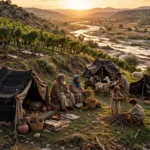
The Philistines were coming again, and Israel was terrified — with good reason. The last time these armies met, Israel had lost thirty thousand men and the ark of God itself had been captured. But this time Samuel had called the nation to repentance at Mizpah, the people had put away their foreign gods, and as the Philistine army approached, “the LORD thundered with a mighty sound that day against the Philistines and threw them into confusion” (1 Samuel 7:10). Israel routed them. And then Samuel did something strange: he took a great stone, set it up between Mizpah and Shen, and named it Ebenezer — eben ha-ezer, “stone of help” — saying, “Thus far the LORD has helped us” (1 Samuel 7:12). He built a monument to a rescue. Ebenezer is the Bible’s great word for remembered help: the practice of marking God’s faithfulness so firmly that forgetfulness cannot erase it.
The Battlefield Stone: What Samuel Actually Did
Notice the details, because each one teaches. Samuel set up the stone after the victory, not before. It was not a good-luck charm carried into battle; it was a memorial raised afterward — gratitude made visible. He placed it between Mizpah and Shen, at the site of the battle, where everyone traveling that road would see it and ask. Memorials are meant to be encountered, not filed away. And he gave it a name that preached: Ebenezer, “stone of help.” In a culture where names carried meaning, every mention of the place — meet me at Ebenezer; we camped near Ebenezer — repeated the testimony. The geography itself became a sermon.
The name held a quiet irony that Israel would have felt. Years earlier, Israel had camped at a place also called Ebenezer — and there they had been catastrophically defeated, losing the ark (1 Samuel 4:1). The old Ebenezer was a monument to presumption: Israel had carried the ark into battle like a talisman, without repentance, and God had let them fall. Samuel’s new Ebenezer, raised at the same region after genuine repentance and divine deliverance, was the redemption of the name. Same word, opposite meaning: the place of shame became the place of testimony. God does that with our Ebenezers too — the sites of our worst failures, revisited in repentance, become the monuments of His greatest help. The geography of defeat becomes the geography of grace.
“Thus Far”: The Honesty of the Phrase
Samuel’s inscription deserves lingering over: “Thus far the LORD has helped us.” Not “the LORD has solved everything forever.” Not “we will never struggle again.” Thus far. The phrase is honest about two things at once: gratitude for the past and dependence for the future. It looks backward — thus far, through the Philistines and the thunder and the rout, He helped. And it looks forward by implication — thus far, and we will need Him thus far again tomorrow. The Ebenezer is not a declaration of arrival; it is a milestone on a longer road.
This is the phrase for everyone mid-journey. You have not reached the destination — the battles are not all won, the Philistines will regroup, the future is uncertain. But thus far — through the diagnosis, the debt, the dark year, the wilderness — the LORD has helped us. That is enough to mark with a stone. Christians sometimes wait to testify until the story is complete, until every loose end is tied. Samuel teaches otherwise: mark the help thus far, in the middle of the story, with the ending still unwritten. The incomplete testimony is still true, and it is the incomplete testimonies that sustain us through the chapters still to come. “Thus far” is faith’s way of saying: He has been faithful to here; He will be faithful to there.
Stones as Memory: Israel’s Habit of Marking
Samuel’s Ebenezer belonged to a long biblical habit: God’s people marked God’s help with physical memorials, because human memory leaks. When Israel crossed the Jordan on dry ground, Joshua commanded twelve stones taken from the riverbed and set up at Gilgal — “that this may be a sign among you. When your children ask in time to come, ‘What do those stones mean to you?’ then you shall tell them” (Joshua 4:6-7). The stones were catechism tools: the children’s question was the point. What do those stones mean? — and the parent’s answer passed the testimony to the next generation.
Jacob set up a stone pillar at Bethel after his dream of the ladder — “this stone, which I have set up for a pillar, shall be God’s house” (Genesis 28:22). Joshua, at the end of his life, set up a great stone under the oak at Shechem as a witness to the covenant: “it has heard all the words of the LORD that he spoke to us” (Joshua 24:27) — as if the stone itself could testify. The pattern is consistent: when God acts, mark it. Write it, pile it, name it, set it where you will see it. The memorials were never for God’s benefit — He does not forget. They were for ours, because we do.
Why does forgetfulness come so easily? Because present troubles shout louder than past mercies. Israel, fed with manna in the morning, grumbled by evening. The disciples, having watched Jesus feed five thousand, panicked in the next storm. Amnesia is the default setting of the human heart — which is why God commanded memorials. The Ebenezer is God’s prescribed medicine for spiritual forgetfulness: a visible, tangible, unmissable reminder that thus far, He has helped. In the next crisis, the stone does its work: you look at it, you remember, and faith steadies.
When the Stone Is Hard to Raise: Ebenezers in Dark Seasons
Samuel raised his Ebenezer after a victory. But what about the seasons with no victory yet — the ongoing illness, the unanswered prayer, the battle still raging? Can you raise an Ebenezer before the thunder comes? Scripture says yes, and the practice may matter most precisely there. David raised his Ebenezers in caves, not palaces: “I will bless the LORD at all times” (Psalm 34:1) was written by a fugitive, not a king. Habakkuk raised his with the fields empty and the stalls bare: “yet I will rejoice in the LORD; I will take joy in the God of my salvation” (Habakkuk 3:18). Paul and Silas raised theirs in a Philippian jail at midnight, “praying and singing hymns to God” with their feet in stocks (Acts 16:25).
The principle: an Ebenezer does not require a completed rescue; it requires a remembered one. In the dark season, you do not mark what God will do (though you trust it) — you mark what He has done: thus far. The Israelite in exile could still point to the Red Sea. The patient in the hospital bed can still point to a hundred past mercies. Gratitude in the valley is not denial; it is defiance — defiance of despair, rooted in history. Raise the stone now, in the middle of it: write down three “thus far” mercies today, speak one aloud to someone you love, set the marker where tomorrow’s fear will have to walk past it. The thunder may not have come yet. The stone can still stand.
Raising Your Own Ebenezer: The Practice Today
We do not pile fieldstones much anymore, but the practice translates. Your Ebenezer might be a journal — dated entries of prayers answered, rescues witnessed, “thus far” moments recorded before they fade. Years later, in a dark season, those pages preach. It might be a habit of testimony — telling the story, out loud, to your children, your friends, your small group: this is what God did; this is thus far. Spoken memory is a memorial. It might be a physical object — the hospital bracelet kept in a drawer, the letter framed on a wall, the stone on a desk. Tangible reminders anchor intangible grace.
The practice has a corporate dimension too. Churches are, at their best, communities of Ebenezers — gatherings where “thus far” testimonies are shared and the stones pile up collectively. This is part of what the Lord’s Supper does: “do this in remembrance of me” (Luke 22:19) is a standing Ebenezer, a regularly raised memorial to the greatest help ever given. Every communion table is a stone of help, every baptism a marker at the riverbank. The church that remembers well is the church that trusts well — because remembered faithfulness is the fuel of future faith.
So raise the stone. Name the help. Say it out loud: thus far the LORD has helped us — through the battle you thought would break you, in the year you thought would end you, at the Mizpah where you repented and the thunder came. Mark it where you will see it, where your children will ask about it, where the next Philistine army will have to march past it. The stone will outlast the fear. For the history of the word and its famous use in hymnody, see the article on Ebenezer.