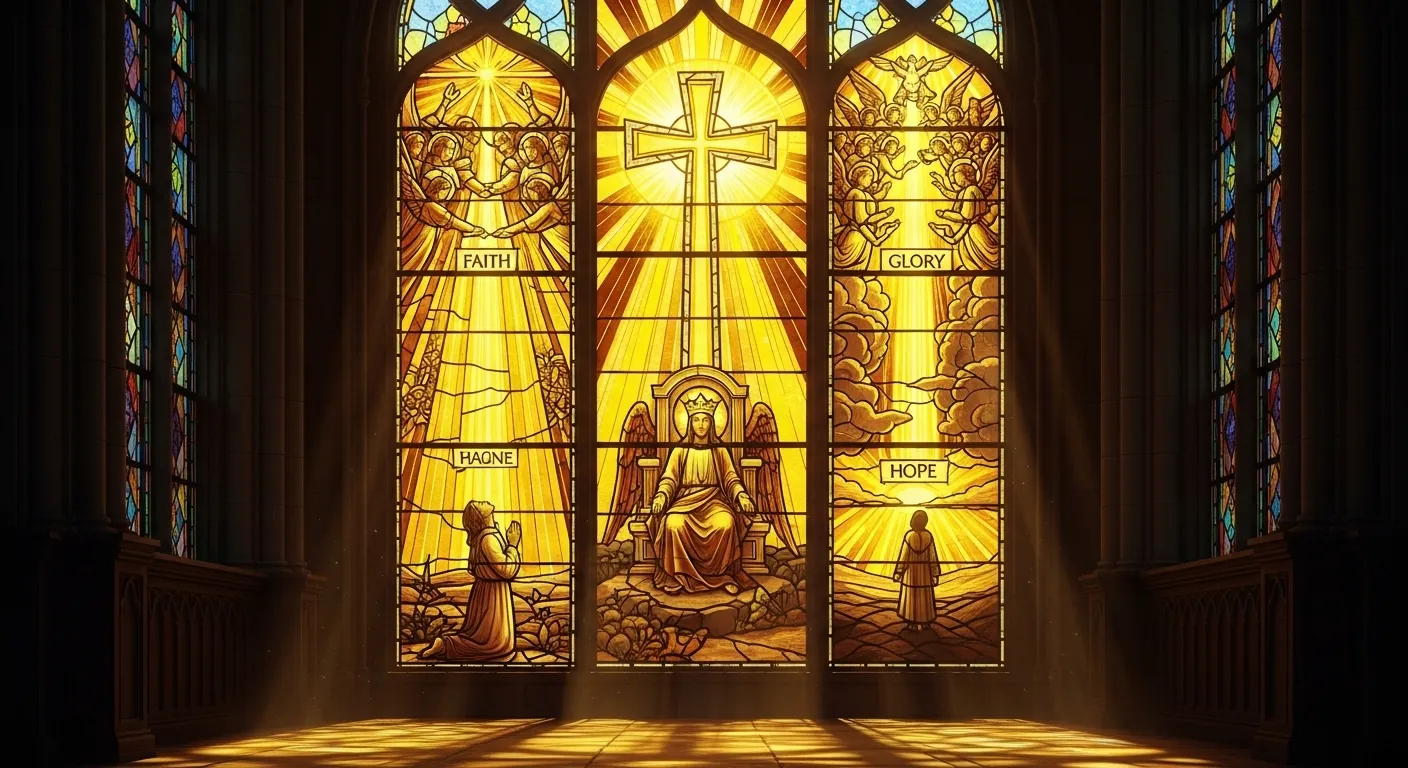
The first yellow in the Bible is gold, and it shows up before Israel has a king, a temple, or a settled home. Wandering in the wilderness, the people are commanded to build a portable sanctuary — and at its heart, the ark of the covenant, “overlay it with pure gold, inside and outside” (Exodus 25:11). The lampstand: pure gold. The table of showbread: overlaid with pure gold. The altar of incense: overlaid with pure gold. A homeless people carrying a golden God. From its first appearance, the Bible’s yellow is the color of glory in motion — precious, radiant, and never merely decorative.
That is the key to yellow’s biblical meaning. Scripture rarely discusses the color yellow as a color. Instead it shows you gold, fire, light, and ripened grain — and lets the symbolism accumulate. Yellow in the Bible is glory, refinement, illumination, and harvest. Follow the gold and you find the meaning.
Gold: The Bible’s Yellow
Gold saturates the worship of Israel because gold says what words cannot: this matters, this is set apart, this is for the King. The tabernacle’s gold was not wealth display; it was theology in metal. When Solomon later built the temple, “he overlaid the whole house with gold” (1 Kings 6:22) — the inner sanctuary gleaming like a captured sunrise. The message to every worshipper was unmistakable: you are approaching Someone of incalculable worth.
But Scripture refuses to let gold mean only splendor. The prophets and apostles keep dragging it into the furnace. Gold’s glory is real, but gold’s lesson is refinement — and refinement is never comfortable. That tension is where yellow’s deepest biblical meaning lives.
Refined, Not Decorated
Job, sitting in ashes with everything lost, makes the astonishing claim: “But he knows the way that I take; when he has tried me, I shall come out as gold” (Job 23:10). Not “I shall be comforted.” Not “I shall be restored.” Gold. The trial is a refiner’s fire, and Job is the metal in it. The image assumes what every ancient metalworker knew: gold goes into the furnace impure and comes out pure. The fire does not destroy the gold; it destroys everything that is not gold.
Zechariah gives the same picture to the whole nation: “I will put this third into the fire, and refine them as one refines silver, and test them as gold is tested” (Zechariah 13:9). Malachi makes the Refiner a person: “He will sit as a refiner and purifier of silver, and he will purify the sons of Levi and refine them like gold and silver” (Malachi 3:3). And Peter applies it to the Christian: the genuineness of faith, “more precious than gold that perishes though it is tested by fire” (1 Peter 1:7). Yellow’s sermon is therefore double-edged: glory, yes — but glory that has passed through fire. The gold that never met the furnace is just pretty metal. The faith that never met the trial is just pretty sentiment.
This reframes suffering for the believer who keeps noticing gold and yellow in Scripture. The color does not promise exemption from the furnace. It promises the furnace has a purpose — and a Refiner who is watching the metal, not abandoning it. The silversmith knows the refining is done when he can see his face reflected in the molten metal. God’s goal in your trial is His own reflection.
The golden lampstand — the menorah — fused yellow’s two registers, gold and light, into one object. “You shall make a lampstand of pure gold,” God commanded, “its base, its stem, its cups, its calyxes, and its flowers” all of hammered gold (Exodus 25:31), and it burned continually in the holy place, the only light in the windowless room. Gold that gives light: glory that illuminates. The lampstand stood opposite the table of showbread, flanking the approach to God’s presence — a golden tree of fire burning in the dark, fed by pure olive oil, tended morning and evening by the priests. It is yellow’s complete sermon in a single furnishing: precious (gold), refining (hammered work), illuminating (burning), and priestly (tended). And Revelation sets seven golden lampstands around the risen Christ Himself (Revelation 1:12–13) — the churches as lampstands, the same golden light, now carried by God’s people into the world’s darkness.
Light for Dark Roads
Yellow’s second biblical register is light. “You are the light of the world,” Jesus tells His followers (Matthew 5:14) — not “you will be,” but “you are,” present tense, commissioning tense. Light in Scripture is almost always yellow-white: the sun, the lamp, the dawn. “Your word is a lamp to my feet and a light to my path” (Psalm 119:105). The sunrise itself becomes a resurrection image: “the sun had risen on the earth” when the women reached the tomb (Mark 16:2).
Dawn carries the promise embedded in yellow: darkness is temporary by design. “Weeping may tarry for the night, but joy comes with the morning” (Psalm 30:5). The color of morning is the color of God’s faithfulness on schedule — every sunrise a small, silent sermon that the night did not win. For the believer in a dark season, yellow light is Scripture’s shorthand for hope with a track record.
The Harvest Yellow
There is a third yellow in the Bible, and it is agricultural: the gold of ripened grain. “The harvest is plentiful, but the laborers are few” (Matthew 9:37) — Jesus looks at crowds and sees a wheat field gone golden, ready and urgent. John sharpens it: “Look, I tell you, lift up your eyes, and see that the fields are white for harvest” (John 4:35) — grain at the exact moment of ripeness, when delay means loss. The yellow of harvest is the color of now: souls ready, time short, workers needed.
This is yellow as calling. It does not merely comfort the believer; it recruits them. The golden field is not a painting to admire but a harvest to enter.
The Pale Yellow That Warns
Honesty requires the other side. In the leprosy laws, the priest examines a skin affection, and “if… there is in it yellow hair” (Leviticus 13:30), it signals uncleanness. Pale, sickly yellow — the color of disease, of fading, of life draining out — stands as yellow’s shadow meaning. Not every yellow comforts. Some yellows diagnose.
The principle holds across Scripture’s color symbolism: context governs. The same spectrum that gives you the golden ark gives you the jaundiced warning. The difference is the setting — glory versus decay, refinement versus disease. This is why no color in the Bible functions as a private code, and why “yellow appeared in my dream” can never be interpreted apart from the whole counsel of God’s Word. The color illustrates; Scripture interprets.
The Golden City
Yellow’s final biblical appearance is its most dazzling: the New Jerusalem. John sees the holy city, “and the city was pure gold, like clear glass” (Revelation 21:18). The street of the city “was pure gold, like transparent glass” (Revelation 21:21). Gold so pure it becomes transparent — a physical impossibility that makes the theological point: in the end, glory has nothing to hide. Earth’s gold is opaque, hoarded, alloyed. Heaven’s gold is clear.
This is where the refining motif reaches its destination. Every furnace in Scripture — Job’s trials, Zechariah’s third refined like gold, Peter’s tested faith “more precious than gold” — was preparing a people for a city made of the finished product. The Refiner’s goal was never just purer metal; it was inhabitants fit for a golden city. And notice what the city doesn’t need: “the city has no need of sun or moon to shine on it, for the glory of God gives it light” (Revelation 21:23). The yellow of created light — sun, lamp, dawn — is retired, replaced by uncreated light. Every lesser yellow in the Bible was a rehearsal. The gold of the tabernacle, the fire of the refiner, the dawn of the resurrection morning: all of them were pointing to the day when God Himself is the gold, the fire, and the dawn, and His people walk streets of transparent glory.
Gather it up: yellow in the Bible is the gold of God’s worth, the fire of God’s refining, the light of God’s guidance, and the harvest of God’s mission — with a pale shadow that reminds us glory can fade when separated from its Source. It is the color of value under construction. The story of yellow across human culture — gold, sunlight, harvest, caution — runs on parallel tracks to Scripture’s own; the Bible simply adds what culture cannot: a Refiner who guarantees the outcome of the fire.










