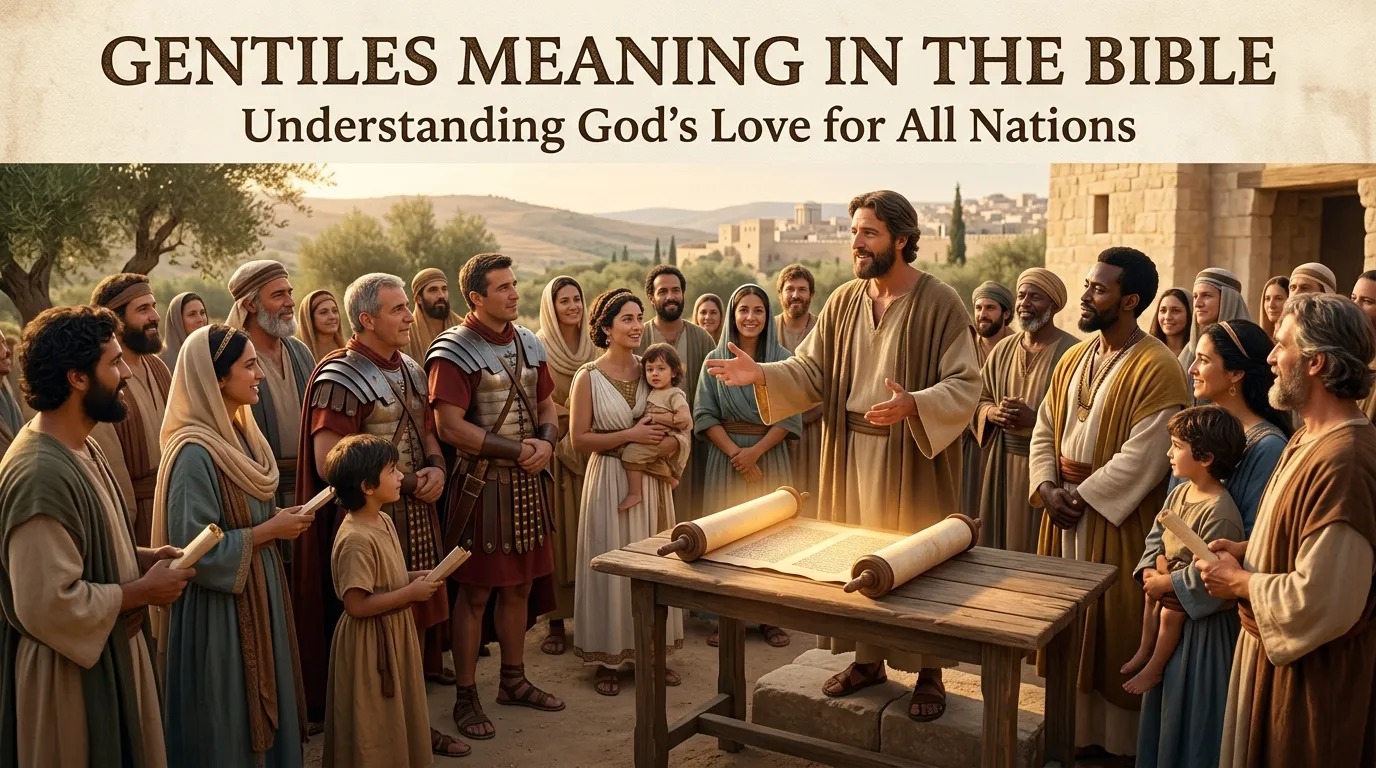
The word “Gentiles” simply means “the nations” — everyone who is not part of Israel. But behind that dictionary definition lies the most sweeping storyline in the Bible: God’s plan to bless the entire world through one particular family. The story of the Gentiles is the story of how outsiders became insiders, how the far-off were brought near, and how a promise made to one man in Mesopotamia reached every tribe, tongue, and nation on earth.
To understand the Gentiles in the Bible, you have to follow the arc. It begins with a call, passes through centuries of separation, breaks open in the ministry of Jesus, explodes in the book of Acts, and ends with a multitude no one can count. This article walks that arc — because the meaning of “Gentiles” is not a definition. It is a history.
The Promise: “All the Families of the Earth”
The story starts in Genesis 12, before there is an Israel at all. God calls Abram out of Ur and makes a promise with a universal horizon: “In you all the families of the earth shall be blessed.” The particular (one man, one family, one nation) is chosen for the sake of the universal (all families). Israel is never meant to be God’s only people. Israel is meant to be the channel through which God’s blessing reaches all peoples.
This is crucial for everything that follows. The election of Israel is not the rejection of the nations. It is the strategy for their salvation. God narrows to widen: He chooses one family so that through that family, every family can be blessed. Whenever Israel forgets this — and she forgets it often — the prophets remind her. Isaiah sees the mountain of the Lord’s house drawing “all nations.” He calls Israel “a light for the nations, that my salvation may reach to the end of the earth.” The Gentiles are not an afterthought in God’s plan. They are in the first paragraph.
The Separation: A Wall with a Purpose
And yet for most of the Old Testament, the Gentiles stand outside. Israel is given the law, the covenants, the temple, the promises. The nations have none of these. Paul will later describe the Gentiles’ former state with stark honesty: “separated from Christ, alienated from the commonwealth of Israel and strangers to the covenants of promise, having no hope and without God in the world.”
The separation had a purpose. Israel was to be holy — set apart — as a witness to the nations. The dietary laws, the circumcision, the Sabbath: all of it marked Israel as different, creating a visible distinction between God’s people and the surrounding idolatry. The wall was pedagogical. It taught the world, by contrast, what holiness looked like.
But walls built for teaching can become walls of pride. By Jesus’ day, many in Israel had come to view Gentiles with contempt — as dogs, as unclean, as beyond hope. The middle wall of partition, as Paul calls it, had become not just a boundary but a barrier of hostility. The stage was set for the most radical demolition project in history.
The Cracks: Gentiles in the Old Testament
Even during the centuries of separation, the wall had doors. The Old Testament is studded with Gentiles who found their way in — and each one is a preview of what was coming. Rahab, the Canaanite prostitute, hides the spies and ends up in the genealogy of Jesus. Ruth, the Moabite, clings to Naomi with the most famous pledge of loyalty in Scripture and becomes the great-grandmother of David. Naaman, the Syrian general, is healed of leprosy and confesses, “Now I know that there is no God in all the earth but in Israel.”
Then there is Jonah — the whole book is about Gentiles. God sends His prophet to Nineveh, the capital of Israel’s cruelest enemy, and Jonah flees in the opposite direction. He would rather die than see Assyrians repent. But the Assyrians do repent — from the king to the cattle — and God spares the city, leaving Jonah furious under his withered plant. The book ends with God’s question hanging unanswered: “Should not I pity Nineveh, that great city?” The implied answer is yes. The book of Jonah is the Old Testament’s great tract on God’s love for Gentiles, and its hero is the villain — the prophet who resented grace.
These stories are not exceptions to the rule. They are announcements of the rule’s end. Every Rahab, every Ruth, every Ninevite is a signal flare: the nations are coming in.
The Breaking: Jesus and the Nations
Jesus’ ministry begins within Israel — “I was sent only to the lost sheep of the house of Israel” — but it constantly overflows the boundaries. He marvels at the faith of the Roman centurion: “Truly, I tell you, with no one in Israel have I found such faith.” He grants the Canaanite woman’s plea, praising her great faith. He spends two days with the Samaritans — half-Gentiles, despised by Jews — and they confess Him as “the Savior of the world.”
The parables point the same way. The great banquet: the invited guests refuse, so the master sends his servant to “the highways and hedges” to compel people to come in. The vineyard: the tenants who reject the son will lose the vineyard to others. John states the theology outright: Jesus would die “not for the nation only, but also to gather into one the children of God who are scattered abroad.”
And the Great Commission makes it explicit and universal: “Go therefore and make disciples of all nations.” The risen Christ does not merely permit the Gentile mission. He commands it. The wall is not just cracked now. It is commissioned for demolition.
The Explosion: Acts and the Council
The book of Acts is the story of the demolition. It begins with Peter’s vision on a rooftop in Joppa: a sheet descending with all the unclean animals, and the voice, “What God has cleansed, do not call common.” While Peter is still puzzling over it, Gentile messengers arrive from Cornelius, a Roman centurion. Peter goes, preaches, and watches the Holy Spirit fall on Gentiles exactly as He had on Jews at Pentecost. Peter’s conclusion is the turning point of the New Testament: “Truly I understand that God shows no partiality.”
Then Paul — the apostle to the Gentiles — carries the gospel across the empire: Cyprus, Galatia, Macedonia, Greece, Rome itself. The question of whether Gentiles must become Jews (circumcision, food laws) threatens to split the church, and the Jerusalem Council in Acts 15 settles it: Gentiles are saved by grace through faith, no conversion to Judaism required. James quotes Amos: God is taking “from the Gentiles a people for his name.” The decision is arguably the most important in church history. Without it, Christianity remains a Jewish sect. With it, it becomes a world faith.
The Mystery: One New Man
Paul’s letters give the theological meaning of it all, and Ephesians 2 is the crown: “But now in Christ Jesus you who once were far off have been brought near by the blood of Christ. For he himself is our peace, who has made us both one and has broken down in his flesh the dividing wall of hostility… that he might create in himself one new man in place of the two.”
“One new man.” Not two peoples tolerating each other, but a single new humanity — Jew and Gentile reconciled in one body through the cross. This, Paul says, is “the mystery hidden for ages”: that the Gentiles are “fellow heirs, members of the same body, and partakers of the promise in Christ Jesus through the gospel.” The church is not Israel plus guests. It is a new creation in which the old divisions are abolished.
Revelation shows the end of the arc: “a great multitude that no one could number, from every nation, from all tribes and peoples and languages, standing before the throne.” The promise to Abraham — “all the families of the earth” — is fulfilled. The Gentiles, once far off, are home. And the story that began with one man’s call ends with a crowd no one can count, singing in every language at once.
The historical and linguistic background of the term is covered in the article on the word Gentile, which traces its use from the Hebrew goyim through the Greek ethnē to the present day.










