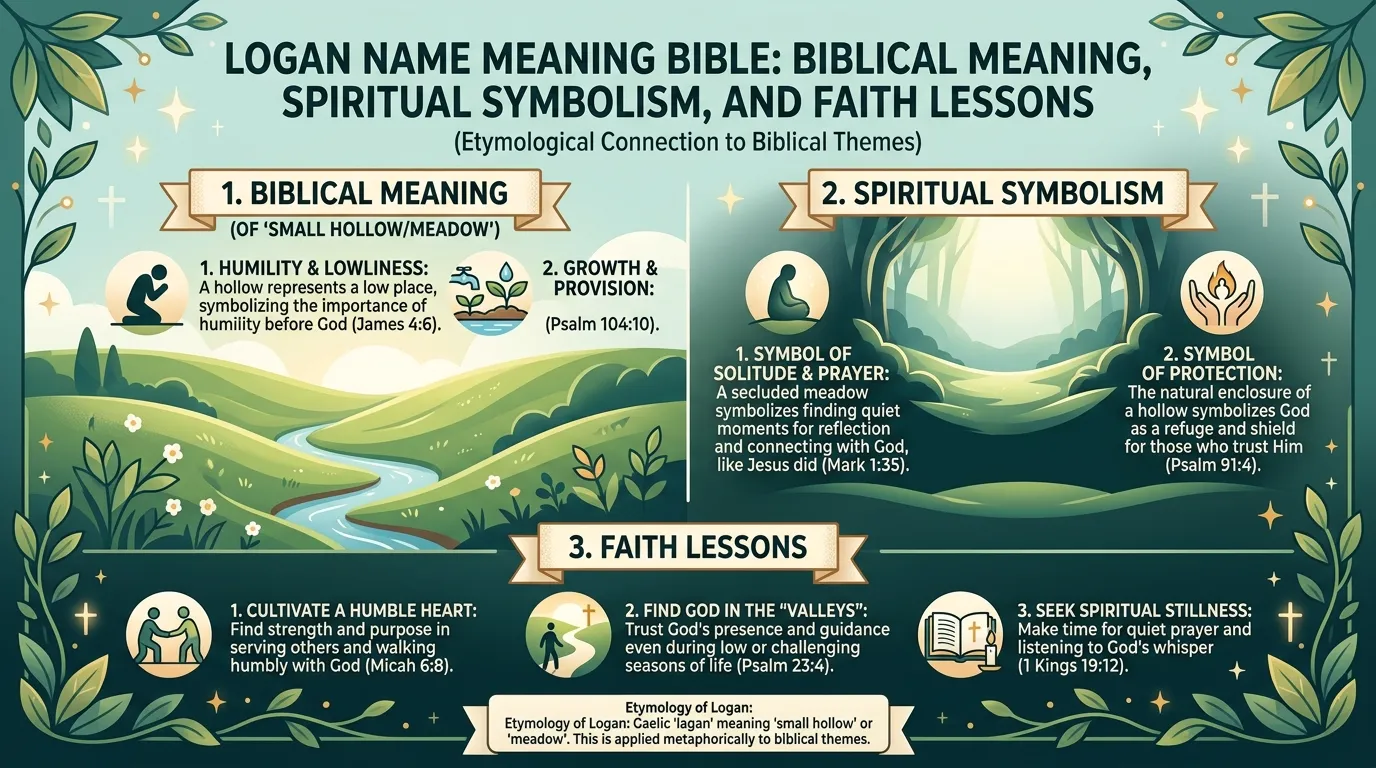
Logan is everywhere. It has been one of the most popular boys’ names in the English-speaking world for two decades, familiar from playgrounds, classrooms, and a certain clawed superhero. And inevitably, Christian parents who love the name ask the question: is Logan in the Bible? The answer is no. It is a Scottish name, derived from a place name meaning “little hollow,” with no Hebrew or Greek pedigree and no appearance in Scripture.
That fact disappoints some people, and it should not. The disappointment rests on an assumption the Bible never makes — that a name is spiritually valuable only if it appears in the text. The Bible’s own story undermines that assumption at every turn. This article will not try to baptize Logan with a fake biblical origin. Instead, it will ask a better question: what does the Bible actually teach about names, and what can it teach the millions of families who choose names like Logan?
A Scottish Name with No Biblical Passport
Logan comes from the Scottish Gaelic lagan, a diminutive of lag, meaning a hollow or small valley. It began as a surname and a place name — there are Logans on the map of Scotland — and crossed into use as a first name relatively recently. Its rise in the English-speaking world owes more to immigration, literature, and popular culture than to any religious tradition.
There is nothing deficient about that. The Bible was written in Hebrew, Aramaic, and Greek, but Christianity has never restricted names to those languages. Irish Christians named their children Patrick and Bridget. German Christians used names like Frederick and Matilda. African, Asian, and Latin American Christians have always named children from their own languages, and the church has never objected. A name’s origin in Scotland rather than in Scripture is not a spiritual handicap. It is simply a fact of linguistic history.
What the Bible Actually Teaches About Names
The Bible cares deeply about names — but not in the way name-meaning websites suggest. Scripture never teaches that a name’s dictionary definition determines a child’s destiny. What it teaches is richer and stranger.
First, God names things as an act of authority and relationship. He names the day and night, the stars, and His people. To be named by God is to be known by God. The comfort of the Christian faith is not that our names have impressive meanings, but that the God who named the stars also knows our names individually: “I have called you by name, you are mine.”
Second, God sometimes renames people to mark a new reality — Abram becomes Abraham, Sarai becomes Sarah, Jacob becomes Israel, Simon becomes Peter. But notice: the renaming follows the reality, it does not create it. God changes the person, then updates the name to match. The power is in the transformation, not the syllables.
Third, the Bible warns against trusting in names as talismans. The sons of Sceva try to use the name of Jesus as a magic formula and are humiliated. The prophets mock those who carry the temple’s name while practicing injustice: “Do not trust in these deceptive words: ‘This is the temple of the Lord.'” A name — even the right name — is no substitute for the reality it points to.
The upshot is liberating. A child named Logan is not spiritually disadvantaged by his name’s Scottish origin, and a child named Ezekiel is not spiritually advantaged by his name’s Hebrew majesty. What matters is whether the child comes to know the God who calls His own by name.
The Real Question: What Will the Name Carry?
If the dictionary meaning does not determine anything, what does a name do? It carries associations — and associations are shaped by the life lived under the name. The most important meaning of “Logan” for any particular Logan will not be “little hollow.” It will be whatever his parents, his choices, and his faith make of it over the decades.
This is where Christian parents have genuine agency. They cannot control a name’s etymology, but they can fill the name with meaning through prayer, teaching, and example. A family can decide that in their house, Logan will be associated with courage, kindness, integrity, and faith — not because the Gaelic demands it, but because the family intends it. Names become what lives make of them. Every Logan gets to write the definition.
There is a biblical precedent for exactly this. When Ruth’s son is born, the women of Bethlehem name him Obed, saying “A son has been born to Naomi” — they name the child for what his life means to the family, not for a dictionary entry. Names in Scripture are often memorials of experience rather than predictions of destiny. Parents choosing Logan can do the same: let the name memorialize the joy of his arrival, the hopes they prayed over him, the God they trust with his future.
Every Good Gift
James writes that “every good and perfect gift is from above, coming down from the Father of lights.” A child is such a gift, and a name is the wrapping. The wrapping matters less than the gift, but it is still chosen with love — and God honors the love behind the choosing even when the etymology is Scottish rather than Semitic.
Parents who feel a twinge of guilt for not choosing a “biblical” name can lay it down. The Bible’s standard for parenting is not onomastic correctness. It is the command repeated from Deuteronomy to Ephesians: teach your children the word of God, discipline them in love, bring them up in the instruction of the Lord. A Logan raised in a home like that has received something no name-origin can supply and no name-origin can prevent.
And there is a final encouragement. The Bible ends with a promise about names: to the one who conquers, Jesus will give “a new name” written on a white stone, “which no one knows except the one who receives it.” Whatever name is on the birth certificate, God has a name prepared that is personal, secret, and perfect — the name He has called us all along. Logan, like every name, is temporary. The name God gives is eternal.
Ordinary Names, Extraordinary Callings
It is worth remembering how many of the Bible’s heroes had utterly ordinary names. Amos means “burden-bearer” and he was a shepherd. The twelve apostles include several Simons and two Jameses — the first-century equivalent of naming your sons Mike and Dave. Nobody in the Gospels comments on the etymological significance of “Bartholomew.” God does not appear to shop for impressive names. He calls shepherds, fishermen, tax collectors, and teenagers, and the names they happen to carry become glorious by association, not by definition.
This is the pattern every Logan inherits. The name does not need to be remarkable. The life does. When Scripture says God “chose the foolish things of the world to shame the wise” and “the weak things of the world to shame the strong,” it is describing a God who specializes in making much of little — including little hollows, little names, and little-noticed people. A “little hollow” is, after all, a vessel: empty, ready to be filled. That is not a bad image for a Christian life.
What to Pray Over a Logan
For parents who want to give the name spiritual content, here is a framework drawn from the name’s own meaning. Pray that the “hollow” would be a place of humility — a life that knows its emptiness apart from God. Pray that it would be filled — with the Spirit, with the word, with love for others. And pray that from the hollow would flow a spring: Jesus promised that whoever believes in Him would have “rivers of living water” flowing from within. A little hollow, filled by God, becomes a well for others.
Pray, too, against the superstitions. Pray that no one in the family would treat the name as a charm or a curse, and that the child would learn early where identity truly comes from: not from Gaelic roots or internet name-meaning pages, but from the voice that says, “You are mine.”
Naming Without Superstition
A word of caution belongs here, because the internet’s name-meaning industry trades in superstition. Articles that claim a name “means” a child will be brave, or prosperous, or spiritually gifted are selling comfort, not truth. The Bible never promises that names shape destinies, and Christians should not outsource parental hope to etymology. Hope belongs in God, not in Gaelic.
This also applies to the cottage industry of finding “hidden biblical meanings” in modern names — the strained Hebrew roots, the alleged prophecies, the dream interpretations. Discernment is a Christian virtue. When a name’s origin is Scottish, the honest Christian answer is “it’s Scottish,” followed by the far more important conversation about what the family will build under that name. Truthfulness about small things, like name origins, trains us for truthfulness about large things.
So: Logan means “little hollow.” It is not in the Bible. And none of that matters nearly as much as the question every parent must answer regardless of the name they choose — will this child be raised to know the God who calls him by name? Answer that question well, and the etymology takes care of itself.
The broader human practice behind all of this — how societies create, bestow, and inherit personal names — is surveyed in the study of given names across cultures, a useful reminder that every naming tradition, biblical or otherwise, is a human attempt to say: this person matters.










