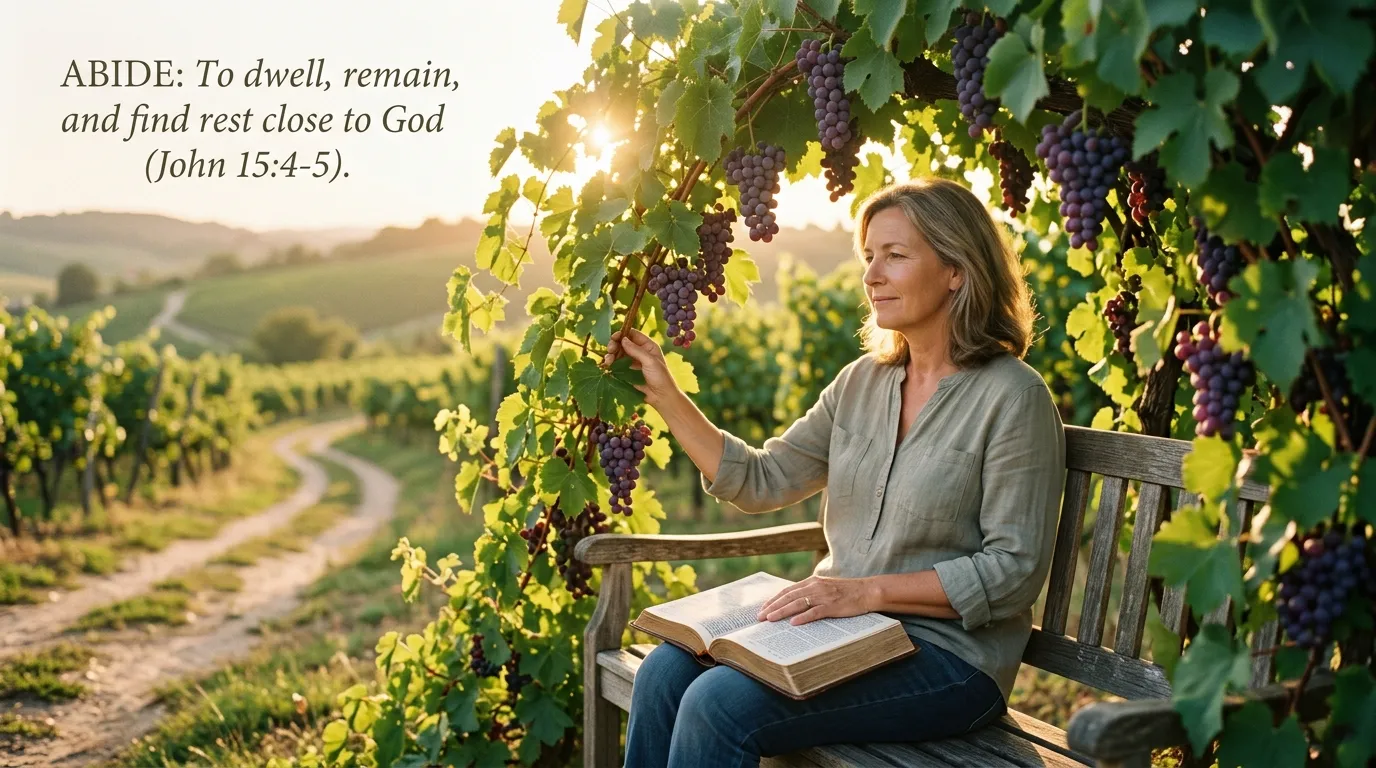
Walk through a vineyard in late summer and you will see it. The branches do not strain to produce grapes. They do not attend seminars on fruitfulness or set quarterly grape goals. They simply remain attached to the vine, drawing everything they need through a connection they never break, and the fruit appears as naturally as breathing. Jesus chose this exact picture to explain one of the most important words in the Christian life: abide. “Abide in me, and I in you. As the branch cannot bear fruit by itself, unless it abides in the vine, neither can you, unless you abide in me” (John 15:4).
The Greek word behind abide is meno, and it is beautifully ordinary. It means to remain, to stay, to continue, to dwell, to make your home somewhere. It is the word used when travelers stay the night in a village, when someone remains in a house, when a person continues in a course of action. John uses it over and over in his Gospel and letters, like a musician returning to a favorite chord. To abide in Christ is not a mystical achievement for spiritual elites. It is the daily, unglamorous decision to stay put in Him, the way a branch stays put in the vine.
Staying Is Harder Than It Sounds
Here is the quiet scandal of the Christian life: remaining is difficult. Starting is exciting. Leaving is dramatic. But staying, day after ordinary day, through unanswered prayers, boring routines, and seasons when God feels silent, staying is the hardest spiritual discipline there is. That is precisely why Jesus commands it. Commands in Scripture are usually aimed at the things we would not do on our own.
Think of how often Scripture’s heroes struggled to remain. Israel, delivered from Egypt with miracles, wanted to go back within weeks (Exodus 16:3). Demas, Paul’s fellow worker, abandoned the ministry because he loved this present world (2 Timothy 4:10). The seed in Jesus’ parable sprang up quickly and withered just as fast because it had no root (Matthew 13:20-21). The pattern repeats: enthusiasm is cheap, but abiding is rare. Jesus is not asking for your excitement. He is asking for your remaining.
John makes the stakes explicit. “No one who abides in him keeps on sinning” (1 John 3:6), not as a claim of perfection but as a description of direction. The branch connected to the vine grows in the vine’s direction. And the promise attached to abiding is staggering: “If you abide in me, and my words abide in you, ask whatever you wish, and it will be done for you” (John 15:7). Prayer is not a vending machine. It is the conversation of someone who has stayed close enough to want what God wants.
What Abiding Actually Looks Like on a Tuesday
Abiding can sound abstract until you translate it into an ordinary week. What does remaining in Christ look like when the alarm rings and the day begins?
It looks like Scripture dwelling in you, not just visited occasionally. “Let the word of Christ dwell in you richly” (Colossians 3:16). Dwell is the same idea as abide. God’s Word is not meant to be a guest that drops by on Sundays. It is meant to move in, rearrange the furniture, and stay. This is why Jesus ties abiding to His words abiding in us. The branch draws sap from the vine; the believer draws life from the Word.
It looks like prayer as ongoing conversation rather than emergency calls. Paul’s instruction to “pray without ceasing” (1 Thessalonians 5:17) only makes sense as abiding. You cannot schedule ceaseless prayer, but you can live in ceaseless awareness, turning the heart toward God in the car, at the desk, in the kitchen, the way you would keep talking to a friend walking beside you all day.
It looks like obedience as love’s language. Jesus is direct: “If you keep my commandments, you will abide in my love” (John 15:10). Obedience is not the price of admission to God’s love. It is the atmosphere in which that love is experienced. A branch does not earn its place by producing fruit; it produces fruit because it stayed.
It looks like love for other believers. John will not let anyone spiritualize abiding into private mysticism. “Whoever says he abides in him ought to walk in the same way in which he walked” (1 John 2:6), and the way He walked was toward people, washing feet, touching lepers, weeping with friends. Abiding that never touches another person is not abiding. It is hiding.
The Psalm 91 Picture of Dwelling
Long before John 15, the psalmist painted the same portrait with different colors. “He who dwells in the shelter of the Most High will abide in the shadow of the Almighty” (Psalm 91:1). Dwelling and abiding, shelter and shadow. The image is of someone who has moved into God’s presence the way you move into a house, not visiting, not passing through, but living there.
Notice what the shelter provides. Protection from the fowler’s snare and the deadly pestilence. Refuge under wings. A fortress. The psalm does not promise that trouble will never come near the dwelling place. It promises that the One who lives there with you is bigger than whatever comes. Abiding does not remove you from the storm. It puts you in the shelter during the storm.
This is why the invitation to abide is ultimately an invitation to rest. The branch does not anxiously manufacture grapes. Martha, anxious and troubled about many things in the kitchen, needed what Mary had chosen in the sitting room: the one necessary thing, remaining at the feet of Jesus (Luke 10:38-42). Much of our spiritual exhaustion comes not from abiding too much but from striving while disconnected, trying to produce fruit that only connection can grow.
When Abiding Feels Like Nothing Is Happening
Every branch has seasons when nothing seems to be growing. Winter vines look dead. Pruning looks like destruction. Jesus mentions pruning in the same breath as abiding: “Every branch that does bear fruit he prunes, that it may bear more fruit” (John 15:2). The Father’s pruning shears are not a sign of abandonment. They are a sign of attention. God prunes the branches He intends to keep.
If you are in a season where prayer feels like talking to the ceiling and Scripture feels flat, that is not necessarily evidence that you have stopped abiding. Feelings are weather; abiding is climate. The branch does not check daily whether it feels connected. It simply stays. Keep the practices. Keep showing up. Keep the Word open even when it seems silent. “And let us not grow weary of doing good, for in due season we will reap, if we do not give up” (Galatians 6:9).
And remember the other half of the promise. Abiding is mutual. “Abide in me, and I in you.” You are not clinging to a distant God through sheer willpower. He is abiding in you at the same time, holding the connection from His side with a grip stronger than yours. “No one will snatch them out of my hand” (John 10:28). The branch’s job is to remain. The vine’s job is everything else.
Abiding Together: You Cannot Remain Alone
There is a temptation to hear “abide in me” as a purely private instruction, as if abiding were a solo retreat with Jesus and everyone else were a distraction. John’s letters demolish that idea. The same apostle who recorded the vine teaching also wrote, “If we walk in the light, as he is in the light, we have fellowship with one another” (1 John 1:7). Abiding in Christ and abiding in His people are two sides of one remaining.
The early church understood this instinctively. “They devoted themselves to the apostles’ teaching and the fellowship, to the breaking of bread and the prayers” (Acts 2:42). Notice the plural verbs. They did not merely believe the same things in isolation. They shared life, meals, possessions, and prayers. The writer of Hebrews commands believers not to neglect meeting together but to encourage one another (Hebrews 10:25), because encouragement is one of the ways God keeps branches connected.
This has a practical edge. If you are trying to abide while avoiding God’s people, you are trying to remain in the vine while cutting yourself off from the other branches. It does not work. The branch draws life through the vine, but it grows alongside fellow branches, and the fruit it bears feeds others. Find a community where the Word is taught, where prayer is real, where confession is safe, and stay there. Abiding is a team discipline disguised as a personal one.
The Promise Kept for Those Who Remain
Scripture attaches extraordinary promises to remaining. John writes, “Let what you heard from the beginning abide in you. If what you heard from the beginning abides in you, then you too will abide in the Son and in the Father. And this is the promise that he made to us, eternal life” (1 John 2:24-25). Abiding is the path, and eternal life is the destination. The connection is not mechanical but organic: those who remain in Christ remain in life, because Christ is life.
There is also a warning for those who do not remain, and honesty requires mentioning it. Jesus said branches that do not abide are thrown away and withered (John 15:6). John observed that some who left the fellowship demonstrated by leaving that they had never truly belonged (1 John 2:19). Remaining is therefore both a comfort and a diagnostic. The one who keeps remaining, through dry seasons and doubts, has evidence of genuine life. Perseverance is not the cause of salvation, but it is one of its clearest signs.
So remain. Not perfectly, not without stumbling, but persistently. The Vine does not drop branches that cling to Him in weakness. He strengthens them.
To abide is to come home and stay home. The door is open, the shelter is ready, and the Vine is waiting. For readers who want to explore how this concept of dwelling and remaining has been reflected on across Christian history, the Wikipedia entry on abiding in Christ provides a helpful overview, but the living reality is simpler than any commentary: stay connected, and the life of the Vine will become your life too.










