When the Persian king Cyrus issued his decree in 538 BC, he did something no conqueror in history had ever done. He told a defeated, exiled people that they could go home. The Jews of Babylon — deported by Nebuchadnezzar, settled in a foreign land, grieving for a destroyed temple — were free to return to Jerusalem, rebuild their temple, and worship their God. The decree was not a footnote. It was the hinge of the Old Testament. Without it, there would have been no restored Jerusalem, no second temple, no Judaism as we know it, and no setting for the coming of Jesus. The Persian Empire is the empire that sent God’s people home — and the Bible treats that act as one of the clearest proofs that God rules over kings.
The rise of Persia: from vassal to superpower
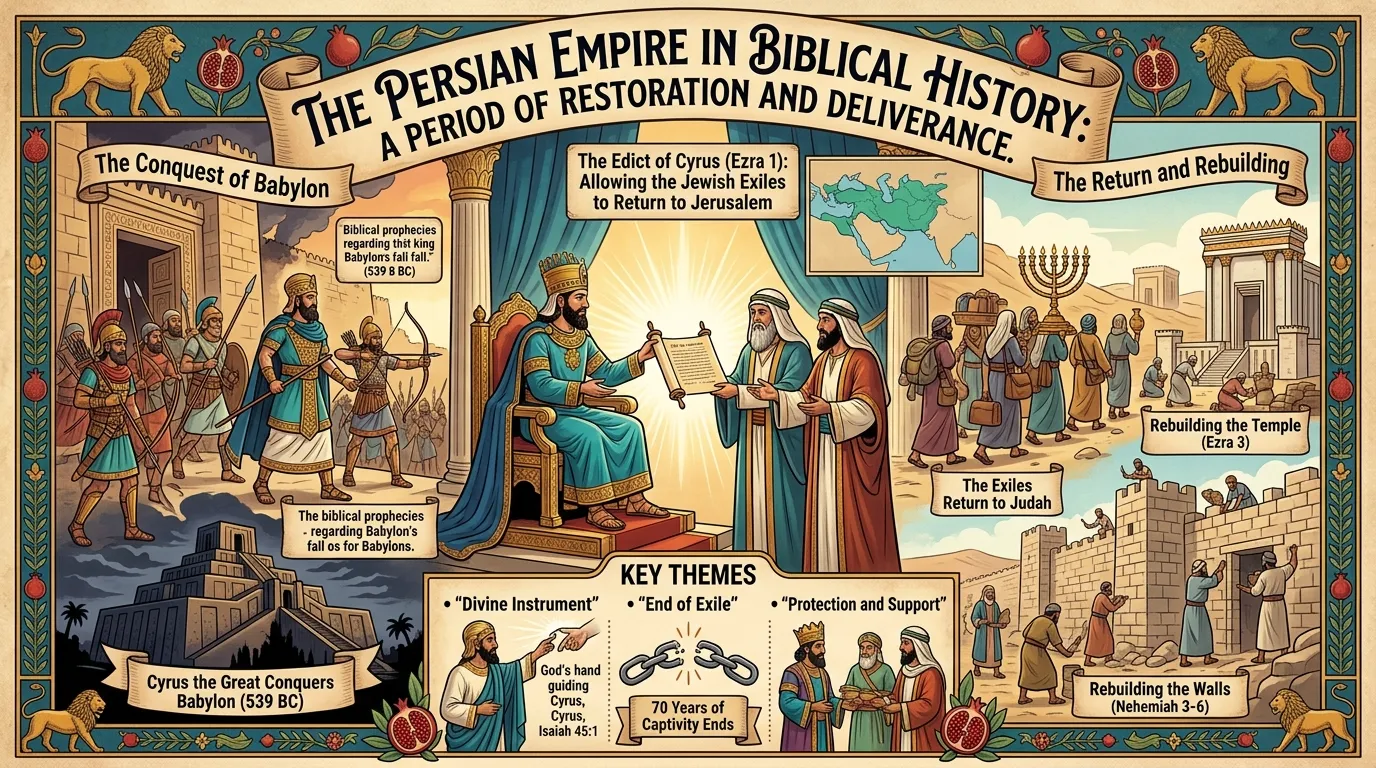
Persia began as a small kingdom in the mountains of modern-day Iran, a vassal of the Median Empire. Under Cyrus the Great (reigned 559–530 BC), it exploded. Cyrus conquered Media in 550 BC, Lydia in 546 BC, and Babylon in 539 BC — in less than two decades, he built the largest empire the world had ever seen, stretching from India to the Aegean Sea. His conquest of Babylon was famously bloodless: the Babylonian king Nabonidus was unpopular, the priests of Marduk welcomed Cyrus, and the city’s gates were opened. The empire that had terrorized the ancient world fell without a battle.
Cyrus’s genius was not only military. He was a statesman who understood that empires survive by tolerance, not terror. Where Assyria had deported and brutalized, and Babylon had exiled and oppressed, Cyrus allowed conquered peoples to keep their gods, their customs, and their leaders — as long as they paid tribute and kept the peace. The Cyrus Cylinder, a clay inscription from his reign, records his policy of restoring temples and returning displaced peoples. It is the first charter of religious tolerance in history, and it is the document that made the Jewish return possible.
Cyrus: the pagan king God called “anointed”
The most astonishing thing the Bible says about Persia is what Isaiah says about Cyrus. Writing a century and a half before Cyrus was born, Isaiah names him: “I will raise up Cyrus in my righteousness: I will make all his ways straight. He will rebuild my city and set my exiles free” (Isaiah 45:13). God calls Cyrus “his anointed” — the Hebrew word is messiah — and “his shepherd” (Isaiah 45:1; 44:28). No other pagan king in Scripture receives such titles.
The point is not that Cyrus was a believer. Isaiah is explicit: God says to Cyrus, “I will give you hidden treasures, riches stored in secret places, so that you may know that I am the LORD, the God of Israel, who summons you by name… though you have not acknowledged me” (Isaiah 45:3–4). Cyrus did not know God, but God knew Cyrus — and used him. The Bible’s doctrine of sovereignty is at its strongest here: God can use a king who does not know Him to accomplish a purpose that king does not understand. The return from exile was not Cyrus’s idea. It was God’s idea, executed through Cyrus’s decree.
The return: Ezra, Nehemiah, and the rebuilding
Cyrus’s decree, recorded in Ezra 1:1–4, was specific: “The LORD, the God of heaven, has given me all the kingdoms of the earth and he has appointed me to build a temple for him at Jerusalem in Judah. Any of his people among you may go up to Jerusalem in Judah and build the temple of the LORD.” The first wave of exiles returned under Zerubbabel and Joshua, laid the temple’s foundation, and faced opposition that stalled the work for years. The prophets Haggai and Zechariah urged them to finish. Under Darius I, the temple was completed in 516 BC.
A second wave came under Ezra, the priest and scribe, who brought the Law and re-established the community’s covenant life (Ezra 7–10). A third came under Nehemiah, the king’s cupbearer, who rebuilt the walls of Jerusalem in fifty-two days despite fierce opposition (Nehemiah 6:15–16). The restored community was smaller, poorer, and less glorious than the old kingdom — but it was the community that would preserve the Scriptures, rebuild the temple, and prepare the way for the Messiah.
Persian policy made all of this possible. The empire funded the temple (Ezra 6:4), protected the builders, and allowed the Jews to govern themselves under their own law. The Persian kings — Cyrus, Darius, Xerxes, Artaxerxes — appear in Ezra, Nehemiah, and Esther as the backdrop of the restoration. The empire that could have crushed the tiny Jewish community instead protected it. That is the paradox of Persia: the greatest power on earth became the guardian of the smallest people on earth.
Esther: a Jewish queen in the Persian court
The Book of Esther is the Persian Empire from the inside — a story of palace intrigue, genocide, and deliverance in the court of King Xerxes (Ahasuerus). Esther, a Jewish orphan, becomes queen. Haman, the king’s official, plots to exterminate the Jews. Mordecai, Esther’s cousin, urges her to act: “Who knows but that you have come to your royal position for such a time as this?” (Esther 4:14). Esther risks her life, exposes Haman, and saves her people. The feast of Purim commemorates the deliverance.
Esther is remarkable for what it does not contain: the name of God never appears in the book. Yet God’s providence is everywhere — in the coincidences, the sleepless night, the gallows built for Mordecai that hang Haman instead. Esther teaches that God works in the Persian court as surely as He works in the temple. His sovereignty does not require a miracle. It works through ordinary politics, ordinary courage, and ordinary people in the right place at the right time.
Daniel: faith under Persian law
The Book of Daniel spans the Babylonian and Persian periods, and its Persian chapters are among the most famous. Daniel, now an old man, serves under Darius the Mede and is thrown into the lions’ den for praying to God in defiance of a royal decree. God shuts the lions’ mouths, and Darius issues a decree that all people must fear the God of Daniel (Daniel 6). Later, Daniel receives visions of successive empires — the ram and the goat, the seventy weeks — that place Persia in the sequence of God’s plan for history. Persia is not the end of the story. It is a chapter in it.
Daniel’s faithfulness under Persia is a model for believers living under secular power. He served the empire loyally, but he did not worship its gods. He prayed openly, even when it was illegal. He trusted God in the lions’ den, and God delivered him. The Persian Empire could not make Daniel compromise, and it could not make him silent.
Persia’s fall: the empire that prepared the way
Persia fell to Alexander the Great in 331 BC, at the Battle of Gaugamela. The empire that had sent the Jews home, funded the temple, and protected the restoration lasted barely two centuries. Alexander’s conquest brought Greek language and culture to the whole Near East — the Hellenistic world in which the New Testament would be written. The Greek translation of the Old Testament, the Septuagint, was produced in Alexandria under Ptolemaic rule. The synagogues built during the Persian restoration became the preaching venues of the apostles. The Persian period was the seedbed of the world Jesus was born into: a world with a restored temple, a preserved Scripture, a synagogue in every town, and a Greek language that would carry the gospel to the nations. Persia’s greatest legacy was not its own glory. It was the world it left behind — a world ready for the Messiah.
The Persian kings also appear in the prophets’ oracles against the nations. Haggai, Zechariah, and Malachi all prophesied during the Persian period, and their books are the Bible’s commentary on life under a tolerant empire. Haggai urged the people to finish the temple. Zechariah gave visions of God’s protection and the coming Messiah. Malachi warned against spiritual complacency — the danger of a people who have been restored but have grown cold. The Persian period was not only a time of rebuilding walls. It was a time of rebuilding hearts.
What Persia teaches: God works through the nations
Persia teaches that God is not limited to working through His own people. He used a pagan king to free His people, a pagan empire to fund His temple, and a pagan court to save His people from genocide. The Bible’s God is the God of all nations, not only of Israel. He raises up kings and brings them down. He uses the empires of the world as instruments of His purposes — sometimes to judge, sometimes to deliver, always to advance His plan.
Persia also teaches that restoration is possible. The Jews who returned from Babylon had lost everything — their temple, their city, their king, their land. They came back to ruins. And God rebuilt them, through an unlikely instrument, into a community that would carry the Scriptures to the world and prepare the way for the Messiah. If God could restore Israel through Cyrus, He can restore anyone through any means He chooses.
For the empire’s history, from Cyrus to its fall to Alexander, the Wikipedia article on the Achaemenid Empire gives a detailed account.