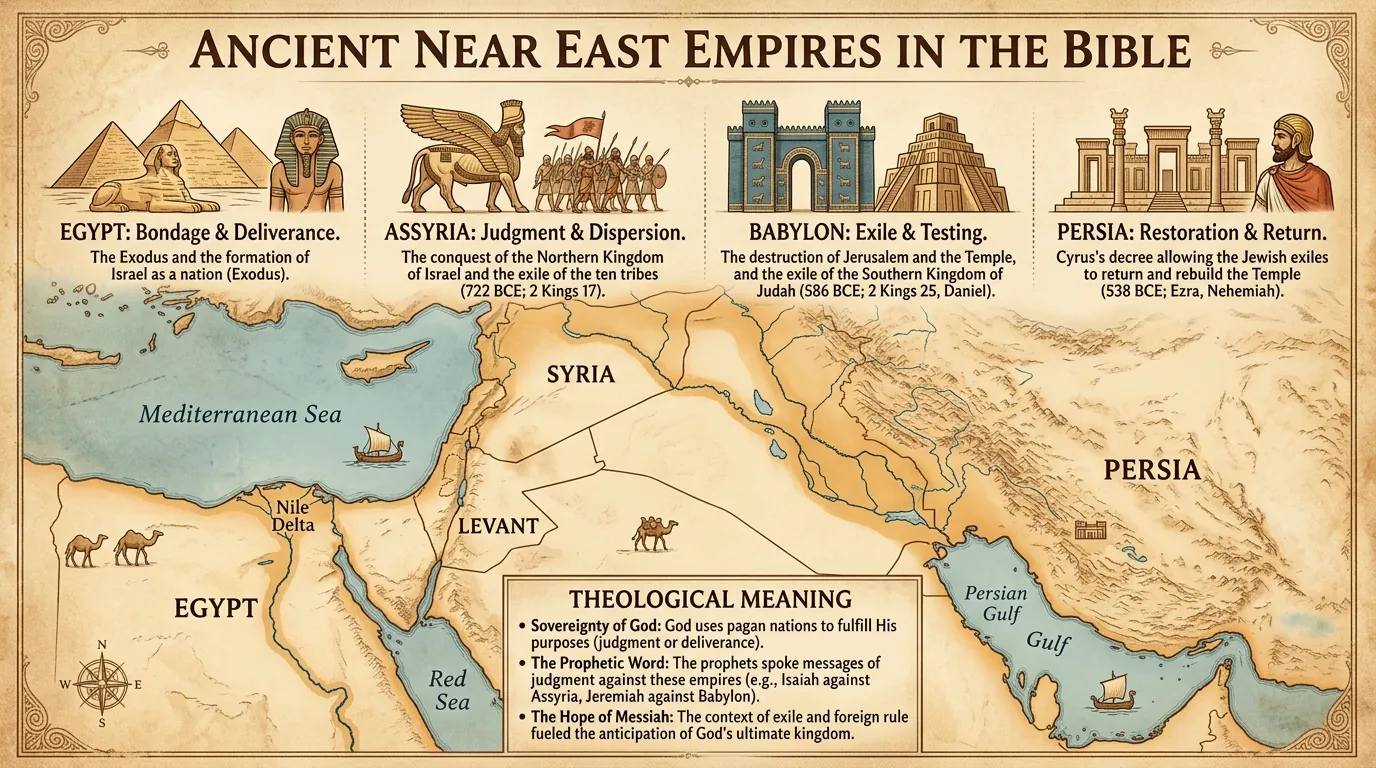
Israel was a small nation in a crowded neighborhood. To the south lay Egypt, ancient and wealthy. To the north and east lay a succession of Mesopotamian empires — Assyria, Babylon, Persia — each more powerful than the last. To the west lay the sea and the Philistines. Israel’s entire history was shaped by the empires around it: invaded by them, exiled by them, rescued by them, and, in the end, outlasting them all. To read the Bible without the empires is to read a story with the background removed. The empires are not decoration. They are the pressure, the threat, and the stage on which God’s people learned who He is.
The neighborhood: a map of power
The ancient Near East was the region stretching from Egypt in the west, through the Levant (modern Israel, Lebanon, Syria), to Mesopotamia (modern Iraq) in the east, and down to the Persian Gulf. It was the cradle of civilization — the place where writing, cities, law codes, and empires were invented. Its geography made it a crossroads: the Fertile Crescent, a band of arable land curving from the Persian Gulf through Mesopotamia to the Mediterranean, was the highway of the ancient world. Armies, traders, and ideas traveled it. Israel sat in the middle of it, on the narrow land bridge between Egypt and Mesopotamia — the most contested real estate on earth.
That location explains Israel’s history. Every empire that wanted to control the ancient Near East had to pass through Israel’s hills. Egypt marched north through it to fight Babylon. Assyria marched south through it to fight Egypt. Babylon marched west through it to fight Egypt. Israel was the doormat of empires — the place armies crossed on their way to fight each other. The prophets understood this geography. When they warned of judgment, they named the empire that would bring it.
Egypt: the house of slavery and the first empire
Egypt was the first empire Israel encountered, and the encounter defined the nation. Israel’s ancestors went down to Egypt during a famine, grew into a great people, and were enslaved. The Exodus — God’s deliverance of Israel from Egypt through Moses, the plagues, and the Red Sea — is the founding event of the Old Testament. Everything else in the Bible looks back to it. Egypt became the symbol of bondage, and the Exodus became the pattern of salvation.
Egypt remained a player in Israel’s story long after the Exodus. Solomon married a pharaoh’s daughter. Pharaoh Shishak invaded Judah and plundered the temple (1 Kings 14:25–26). Jeremiah warned the people not to flee to Egypt after the Babylonian conquest. Egypt was a constant temptation: a powerful, wealthy neighbor that offered security in exchange for dependence. The prophets’ message was consistent: do not trust Egypt. Trust God.
Assyria: the rod of judgment
Assyria rose in the ninth century BC and became the first empire to conquer the entire Near East. Its armies were feared for their brutality — impaling, flaying, and deporting conquered peoples. In 722 BC Assyria destroyed the northern kingdom of Israel and deported its population, scattering the ten tribes. In 701 BC the Assyrian king Sennacherib invaded Judah and besieged Jerusalem, but God intervened: the angel of the Lord struck down 185,000 Assyrian soldiers in a single night, and Sennacherib withdrew (2 Kings 19:35).
The prophets used Assyria as the instrument of God’s judgment — “the rod of my anger” (Isaiah 10:5). God used Assyria to punish Israel’s idolatry, and then He judged Assyria for its own pride. The Book of Jonah tells the surprising story of Assyria’s capital, Nineveh, repenting at Jonah’s preaching. The Book of Nahum tells the sequel: Nineveh’s repentance did not last, and God destroyed the city in 612 BC. Assyria’s rise and fall is the Bible’s first great lesson in the sovereignty of God over empires.
Babylon: the exile and the symbol
Babylon succeeded Assyria and became the empire of the Exile. Under Nebuchadnezzar II, Babylon conquered Jerusalem in 586 BC, destroyed the temple, and deported the population to Babylon. The Exile was the most traumatic event in Israel’s history — the loss of land, temple, king, and nation. The psalmists sang, “By the rivers of Babylon we sat and wept when we remembered Zion” (Psalm 137:1).
But Babylon was also the place where God preserved His people. Daniel rose to high office in Babylon. Ezekiel prophesied there. The exiles built synagogues, preserved the Scriptures, and learned to worship without a temple. Babylon became more than an empire; it became a symbol — of pride, of worldly power, of opposition to God — that runs through the whole Bible, from the Tower of Babel (Genesis 11) to the fall of “Babylon the Great” in Revelation 18. The symbol began as a real city.
Persia: the empire that sent them home
Persia conquered Babylon in 539 BC, and its first king, Cyrus, did something no conqueror had done before: he allowed the exiled peoples to return home. Cyrus’s decree (Ezra 1:1–4) permitted the Jews to return to Jerusalem and rebuild the temple. The prophets saw God’s hand in it: Isaiah had named Cyrus a century and a half before he was born, calling him God’s “anointed” and His “shepherd” (Isaiah 44:28; 45:1).
Persia’s policy of tolerance — allowing conquered peoples to worship their own gods and govern themselves — made the restoration possible. Under Persian kings, Ezra and Nehemiah rebuilt the temple and the walls of Jerusalem, and the Jewish people were re-established in their land. Persia also appears in the Book of Esther, where a Jewish queen saves her people from genocide in the Persian court, and in Daniel, where the “law of the Medes and Persians” could not be revoked. Persia shows that God can work through a pagan empire to accomplish His purposes — even through a king who does not know Him.
The smaller kingdoms: Philistia, Moab, Ammon, and Edom
The great empires were not the only neighbors. Israel lived among smaller kingdoms — Philistia on the coast, Moab and Ammon east of the Jordan, Edom to the southeast, Aram (Syria) to the northeast — and these neighbors shaped the story too. The Philistines, who arrived as part of the Sea Peoples migration, were Israel’s great enemy in the days of Samson, Saul, and David, and the source of Goliath. Moab produced Ruth, the great-grandmother of David, and also the god Chemosh, whose worship led Israel astray. Ammon and Edom were kinsmen — descendants of Lot and Esau — who alternated between alliance and hostility. Aram’s capital, Damascus, was a rival to Israel for centuries. The Bible’s prophets pronounced oracles against all of these nations, not only the great empires. The message is that God’s sovereignty covers the small powers as well as the great ones. No nation is too small for His attention, and no nation is too large for His judgment. The neighborhood was crowded, but God ruled over every house on the street.
The empires and the promise: a thread through the story
Behind every empire in the Bible runs a promise. To Abraham, God promised a nation and a blessing for all nations. To David, He promised a king whose throne would last forever. To the exiles, He promised a return. The empires — Egypt, Assyria, Babylon, Persia — were the obstacles, the instruments, and the backdrop of those promises. Each empire seemed to threaten the promise. Each empire, in the end, served it. Egypt’s slavery led to the Exodus. Assyria’s judgment led to repentance. Babylon’s exile led to the preservation of Scripture. Persia’s tolerance led to the restoration. The empires were the waves; the promise was the rock. The waves crashed, and the rock remained. That is the Bible’s philosophy of history in a single image: God’s promises outlast every empire that opposes them.
What the empires teach: God is Lord of history
The empires teach one great lesson: God is Lord of history. Egypt enslaved Israel, and God delivered them. Assyria conquered Israel, and God judged Assyria. Babylon exiled Judah, and God preserved them. Persia freed them, and God used Cyrus as His instrument. Every empire thought it was eternal. Every empire fell. The Bible’s verdict is consistent: “The LORD foils the plans of the nations; he thwarts the purposes of the peoples. But the plans of the LORD stand firm forever” (Psalm 33:10–11).
The empires also teach that God’s people live in the world but are not of it. Israel was never called to become an empire. It was called to be a light to the nations — a small, faithful people who worshiped the true God in the middle of a world of idols. That calling continues. Christians live under the empires of our own day — political, economic, cultural — and the lesson is the same: empires rise and fall, but the kingdom of God endures. The church’s job is not to become an empire but to bear witness to the King who outlasts them all.
For the broader history of the region and its civilizations, the Wikipedia article on the ancient Near East offers a comprehensive overview.