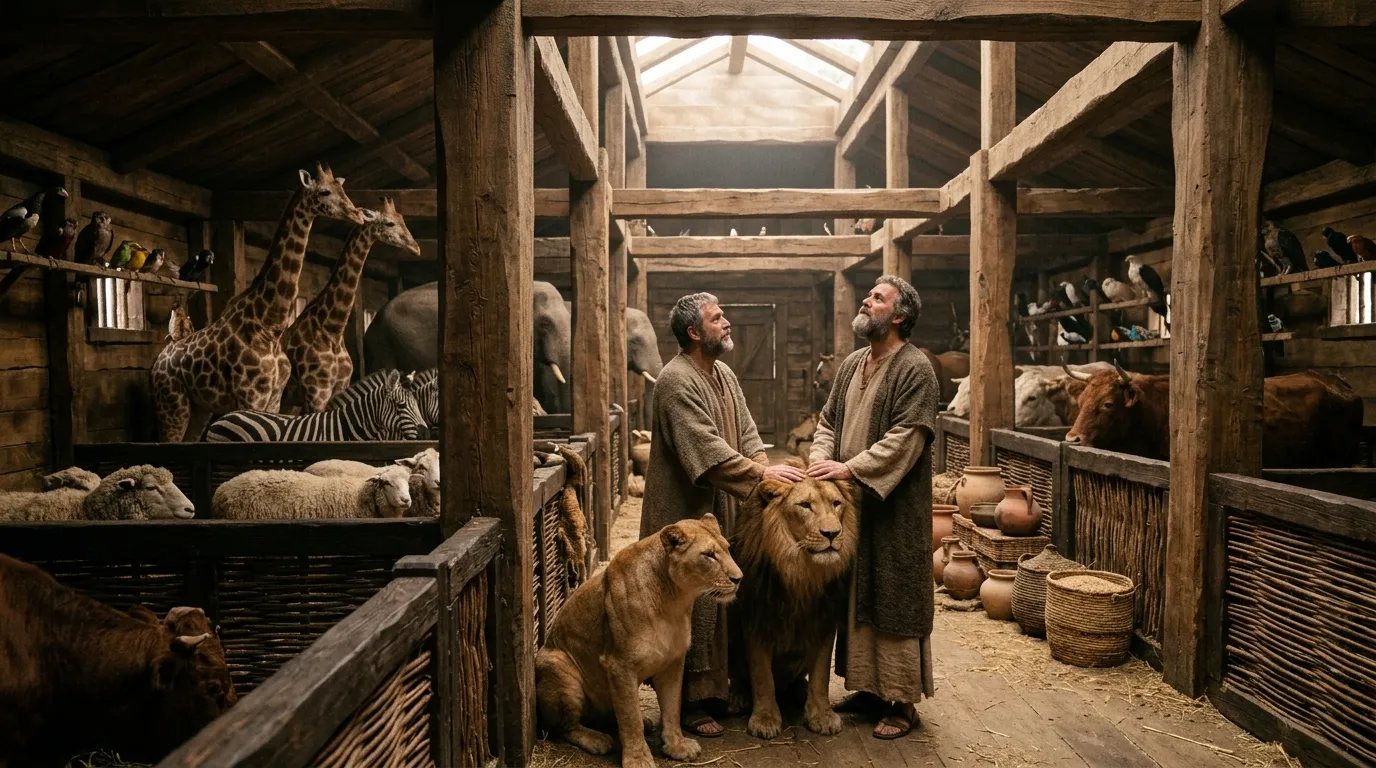
Picture the inside of the ark: a vast, three-decked vessel, sealed against the flood, carrying thousands of animals and eight people through a year of rain, darkness, and waiting. The question almost asks itself: where did the animals live? How were they housed, fed, and kept from chaos? The Bible does not use the phrase “animal pens,” but the question behind it is a good one. It asks what daily life on the ark actually involved, and what the logistics of the ark reveal about God’s provision and Noah’s stewardship.
It is important to be honest about what Scripture says and what it does not say. Genesis describes the ark’s dimensions, its three decks, its roof, its door, and its coating of pitch. It says that Noah was to bring animals in pairs and in sevens, and that he was to store food for them. It does not describe stalls, cages, pens, or any specific system of housing. The Bible leaves the details of animal management to inference. What follows is therefore a careful reconstruction: what the text says, what the ark’s design implies, and what the logistics would have required.
What the Text Actually Specifies
The instructions God gave Noah in Genesis 6 are specific about some things and silent about others. He specified the ark’s size: 300 cubits long, 50 wide, 30 high. He specified three decks. He specified a door in the side and an opening for light near the top. He specified that the ark was to be covered with pitch inside and out. And He specified the cargo: Noah, his wife, his three sons and their wives, plus the animals and food for all of them.
What He did not specify is how the animals were to be arranged. The text does not mention pens, stalls, or partitions. It does not say how the animals were separated, how waste was managed, or how the food was distributed. That silence is worth respecting. The Bible’s focus is not on the mechanics of animal husbandry. It is on the obedience of Noah, the judgment of the flood, and the mercy of the ark. The logistics are left to the reader’s imagination — and to the recognition that whatever system Noah used, it worked for more than a year.
Yet the design of the ark implies organisation. Three decks, in a vessel 450 feet long, provide a great deal of floor space — roughly 100,000 square feet across all three levels. That space had to accommodate the animals, the food, and the family. It is reasonable to infer that Noah divided the space in some way, separating animals by kind, size, or temperament, and keeping the food stores apart from the living quarters. Whether he built wooden partitions, used natural barriers, or relied on the animals’ own instincts is not recorded. The text gives us the vessel and the cargo, and leaves the arrangement to Noah’s wisdom.
Feeding Thousands of Animals for a Year
The food problem is one of the most daunting aspects of the ark’s logistics. Genesis 6:21 says, “You are to take every kind of food that is to be eaten and store it away as food for you and for them.” The ark carried a year’s supply of food for thousands of animals and eight people. That is a staggering amount of provisions, and it raises questions about storage, preservation, and distribution.
The three-deck design helps here. The lowest deck, closest to the waterline, would have been the most stable and the coolest — ideal for food storage. Grain, dried fodder, and other provisions could have been stored in bulk, protected from the animals and from moisture. The middle and upper decks could have housed the animals and the family. The arrangement would have allowed Noah’s family to move food upward as needed, feeding the animals deck by deck.
The variety of diets is another challenge. The ark carried carnivores, herbivores, and birds, each with different nutritional needs. The text does not explain how Noah fed lions and lambs in the same vessel, or how he preserved meat for carnivores without refrigeration. Some readers have suggested that the animals may have entered a state of dormancy or hibernation, reducing their needs. Others have suggested that God supernaturally sustained them. The Bible does not say. What it does say is that Noah did “all that God commanded him.” The provision of food was part of his obedience, and the fact that the animals survived is part of the testimony that God’s plan worked.
Waste, Air, and the Daily Work of the Ark
A year at sea with thousands of animals raises practical questions that the text does not answer: how was waste managed? How did fresh air circulate? How did eight people care for so many creatures? The ark’s design offers some clues. The opening near the top — the “window” or “light” that Noah later opened to release the raven and the dove — would have provided ventilation. The pitch coating would have kept the vessel watertight. The three decks would have allowed for separation of waste and living areas.
The daily work of the ark would have been relentless. Feeding, watering, cleaning, and caring for thousands of animals, day after day, for over a year, with only eight people to do it, is a workload that is difficult to imagine. It is worth pausing over this, because it corrects a sentimental picture of the ark as a peaceful floating zoo. The ark was a place of hard labour, of early mornings and late nights, of smells and noise and mess. Noah’s family did not merely ride out the flood. They worked through it. Their obedience was not a single act of building. It was a year of daily, grinding faithfulness, caring for creatures that could not care for themselves.
That daily labour is part of the ark’s meaning. The ark was not only a vessel of salvation. It was a place of stewardship. Noah and his family were given charge of the animals, and they discharged that charge through months of unseen work. The Bible does not record their complaints or their exhaustion. It records only that they did what God commanded. The pens, stalls, and partitions — whatever they were — were the infrastructure of that stewardship. They were the means by which eight people kept the seed of the new world alive.
Separating Predator and Prey
One of the most intriguing questions about the ark’s housing is how Noah kept predators and prey apart. The ark carried lions and lambs, wolves and sheep, hawks and doves. In the wild, these creatures would not coexist. On the ark, they did, for over a year. The Bible does not explain how. It may be that the three decks allowed for separation, with predators on one level and prey on another. It may be that God supernaturally calmed the animals, just as He brought them to the ark. It may be that the partitions, whatever they were, were sufficient to keep the peace.
Whatever the mechanism, the coexistence of predator and prey on the ark is a picture of the peace that God will one day establish. Isaiah’s vision of the wolf living with the lamb and the lion eating straw like the ox is a picture of the world as it will be when the curse is fully removed. The ark, for a year, was a small preview of that world: creatures that would normally kill each other, kept alive together under God’s protection. The pens of the ark, if we may call them that, were the first glimpse of a peace that the whole creation is waiting for.
The Ark as Stewardship: What the Housing Teaches
The housing of the animals on the ark, whatever its exact form, points to a truth that runs through the whole Bible: God entrusts His creatures to human care, and He expects that care to be diligent. Adam was given dominion over the animals in Eden. Noah was given charge of the animals in the ark. The dominion was not a licence to exploit. It was a responsibility to preserve. The ark’s animal quarters — however they were arranged — were the first great exercise of that responsibility on a large scale.
There is also a picture here of the church. The ark has often been seen as a type of Christ, and the animals within it as a picture of the diversity of the people God saves. Just as the ark held creatures of every kind, kept alive together by God’s provision and Noah’s care, so the church holds people of every nation, tribe, and tongue, kept alive together by Christ’s provision and the care of His people. The pens of the ark, if we may call them that, were the compartments in which God’s diverse creation was preserved through judgment. The church is the vessel in which God’s diverse humanity is preserved through grace.
When the floodwaters receded and Noah opened the ark, the animals went out to repopulate the earth. The housing that had kept them alive for a year was no longer needed. The temporary partitions were abandoned, the decks were emptied, and the creatures spread across the new world. The ark’s work was done. But the pattern it established — God providing a vessel, people stewarding the life within it, and creation preserved through judgment — continues. The story of Noah’s Ark has inspired centuries of reflection on how God preserves life, and the unseen labour of the ark’s household remains one of its most practical lessons.










