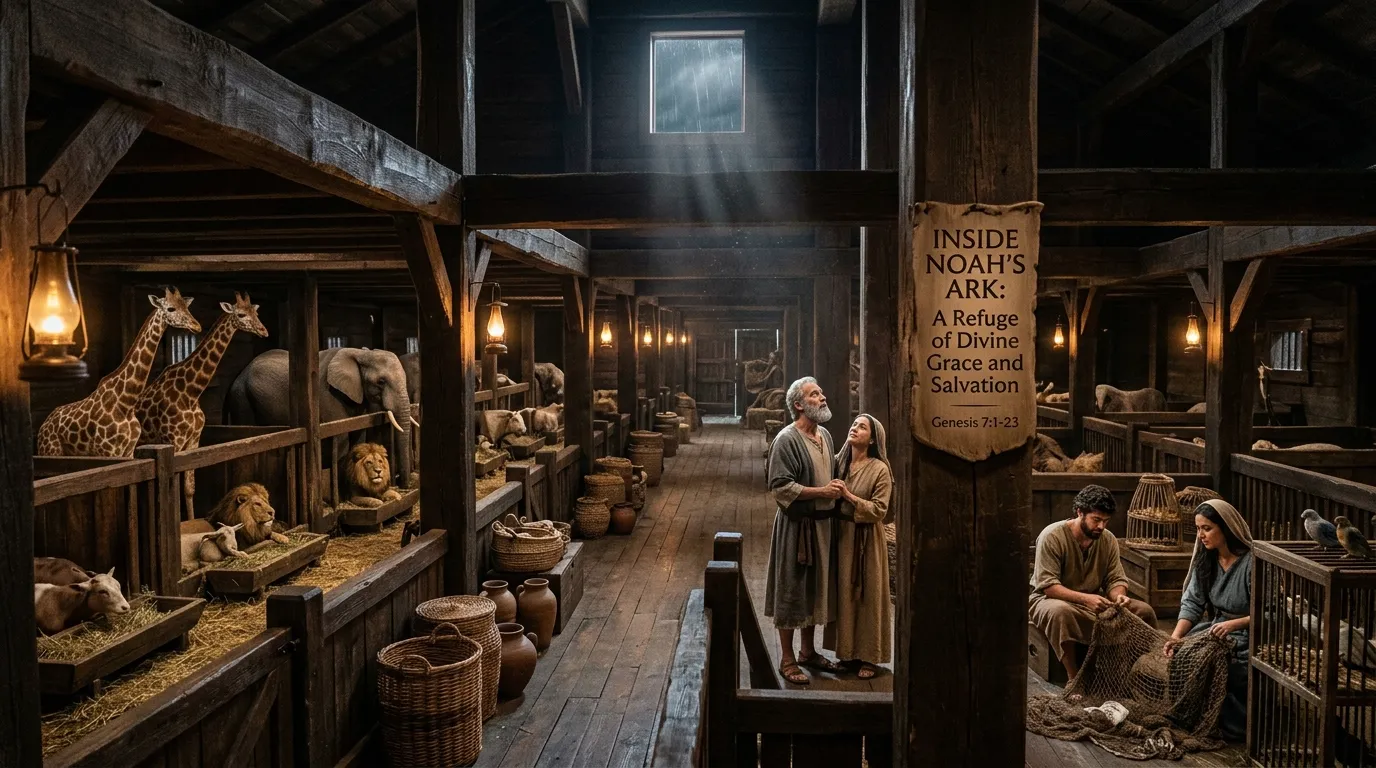
We know what the ark looked like from the outside: a massive wooden vessel, sealed with pitch, riding the floodwaters. But what was it like inside? Genesis gives us only fragments — a door, a window, three decks, a year of waiting — and the rest we must reconstruct from the timeline, the psychology of the passengers, and the theology of the story. To imagine the inside of Noah’s ark is to enter one of the strangest experiences in the Bible: eight people and thousands of animals, shut in by God, floating over a drowned world, waiting for a sign that it was safe to come out.
The first thing to grasp is the duration. The flood was not a brief storm. From the day Noah entered the ark to the day he left it, more than a year passed — 371 days by the most careful reckoning of the Genesis timeline. The rain fell for forty days and nights. The waters prevailed for 150 days. Then the waters receded for months. Then Noah waited, sending out birds, watching the mountaintops appear, waiting for the ground to dry. The inside of the ark was not a weekend shelter. It was a home for over a year, a floating world in which a family lived, worked, and waited while the world outside was remade.
Shut In by God
The most important detail about the inside of the ark is how the door was closed. Genesis 7:16 says, “Then the Lord shut him in.” Noah did not seal the door himself. God did. The significance of that sentence cannot be overstated. The ark’s safety did not depend on Noah’s ability to seal the door against the flood. It depended on God’s act of closing it. The same God who commanded the ark to be built took responsibility for sealing it, and the same God who sealed it would open it again when the time was right.
That detail also means that once the door was shut, there was no way out. Noah could not change his mind. He could not let anyone else in. He could not step outside to check the weather. The family was committed, sealed inside a wooden vessel, floating on a world of water, with no control over where they were going. The ark had no sail, no rudder, and no engine. It went where the waters carried it. The experience of being inside the ark was an experience of total dependence — on the vessel God had designed, on the door God had shut, and on the promise God had made.
The shutting of the door also marks a separation. Outside the ark, the world was being judged. Inside the ark, the world was being preserved. The same waters that destroyed the world outside carried the ark to safety. The same flood that was death to those outside was the means of deliverance to those inside. The ark’s interior was thus a pocket of mercy inside a world of judgment, a space where God’s wrath could not reach because God’s promise had already enclosed it.
The Senses of the Ark: Darkness, Sound, and Smell
What did the inside of the ark feel like? The Bible does not describe it, but the design implies certain realities. The ark had one opening for light, near the top, and a single door in the side. For most of the year, the interior would have been dim. The family’s light would have come from the opening above and from lamps, if they had them. The ark was a world of shadows, lit from above, much like the world itself in the days before the flood.
The sounds would have been overwhelming. Thousands of animals — cattle, sheep, birds, wild creatures — living in close quarters for a year, would have produced a constant chorus of calls, growls, roars, and movements. The rain, hammering on the roof for forty days, would have been deafening. The creaking of the timbers, the shifting of the vessel in the waves, the lapping of water against the hull — all of it would have filled the ark with a noise that never fully stopped. The family lived inside that noise, day and night, for months.
The smells, too, would have been intense. Thousands of animals produce waste, and eight people had to manage it. The ark was a place of hard labour, of cleaning and feeding and caring, in conditions that were far from pleasant. The romantic image of the ark as a peaceful floating zoo does not survive a realistic reading of the text. The inside of the ark was a place of work, of endurance, of faithfulness in difficult conditions. Noah’s family did not merely ride out the flood. They laboured through it.
The Long Wait: Watching for Dry Land
The hardest part of being inside the ark may not have been the storm but the waiting. After the rain stopped, the waters took months to recede. The ark came to rest on the mountains of Ararat, and then the family waited. Genesis records the slow sequence: the tops of the mountains appeared, then forty more days passed, then Noah sent out a raven, then a dove, then a dove again, then a dove that did not return, and then Noah removed the covering of the ark and saw that the ground was dry. Even then, he waited for God’s command before leaving.
The birds are the emotional centre of the waiting. The raven flew back and forth, finding no rest. The dove returned with nothing the first time, returned with an olive leaf the second time, and did not return the third time. Each flight was a test, a question sent out into the world: is it safe yet? Is there life yet? The olive leaf, in particular, is one of the most hopeful images in the Bible. A single leaf, carried in a dove’s beak, meant that trees were growing again, that the world was alive, that the flood was over. The family inside the ark received that news the way prisoners receive news of release — with a joy that only long confinement can produce.
The waiting also reveals Noah’s obedience. Even after the ground was dry, Noah did not leave. He waited for God to say, “Come out of the ark.” The man who had waited 120 years to build the ark, and a year inside it, waited a little longer for the word of God. The inside of the ark was thus a school of patience, a place where Noah learned that deliverance comes not when the circumstances look right, but when God speaks.
Noah’s Family: Eight People in a Floating World
The ark carried eight people: Noah, his wife, his three sons, and their wives. For over a year, these eight were the entire human race. They cooked, cleaned, fed the animals, and waited together, in close quarters, with no privacy and no escape. The family dynamics of that year are not recorded, but they must have been intense. The sons’ wives had left their own families behind. The family had lost everyone else they knew. The ark was a place of grief as well as preservation.
Yet the family endured. The Bible records no quarrels, no mutinies, no breakdowns aboard the ark. The eight people who entered the ark were the eight who left it, and they left together, to begin the world again. The ark’s interior was thus not only a place of animal management. It was a place where a family held together through the greatest catastrophe in history, sustained by a promise and by each other.
The Ark as a Picture of Salvation
The New Testament treats the ark as a picture of salvation. Peter writes that the ark saved Noah’s family through water, and that baptism, which corresponds to the flood, now saves believers — not by washing dirt from the body, but as an appeal to God for a good conscience through the resurrection of Jesus Christ. The parallel is deliberate: just as the ark carried Noah through judgment, so Christ carries believers through judgment. Just as the ark’s door was shut by God, so salvation is secured by God. Just as the ark’s passengers were safe inside while the world outside was judged, so believers are safe in Christ while the world awaits its judgment.
The inside of the ark is thus a picture of what it means to be in Christ. To be in Christ is to be enclosed by a promise, sealed by God, carried through judgment by a vessel not of one’s own making, and kept alive by a provision not of one’s own supplying. The ark’s passengers did not save themselves. They entered a vessel God designed, through a door God opened, and were shut in by God Himself. The Christian’s salvation follows the same pattern: enter through the door God has opened, and trust the God who shuts it behind you.
When Noah finally stepped out of the ark, the first thing he did was build an altar and offer a sacrifice. The first act of the new world was worship. The family that had lived for a year in darkness, noise, and waiting emerged into sunlight and offered thanks. The inside of the ark had been a place of preservation. The outside, now dry, was a place of new beginning. The Genesis flood narrative continues to speak to readers about what it means to be carried safely through judgment and brought out into a new world.










