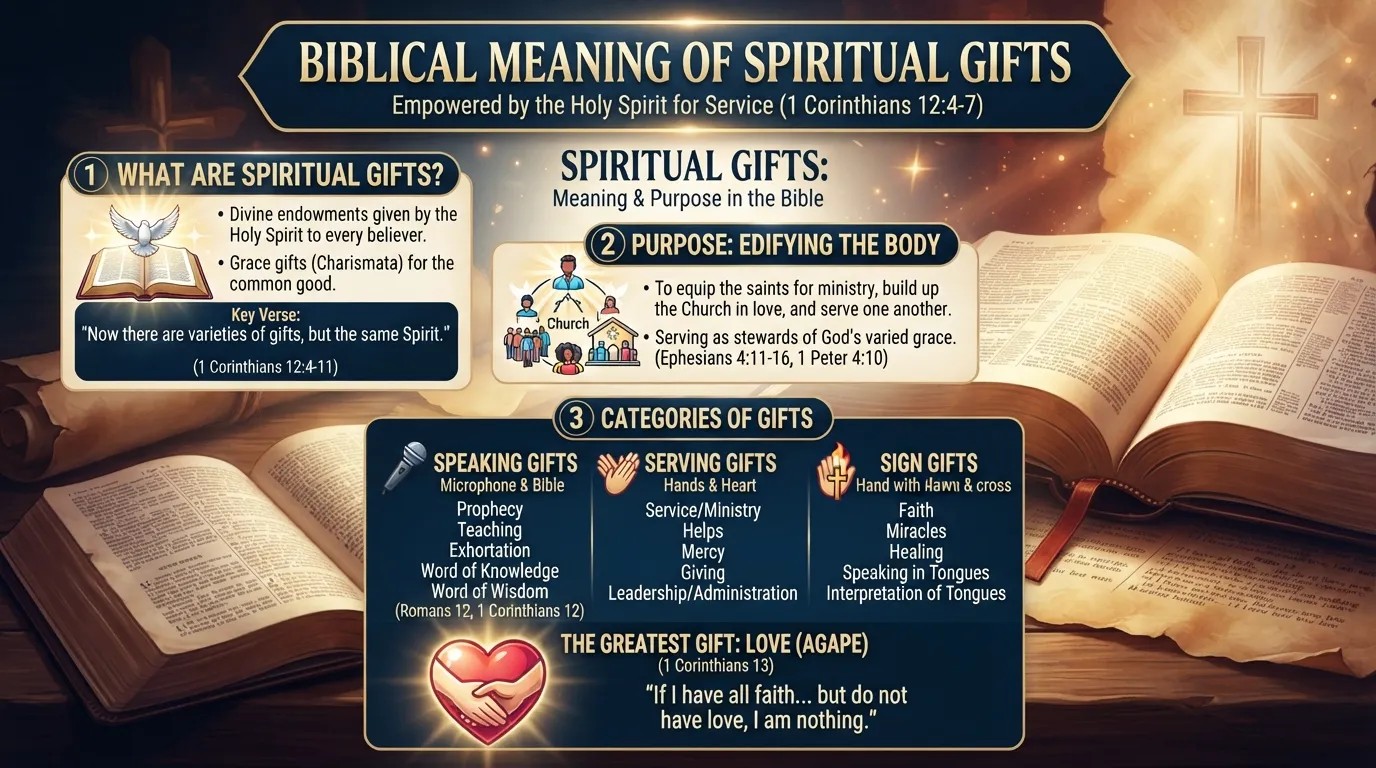
“Now about the gifts of the Spirit, brothers and sisters, I do not want you to be uninformed.” With that sentence, Paul opened one of the most discussed chapters in the New Testament. The Corinthian church was fascinated by spiritual gifts — especially the spectacular ones — and the fascination was tearing them apart. Some believers felt superior because of their gifts. Others felt useless because they lacked them. Worship had become chaotic. Paul’s answer, spread across 1 Corinthians 12–14, is not to diminish the gifts but to relocate them: gifts are given by the Spirit, distributed by His wisdom, and governed by love, for the common good of the body.
The phrase “spiritual gifts” translates the Greek charismata, gifts of grace. The word itself carries the theology: gifts are not wages earned, trophies won, or proofs of spiritual rank. They are grace — free, undeserved, and given for a purpose larger than the person who receives them. Every discussion of spiritual gifts that forgets that word has already gone wrong.
One Spirit, Many Gifts, One Body
Paul begins with the source. “There are different kinds of gifts, but the same Spirit distributes them. There are different kinds of service, but the same Lord. There are different kinds of working, but in all of them and in everyone it is the same God at work” (1 Corinthians 12:4–6). The Trinitarian frame is deliberate: Spirit, Lord, God — one giver behind every gift. No gift is a private possession. No gift originates in the believer’s talent or effort, though talents may be the channel through which the Spirit works.
Then comes the body metaphor, the most sustained image in the passage. The body is one, though it has many parts. The eye cannot say to the hand, “I don’t need you.” The head cannot say to the feet, “I don’t need you.” In fact, Paul argues, the parts that seem weaker are indispensable, and the parts we think less honorable we treat with special honor. This is a radical reversal of Corinthian values, where honor went to the visible and the vocal. In the body of Christ, honor flows toward the hidden and the overlooked.
Paul’s list of gifts in chapter 12 includes wisdom, knowledge, faith, healing, miraculous powers, prophecy, distinguishing between spirits, speaking in tongues, and interpretation of tongues. Romans 12 adds serving, teaching, encouraging, giving, leading, and showing mercy. Ephesians 4 adds apostles, prophets, evangelists, pastors, and teachers. Peter adds hospitality and speaking the very words of God. The lists are not identical, and that is part of the point: no single list is exhaustive. The Spirit is not confined to a catalog.
The Purpose: The Common Good
“Now to each one the manifestation of the Spirit is given for the common good” (1 Corinthians 12:7). That sentence is the constitution of the whole discussion. Gifts are not given for self-promotion, self-gratification, or self-certification. They are given for others. A gift that does not build up the church is being misused, no matter how impressive it looks. This is why Paul can say that prophecy is greater than tongues in gathered worship — not because tongues are invalid, but because prophecy, understood by all, builds up the church, while uninterpreted tongues build up only the speaker.
The common-good principle also answers the question of why different people receive different gifts. The Spirit distributes “to each one, just as he determines” (1 Corinthians 12:11). The distribution is sovereign, not democratic. We do not choose our gifts the way we choose electives. We receive them, discover them, and steward them. Envy of another’s gift is a refusal of the Spirit’s wisdom. A foot that wishes it were a hand has misunderstood both feet and hands.
Love: The More Excellent Way
Between the two great gift chapters sits 1 Corinthians 13 — the hymn to love. Its placement is not decorative. It is structural. Paul has just finished describing the gifts, and he will go on to regulate them, but between description and regulation he inserts the standard: without love, the greatest gifts are noise. “If I speak in the tongues of men or of angels, but do not have love, I am only a resounding gong or a clanging cymbal.” Prophecy, knowledge, faith that moves mountains, even giving everything to the poor — without love, they gain nothing.
Love, as Paul defines it, is not a feeling. It is a pattern: patient, kind, not envious, not boastful, not proud, not dishonoring others, not self-seeking, not easily angered, keeping no record of wrongs. That list is a direct diagnosis of Corinth’s problems. The Corinthians were envious, boastful, proud, self-seeking, and easily angered — and they were exercising spiritual gifts in the middle of it. Paul’s point is devastating: you can exercise a genuine gift in an ungodly way. The gift may be real; the use may be loveless. And loveless use nullifies the value.
Order in Worship
In chapter 14, Paul applies the principles. Everything in gathered worship must be done for strengthening the church. Prophecy is preferred over uninterpreted tongues because it instructs. Tongues are to be limited — two or three at most, one at a time, with interpretation — or the speaker should keep quiet. Prophecy is likewise limited to two or three, with others weighing what is said. “God is not a God of disorder but of peace.” Worship that confuses unbelievers and embarrasses believers is not evidence of the Spirit’s freedom. It is evidence of the flesh’s dominance.
Paul’s regulations are practical, not theoretical. He is writing to a real church where real people were talking over each other, showing off, and leaving the gathering more divided than when they arrived. The goal of worship is not to demonstrate how spiritual we are. It is to leave the church stronger, the unbeliever convicted, and God glorified.
Discovering and Using Your Gift
How, then, should a believer approach spiritual gifts? First, desire them — Paul says to “eagerly desire” the greater gifts, especially prophecy (1 Corinthians 14:1). Desire is not envy. It is a holy hunger to be useful. Second, serve where there is need. Gifts are often discovered in service, not in speculation. The person who serves finds out what the Spirit has equipped them to do. Third, submit your gift to the judgment of the church. Paul expected prophecies to be weighed and gifts to be exercised under the oversight of mature believers. Fourth, measure every gift by love and by edification. If it does not build up others, it is not being used as the Spirit intended.
Finally, remember that the greatest gift is not a gift at all. It is the Giver. The Spirit who distributes gifts is the same Spirit who seals believers, indwells them, and produces the fruit of love, joy, peace, patience, kindness, goodness, faithfulness, gentleness, and self-control. Gifts without fruit are a warning sign. Fruit without gifts is still a full Christian life. The Corinthians wanted gifts. Paul wanted them to want God.
Gifts and the Fruit of the Spirit
The New Testament holds two realities in tension: the gifts of the Spirit and the fruit of the Spirit. Gifts are what the Spirit enables us to do. Fruit is what the Spirit makes us to be. The Corinthians had gifts in abundance and fruit in short supply, and Paul’s letters diagnose the imbalance. A church can be gifted and loveless. It cannot be fruitful and loveless, because love is the first fruit. “The fruit of the Spirit is love, joy, peace, forbearance, kindness, goodness, faithfulness, gentleness and self-control” (Galatians 5:22–23).
The distinction matters because gifts can be impressive without being transformative. A person can prophesy accurately and still be arrogant. A person can speak in tongues and still be unkind. A person can lead brilliantly and still be impatient. Fruit is the test of character. Gifts are the tools of ministry. Tools without character are dangerous. Character without tools is limited, but it is never dangerous in the same way. Paul’s priority is clear: pursue love, and let gifts serve love.
The fruit of the Spirit is also the evidence of the Spirit’s work in a believer’s life. If you wonder whether the Spirit is at work in you, do not begin by asking which gift you have. Begin by asking whether you are more loving, more joyful, more peaceful, more patient than you were a year ago. Gifts may come and go. Fruit grows steadily, season after season, in the soil of a surrendered life.
When Gifts Are Misused
The Corinthian church shows what happens when gifts are misused: worship becomes chaotic, the strong despise the weak, and unbelievers leave confused rather than convicted. Paul’s corrective is not to suppress the gifts but to order them by love. Gifts exercised without love become weapons. Prophecy without love becomes arrogance. Knowledge without love becomes pride. Tongues without love become noise. The test of a gift is not its impressiveness. It is its effect on the church. Does it build up? Does it encourage? Does it comfort? Does it glorify God? If not, it is being misused, no matter how genuine the gift may be.
For a general overview of how this doctrine has been understood across church history, the Wikipedia article on spiritual gifts offers a helpful survey.










