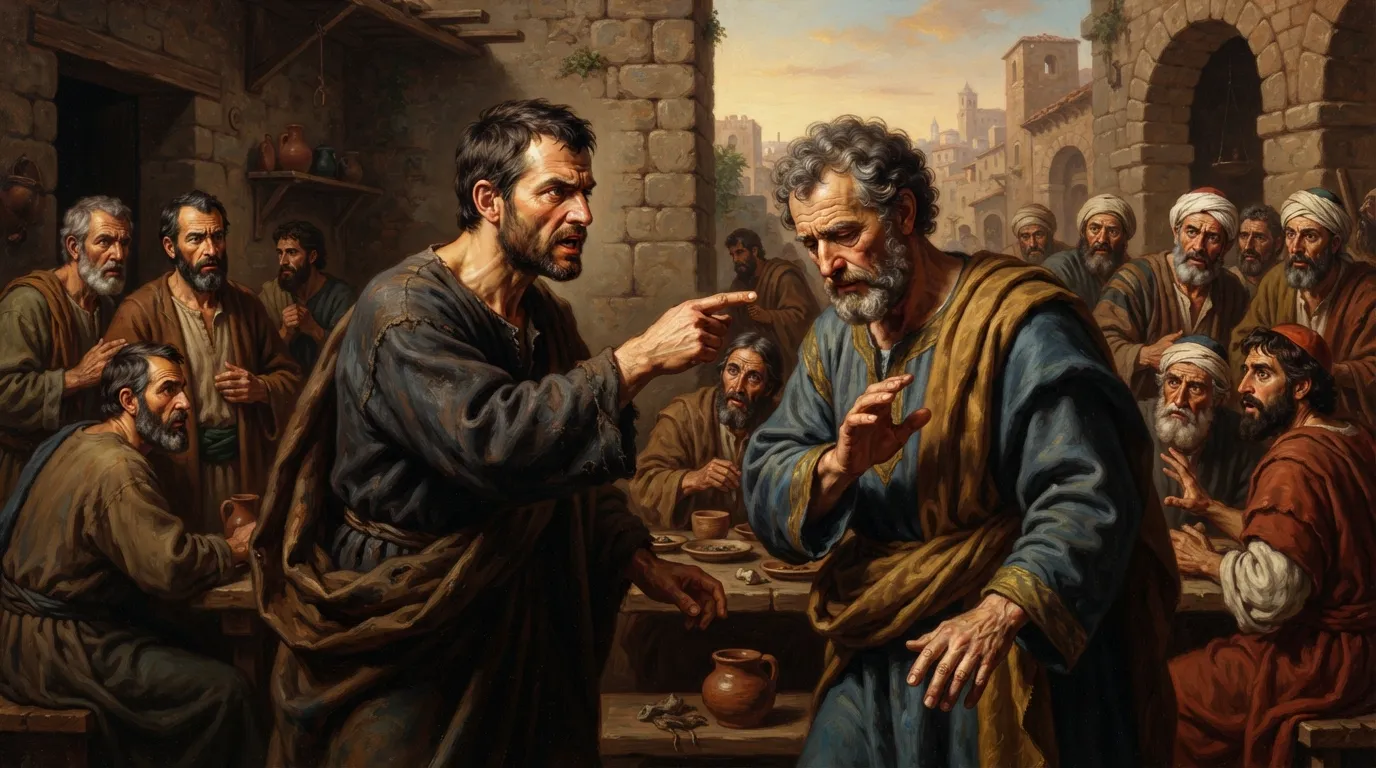
Antioch was the city where the followers of Jesus were first called Christians. It was also the city where two of the greatest apostles had a public confrontation. In Galatians 2:11–14, Paul writes that when Peter came to Antioch, “I opposed him to his face, because he stood condemned.” The cause was table fellowship: Peter had been eating with Gentile believers, then withdrew when men from James arrived, and his withdrawal pulled other Jewish believers — even Barnabas — along with him. Paul called it hypocrisy, and he said so publicly.
This passage is uncomfortable for anyone who prefers a tidy picture of the apostles always agreeing. It is also one of the most important passages in the New Testament, because it shows that the gospel must be defended not only against false teaching but against true teaching betrayed by behavior. Peter did not preach a false gospel at Antioch. He lived a contradiction of the true one. And Paul would not let that stand.
What Peter Did, Step by Step
Paul’s account is precise. Before certain men came from James, Peter “used to eat with the Gentiles.” This was not a small thing. In the ancient world, eating together was a declaration of fellowship and equality. Peter had learned this lesson at Cornelius’s house, where he ate with Gentiles and defended it before the Jerusalem church. He had defended Gentile inclusion at the Jerusalem Council. He knew the theology.
Then the men arrived, and Peter “began to draw back and separate himself from the Gentiles because he was afraid of those who belonged to the circumcision group.” The motive Paul names is fear — fear of criticism, fear of the Jerusalem faction, fear of losing standing. Fear is an honest diagnosis, and Paul does not soften it. The rest of the Jewish believers joined the pretense, and even Barnabas — Paul’s old partner, the son of encouragement — was “led astray.” The word Paul uses for Peter’s conduct is hypokrisis, play-acting: Peter was performing a role that contradicted what he knew to be true.
Why a Meal Mattered This Much
Modern readers sometimes wonder why Paul made such a fuss over lunch. The answer is that in the first-century church, the meal was the gospel made visible. Jewish food laws had long functioned as a boundary between Jews and Gentiles. To eat together — especially to share the Lord’s Supper — was to declare that the boundary had been removed by the cross. If Jewish believers ate separately, they were saying, in effect, that Gentiles were second-class citizens in the kingdom, welcome to be saved but not welcome at the table.
Paul’s charge was theological, not social. He told Peter, “You are a Jew, yet you live like a Gentile and not like a Jew. How is it, then, that you force Gentiles to follow Jewish customs?” Peter’s withdrawal was not neutral. It communicated a requirement: to be fully accepted, Gentiles had to live like Jews. That was the very error the Jerusalem Council had rejected. A seating arrangement had become a gospel issue.
Why Paul Confronted Peter Publicly
Paul opposed Peter “in front of them all.” The public setting was not cruelty; it was proportionality. Peter’s withdrawal had been public, and its influence had spread publicly. A private conversation would not have undone the public signal that Gentiles were not full members of the family. When an error is visible, the correction must be visible too.
This passage also establishes something crucial about apostolic authority: no leader is above correction. Peter was the apostle to the Jews, a pillar of the church, the man who had confessed Christ and preached at Pentecost. He was still wrong, and he was still correctable. The church has no pope of behavior. Every leader, however gifted, can be called back to the gospel — including by a colleague.
How the Confrontation Fits with the Jerusalem Council
The timing matters. The Antioch incident most likely occurred after the Jerusalem Council, which makes Peter’s behavior more striking: he was acting against a decision he had helped make. Agreement in council does not guarantee consistency in conduct. The council had settled the principle; Antioch tested the practice. This is a pattern every church knows. A congregation can affirm unity on Sunday and fracture over a seating chart, a menu, a music choice, or a leadership decision on Monday. The gospel must be re-applied at every table, not just affirmed in every creed.
Paul’s argument in Galatians 2 flows directly from the confrontation into one of the great doctrinal passages of the New Testament: “a person is not justified by the works of the law, but by faith in Jesus Christ” (Galatians 2:16). The confrontation is not a digression. It is the doorway to the letter’s central argument. Behavior at the table and doctrine of justification are connected, because both answer the same question: on what basis does a person belong to God’s people?
Did Peter Repent?
Paul does not record Peter’s response, and the silence has led to speculation. But the rest of the New Testament suggests the rebuke landed. Peter later writes in 2 Peter 3:15–16 of “our dear brother Paul,” acknowledging Paul’s wisdom. The two men are not presented as permanent enemies. The early church tradition uniformly honors both. The most reasonable reading is that Peter accepted the correction, as a godly man does. Proverbs says that the one who rebukes a wise man gains a friend. Peter proved wise by receiving it.
There is also a pastoral lesson here for those who must be corrected. Being rebuked does not disqualify a person. Peter’s failure at Antioch did not erase Pentecost, and it did not end his apostleship. Leaders who can receive a hard word and change course are more trustworthy, not less. The church needs leaders who can say, “I was wrong,” and mean it.
Lessons for Confrontation Today
The Antioch confrontation offers a model for handling serious disagreement among believers. First, confront the behavior, not the person’s salvation. Paul never questioned whether Peter was a Christian. He questioned whether Peter was living consistently with the gospel. Second, name the real motive when it is clear — in this case, fear — but do it without inventing motives that are not evident. Third, match the scope of the correction to the scope of the offense: public error, public correction; private fault, private conversation (Matthew 18:15). Fourth, anchor the rebuke in the gospel, not in personal preference. Paul did not say, “You embarrassed me.” He said, “You are not acting in line with the truth of the gospel.” Fifth, leave the door open for restoration. Paul’s later references to Peter are respectful, and the church went on honoring both men.
The incident at Antioch also warns against a subtle danger: the fear of the circumcision group has modern equivalents. Every church has a faction whose disapproval feels costly — traditionalists, innovators, donors, long-standing families, online critics. When leaders shape their public conduct to appease a faction rather than to honor the gospel, they repeat Peter’s error. The table must be set by the cross, not by the crowd.
Peter’s Later Letters and the Lesson Learned
The Antioch confrontation left a mark on Peter, and his later letters suggest he absorbed the lesson. In 1 Peter, written to scattered believers across Asia Minor — including Gentile Christians — Peter emphasizes that God shows no partiality and that believers are “a chosen people, a royal priesthood, a holy nation” (1 Peter 2:9). The man who once withdrew from Gentile tables now writes to Gentile believers as full members of God’s people, with no hint of second-class status. The man who once feared the circumcision group now exhorts believers not to fear persecution but to honor Christ as Lord in their hearts.
Peter also writes about humility and mutual submission: “Clothe yourselves with humility toward one another, because God opposes the proud but shows favor to the humble” (1 Peter 5:5). It is hard to read that sentence without thinking of Antioch, where Peter was humbled by a public rebuke and clothed himself in repentance. The letter of a humbled man carries a different weight than the letter of a man who has never been corrected.
There is encouragement here for anyone who has been publicly corrected. Peter’s failure at Antioch is preserved in Scripture forever — it is not hidden, not minimized, not forgotten. And neither is his restoration. The same Bible that records the rebuke records the restoration. God does not erase the failures of His servants. He redeems them, and He uses the redeemed failures as teachers. Peter’s letters are better because of Antioch, not in spite of it.
Fear and the Table Today
Peter’s failure at Antioch was driven by fear — fear of the circumcision group, fear of criticism, fear of losing standing. The same fear operates in churches today. Leaders avoid welcoming certain people because they fear the reaction of influential members. Congregations maintain invisible boundaries — around race, class, politics, or background — because crossing them feels risky. The Antioch story calls every church to examine its tables. Who is welcome? Who is kept at a distance? Who eats together, and who eats apart? The gospel must be visible at the table, or it is not visible at all. The church that segregates its tables denies the cross that united them.
For the historical background of this confrontation, see the Wikipedia article on the Incident at Antioch.










