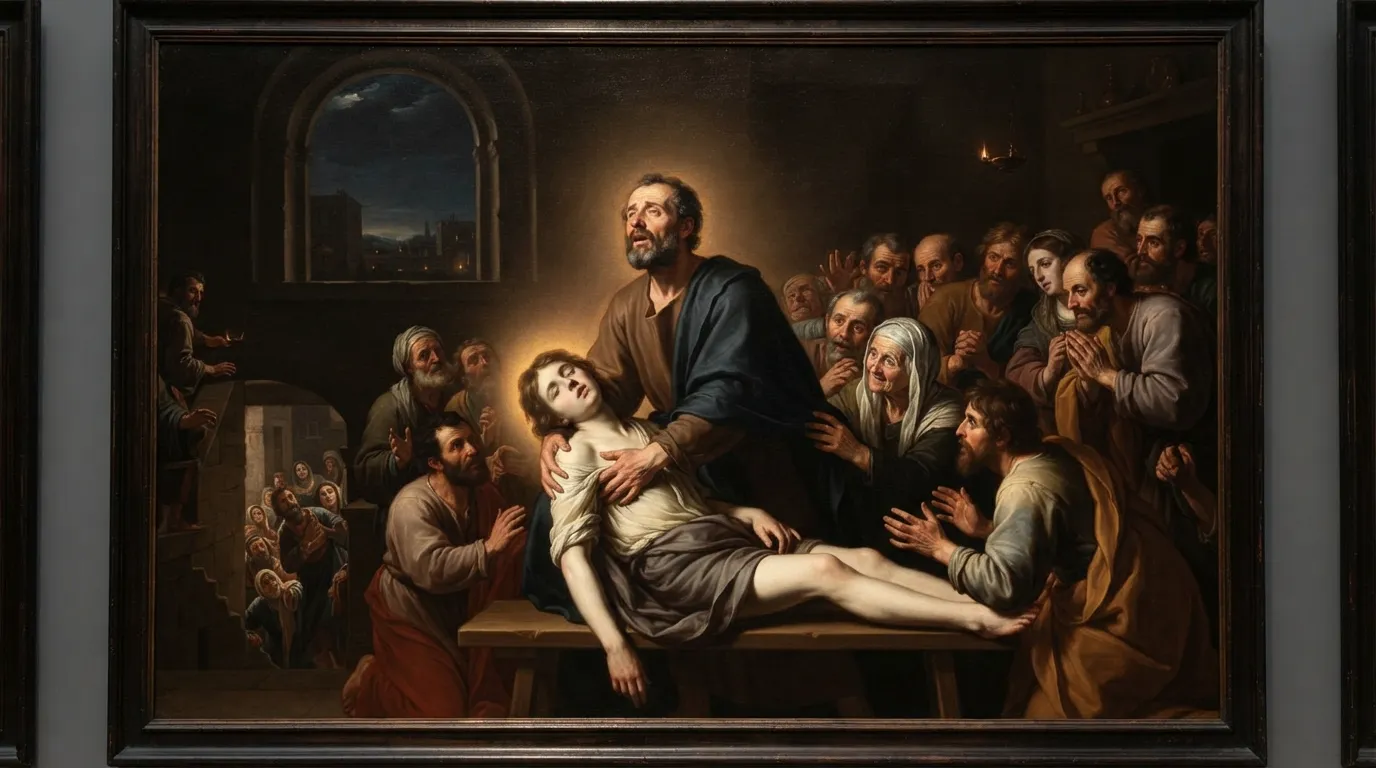
It was past midnight in Troas. A young man named Eutychus was sitting in a window, listening to Paul preach, and slowly losing the battle with sleep. Paul talked on and on — Luke says he kept talking until midnight, because he was leaving the next day. Eutychus sank into a deep sleep, fell from the third story, and was picked up dead. Paul went down, threw himself on the young man, put his arms around him, and said, “Don’t be alarmed. He’s alive!” Then he went back upstairs, broke bread, ate, and kept talking until daylight.
The raising of Eutychus in Acts 20:7–12 is one of the strangest and most tender miracles in the New Testament. It interrupts a farewell sermon with a death and a resurrection. It is the only resurrection performed by Paul recorded in Acts, and it happens not on a battlefield or in a palace but in an upper room, during an ordinary worship gathering, to an ordinary young man whose only distinction was that he fell asleep during a sermon. That ordinariness is part of the point. Resurrection power shows up in ordinary rooms.
The Setting: A Farewell Gathering in Troas
Paul was traveling toward Jerusalem, and he stopped in Troas for seven days. On the first day of the week — a detail Luke includes deliberately, since it is one of the earliest references to Christians gathering on Sunday — the believers met to break bread. Paul spoke to them, and because he was leaving the next day, he kept on talking until midnight. There were many lamps in the upstairs room. The air would have been warm, the room crowded, the hour late. Eutychus, whose name means “fortunate” or “lucky,” sat in the window — probably to catch air, or because the room was full.
Luke, who was present (the passage uses “we”), tells the story with a physician’s precision and a storyteller’s restraint. He does not blame Eutychus for falling asleep. He does not blame Paul for preaching long. He simply reports what happened: the young man “sank into a deep sleep as Paul talked on and on,” fell, and was picked up dead. The honesty of the narrative is worth noting. The early church did not edit out embarrassment. A boy fell asleep in church and died. It is in the Bible.
What Paul Did — and What It Echoed
Paul’s response echoes two older stories. In 1 Kings 17, Elijah stretched himself out on the widow of Zarephath’s dead son three times and prayed, and the boy’s life returned. In 2 Kings 4, Elisha lay on the Shunammite woman’s dead son, mouth to mouth, eyes to eyes, hands to hands, until the boy sneezed seven times and opened his eyes. Paul’s action — going down, throwing himself on Eutychus, embracing him — belongs to that prophetic pattern. Luke’s wording closely parallels the Elijah and Elisha accounts, and the parallel is deliberate: the God who raised the dead through the prophets was still raising the dead through the apostles.
It also echoes Jesus. The Lord had raised the widow of Nain’s son, Jairus’s daughter, and Lazarus. Paul’s miracle is a continuation of the same ministry. The resurrection of Eutychus is not Paul showing off. It is the risen Christ working through His apostle, confirming that death does not have the last word even in a rented upper room in Troas.
Why Luke Included This Story
Acts is full of dramatic miracles — healings, exorcisms, prison doors opening. Why preserve this one? Several reasons suggest themselves. First, it confirms Paul’s apostolic authority at a moment when he was heading toward Jerusalem and arrest. The man going to suffer had the power of the resurrection on him. Second, it demonstrates the Lord’s care for the overlooked. Eutychus was not a leader. He was a youth in the window. Heaven noticed him. Third, it models the church’s response to tragedy: do not panic, do not disperse, bring the matter to God, and then return to the table.
Notice what happened after the miracle. Paul went back upstairs, broke bread, ate, and talked until daylight. The gathering was not canceled. The meal was not abandoned. The church did what the church does: it worshiped, ate, and listened, with a young man alive among them who had been dead an hour before. The resurrection did not replace worship. It fueled it.
Eutychus and the Danger of Sleep
Preachers have long used Eutychus as a warning against sleeping in church, and there is a gentle humor in that. But the deeper application runs the other way. Eutychus was in the room. He showed up. He stayed late. He was trying to listen. Spiritual sleepiness is real — the drowsiness that comes from long sermons, late nights, warm rooms, and weary bodies — but the answer is not guilt. The answer is the presence of people who notice when you fall, come down to where you are, and refuse to leave you on the ground.
There is also a word here for those who carry the preaching ministry. Paul talked “on and on.” Luke’s phrasing hints that the sermon was long, and Eutychus’s sleep was at least partly a natural response. Faithful preaching does not require exhausting the hearers. The miracle does not erase the humanity of the situation: bodies get tired, attention fades, and grace covers both the preacher’s excess and the hearer’s weakness.
Resurrection as a Pattern, Not an Exception
The raising of Eutychus points beyond itself to the resurrection that defines Christian faith. Paul would later write to the Corinthians that if Christ has not been raised, preaching is useless and faith is futile (1 Corinthians 15:14). Eutychus’s return to life was a small, local sign of that great reality. The same power that raised Jesus, and that raised Eutychus, is the power at work in every believer’s new life. Paul says in Ephesians 2 that God “made us alive with Christ even when we were dead in transgressions.” Every conversion is a Eutychus moment — someone dead in sin, picked up, embraced, and brought back to the table.
The story also anticipates the final resurrection. Eutychus would die again someday. His restoration was temporary, a reprieve, not the final victory. But it was a signpost. The God who interrupted a sermon to raise a boy in Troas will one day interrupt history to raise all His people. The window in Troas looks forward to the trumpet and the open graves.
What This Means for Ordinary Gatherings
The most practical lesson of Acts 20:7–12 may be the simplest: God works in ordinary gatherings. The church in Troas was not holding a special miracle crusade. They were breaking bread, listening to a farewell sermon, sitting in a crowded, lamp-lit room. Miracles happen in such rooms — healings of bodies, awakenings of consciences, restorations of the fallen. The presence of Christ among His people is not limited to dramatic settings.
If you have ever felt like Eutychus — drowsy, peripheral, sitting in the window while everyone else seems engaged — this story is for you. You are not invisible. The Lord sees the ones in the window. And if you have ever watched someone fall, the story gives you Paul’s pattern: go down to them, embrace them, speak life over them, and bring them back to the table. The church is full of Eutychuses. It is also full of Pauls. Sometimes we are both in the same evening.
Troas and the First Day of the Week
The raising of Eutychus happened on “the first day of the week,” and that detail deserves attention. Luke is describing one of the earliest Christian Sunday gatherings. The believers met to break bread — the Lord’s Supper — and to hear teaching. The Sabbath was Saturday, but the church was already gathering on Sunday, the day of resurrection. The shift was theological: the church’s week began with resurrection, not with rest. Every Sunday was a small Easter.
That context deepens the Eutychus story. The resurrection of a young man happened in a gathering that existed because of a resurrection. The church met on Sunday because Jesus rose on Sunday, and in that Sunday gathering, Jesus raised another young man. The pattern is deliberate: the risen Lord keeps raising the dead in the assemblies of His people. Not always physically — the raising of Eutychus is extraordinary — but always spiritually. Every Sunday, in every faithful gathering, people dead in sin are made alive in Christ. The Eutychus miracle is the visible form of what happens invisibly every Lord’s Day.
There is also a practical note. Paul’s farewell sermon ran long because he was leaving. The gathering mattered to him, and he poured himself into it. Long sermons are not always wise, but the impulse behind this one was love — a pastor who did not want to leave anything unsaid. The church in Troas received the longest sermon and the greatest miracle in the same night.
The young man at the heart of this story is profiled in the Wikipedia article on Eutychus.










