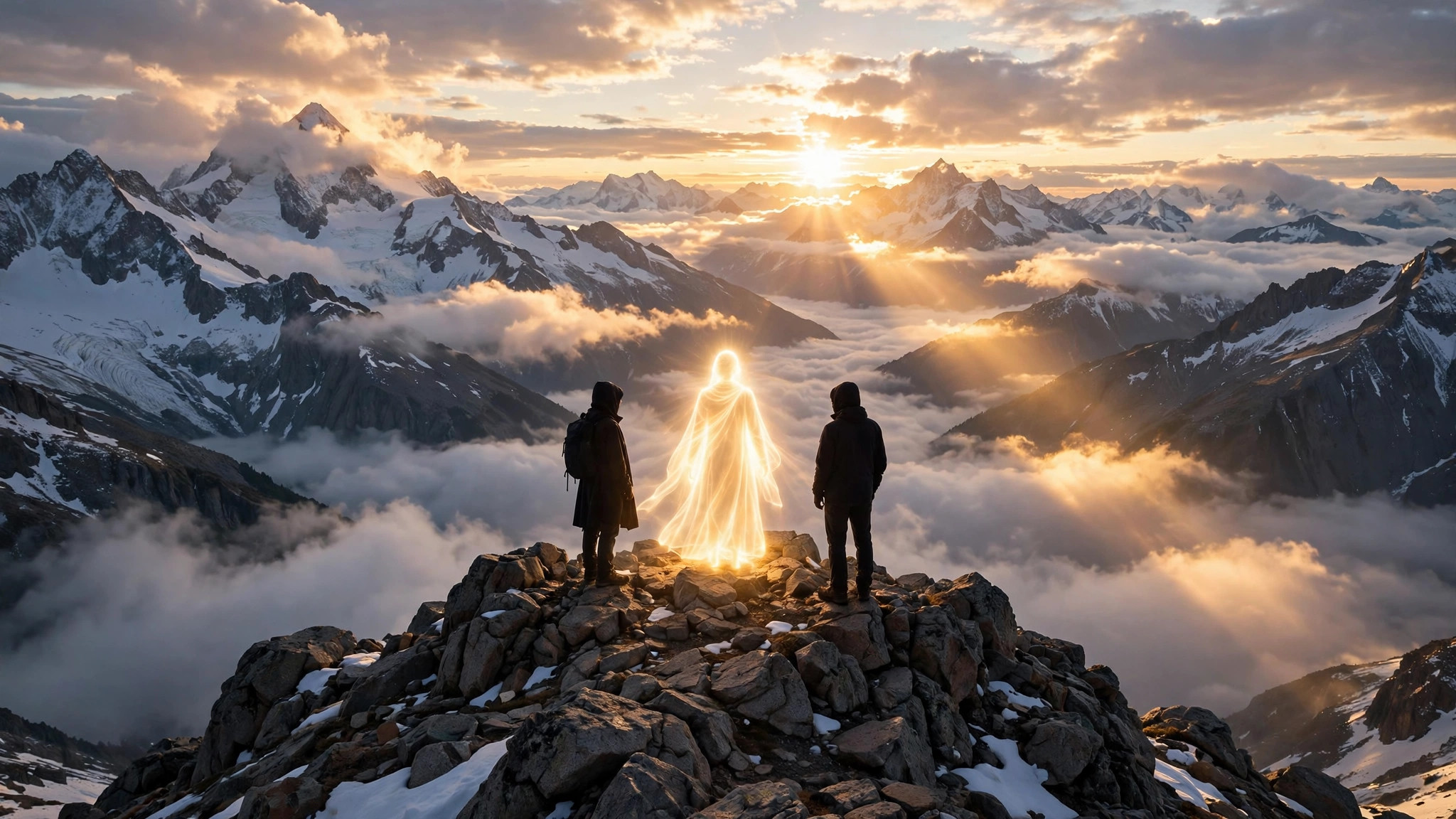
Thirty years after the event, an old man sat down to write his last letter. He knew he was going to die soon. And the story he chose to tell — the memory he wanted the church to carry after he was gone — was a mountain. “We did not follow cleverly devised stories when we told you about the coming of our Lord Jesus Christ in power,” Peter wrote, “but we were eyewitnesses of his majesty” (2 Peter 1:16).
The event was the Transfiguration of Jesus — the moment on the mountain when glory broke through. Peter had never gotten over it. Decades later, facing execution, it was still the most important thing he had ever seen. This is the story of why.
Before the Mountain: A Confession and a Shock
To understand the Transfiguration, you have to understand the week before it. At Caesarea Philippi, Jesus asked his disciples, “Who do you say I am?” Peter answered, “You are the Messiah, the Son of the living God” (Matthew 16:15-16, in substance). It was the greatest confession in the Gospels.
Then Jesus said something that shattered them: “The Son of Man must suffer many things and be rejected by the elders, the chief priests and the teachers of the law, and he must be killed and on the third day be raised to life” (Mark 8:31, in substance). Peter took Jesus aside and rebuked him: “Never, Lord! This shall never happen to you!” (Matthew 16:22). Jesus’ reply was severe: “Get behind me, Satan! You are a stumbling block to me; you do not have in mind the concerns of God, but merely human concerns” (Matthew 16:23).
The disciples were left with a contradiction they could not resolve. The Messiah — glorious, powerful, victorious — was going to suffer and die? How could both be true? The Transfiguration was God’s answer: the glory and the suffering belong to the same person. The mountain would show them the glory, so that they could endure the cross.
The Climb: Eight Days Later
Luke says it happened “about eight days after” (Luke 9:28); Matthew and Mark say “after six days” (Matthew 17:1; Mark 9:2) — the difference is just whether you count the days at both ends. Jesus took Peter, James, and John — his inner circle — up a high mountain. Luke adds the detail that matters most: Jesus went up “to pray” (Luke 9:28).
The mountain is a pattern in Scripture. Moses met God on Sinai. Elijah heard God’s whisper on Horeb. God reveals himself on mountains because mountains require ascent — effort, separation, leaving the crowds behind. The disciples had to climb to see the glory. So do we. Glory is rarely found in the noise of the valley. It is found in the quiet of prayer, on the mountain apart.
The Transformation: What the Disciples Saw
“There he was transfigured before them. His face shone like the sun, and his clothes became as white as the light” (Matthew 17:2). Mark says his clothes became “dazzling white, whiter than anyone in the world could bleach them” (Mark 9:3). Luke says, “As he was praying, the appearance of his face changed, and his clothes became as bright as a flash of lightning” (Luke 9:29).
The Greek word is metamorphoō — metamorphosis. This was not Jesus putting on glory like a costume. It was glory breaking out from within, the way light breaks through a lampshade. The humanity of Jesus was the veil; for a moment, the veil became transparent, and the disciples saw what had been true all along: the man from Nazareth was the eternal Son of God.
John, one of the three, would later write: “We have seen his glory, the glory of the one and only Son, who came from the Father, full of grace and truth” (John 1:14). The Transfiguration was the source of that testimony. John saw it on the mountain, and he never forgot it either.
The Two Visitors: Law and Prophets Bear Witness
“Just then there appeared before them Moses and Elijah, talking with Jesus” (Matthew 17:3). The two greatest figures of the Old Testament stood beside him — Moses, who received the Law, and Elijah, the greatest of the prophets. Luke tells us their topic: “They spoke about his departure, which he was about to bring to fulfillment at Jerusalem” (Luke 9:31). The word “departure” is exodus in Greek. Moses led the first exodus out of Egypt; Jesus would lead the greater exodus out of sin and death.
Why these two? Because Moses and Elijah represent the whole Old Testament — the Law and the Prophets. Their presence declared that everything Scripture had promised was coming to fulfillment in Jesus. Moses had died and been buried by God; Elijah had been taken to heaven in a whirlwind. One represented those who die in faith; the other, those who will be alive at the Lord’s return. Together, they testified that Jesus is the center of all of it — the one to whom the whole story points.
Peter, overwhelmed, suggested building three shelters — one for each (Matthew 17:4). It was a sincere mistake. He wanted to make Jesus one among equals. God would not allow it.
The Voice: The Father’s Verdict
“While he was still speaking, a bright cloud covered them, and a voice from the cloud said, ‘This is my Son, whom I love; with him I am well pleased. Listen to him!'” (Matthew 17:5). The cloud was the glory-cloud of God’s presence — the same cloud that led Israel in the wilderness (Exodus 13:21) and filled the temple (1 Kings 8:11). The voice was the Father’s.
The Father had spoken at Jesus’ baptism: “This is my Son, whom I love” (Matthew 3:17). Now he added the command that defines Christian discipleship: “Listen to him.” Moses had promised a prophet like himself, and commanded, “You must listen to him” (Deuteronomy 18:15). The Father was declaring that the Prophet had come. Moses’ word was fulfilled; Elijah’s ministry was complete; now there was one voice to heed.
“When the disciples heard this, they fell facedown to the ground, terrified” (Matthew 17:6). Then came the tenderest moment in the story: “But Jesus came and touched them. ‘Get up,’ he said. ‘Don’t be afraid.’ When they looked up, they saw no one except Jesus” (Matthew 17:7-8). Moses gone. Elijah gone. Cloud gone. Only Jesus. That is the whole gospel: when everything else fades, Jesus alone remains — and he is enough.
After the Mountain: Silence, Suffering, and Glory
Jesus ordered them to keep silent “until the Son of Man had risen from the dead” (Mark 9:9). The glory could not be understood until the cross had interpreted it. A Messiah without a cross is a misunderstanding — and the disciples had to learn that the hard way, through denial, flight, and despair, before the resurrection made sense of the mountain.
Peter’s later life proves the mountain’s power. The man who fell facedown in terror became the man who stood before the Sanhedrin without fear. The man who suggested building tents became the man who wrote, “We ourselves heard this voice that came from heaven when we were with him on the sacred mountain” (2 Peter 1:18). The glory he saw sustained him through suffering, imprisonment, and martyrdom. The mountain did its work: it gave him a vision strong enough to die for.
The same promise holds for us. Paul writes that we “are being transformed into his image with ever-increasing glory, which comes from the Lord, who is the Spirit” (2 Corinthians 3:18). The word “transformed” is the same word as the Transfiguration. What happened to Jesus on the mountain is what is happening to us, slowly, daily — and what will be completed when he returns: “He will transform our lowly bodies so that they will be like his glorious body” (Philippians 3:21).
The Mountain Pattern: Sinai and the Transfiguration
The Transfiguration did not come out of nowhere. It followed a pattern God had set centuries earlier at Mount Sinai. Moses went up the mountain, “and the cloud covered it” for six days (Exodus 24:15-16, in substance). On the seventh day, God called to him. When Moses came down, “his face was radiant because he had spoken with the Lord” (Exodus 34:29). The cloud, the six days, the shining face — all of it reappeared on the mountain of Transfiguration.
But the differences are as important as the parallels. Moses’ face shone with reflected glory — light borrowed from being near God. Jesus’ face shone with his own glory — light breaking out from within. Moses wore a veil to hide the fading glory; Jesus needed no veil, because his glory does not fade. Moses went up the mountain to receive the Law; Jesus went up the mountain to fulfill it. The old mountain gave us commandments written on stone. The new mountain gives us a Person to listen to — and his words are written on our hearts.
That is why the Transfiguration matters for every believer. The glory that Moses borrowed and that Jesus revealed is the glory we are being changed into, day by day. “And we all, who with unveiled faces contemplate the Lord’s glory, are being transformed into his image with ever-increasing glory” (2 Corinthians 3:18). The mountain was a preview of your destiny: unveiled faces, reflected glory, transformation that never fades.
Listen to Him
The Father’s command still stands: “Listen to him.” In a world of a thousand voices — the news, the influencers, the anxieties, the accusations — the Father’s voice cuts through: listen to Jesus. His words are the final word. His way is the true way. His glory is the true glory. And when everything else fades — the heroes, the clouds, the mountains — only Jesus remains. He is enough. For further historical and theological background, the Wikipedia article on the Transfiguration of Jesus provides a helpful overview.










