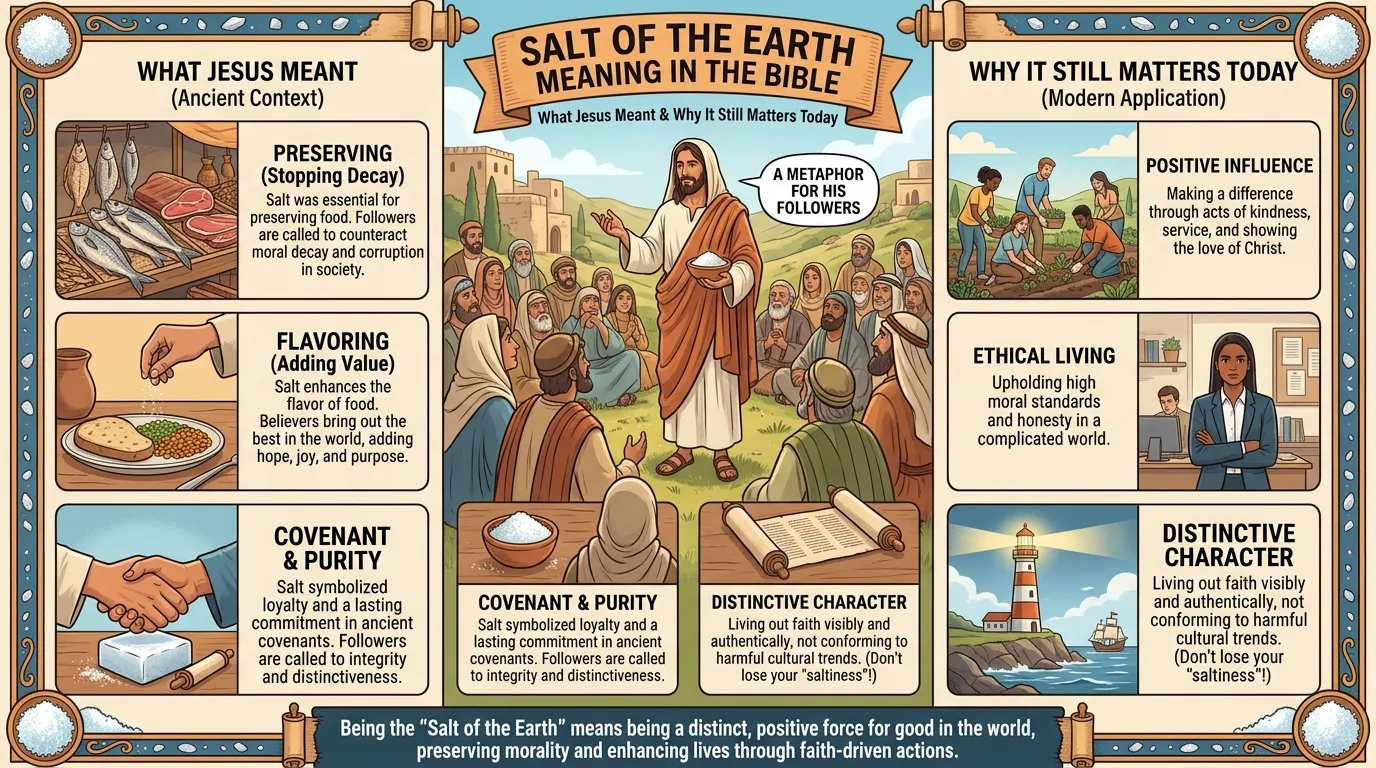
It may be the most quoted three words Jesus ever spoke about His followers’ mission: “You are the salt of the earth” (Matthew 5:13). Not you should become — you are. Spoken on a Galilean hillside to fishermen, tax collectors, and nobodies, the declaration was as startling then as it is now. But what did salt mean to people who heard it before refrigeration, before supermarkets, before salt was a cheap shaker on every table? In Jesus’ world, salt was precious, powerful, and covenantal — and every one of its uses unlocks what He expects of us.
What Salt Did in Jesus’ World
1. Salt preserved. This was its supreme value. Without refrigeration, meat and fish rotted within hours in the Middle Eastern heat; salt was the difference between food and poison, between a village fed through winter and a village starving. Salt arrested decay. When Jesus calls His followers the salt of the earth, the first meaning is preservative: Christians are placed in a decaying world to slow the rot — to preserve truth where lies spread, to preserve integrity where corruption creeps, to preserve human dignity where cruelty dehumanizes. We are not called to escape the world’s decay but to interrupt it, the way salt interrupts putrefaction.
2. Salt flavored. “Can that which is tasteless be eaten without salt?” (Job 6:6). Salt doesn’t become the meal; it reveals the meal — drawing out flavors already present but hidden. So with believers: we don’t replace the world’s cultures, vocations, and communities; we season them, bringing out their God-given goodness. Paul extends the metaphor to speech: “Let your speech always be gracious, seasoned with salt” (Colossians 4:6) — conversation that is flavorful rather than bland, gracious rather than corrosive. The salty Christian makes truth taste good; the unsalty one makes even truth unpalatable.
3. Salt sealed covenants. This is the use modern readers miss entirely. In ancient Israel, covenants were sealed with salt — “a covenant of salt forever before the LORD” (Numbers 18:19), describing God’s irrevocable grant to Aaron’s priesthood. Salt’s incorruptibility made it the perfect emblem of permanence: what is salted does not rot, and what is covenanted with salt does not break. Every grain offering in the temple had to include salt: “you shall not let the salt of the covenant with your God be missing from your grain offering” (Leviticus 2:13). To be the salt of the earth, then, is to be a covenant people — carriers of God’s permanent, unrotting promise in a world of broken contracts.
4. Salt was valuable. Roman soldiers were sometimes paid in salt — the origin of the word salary (from salarium). “Worth his salt” survives as an English idiom because salt was wealth. Jesus’ metaphor quietly dignifies the nobodies on the hillside: you — fishermen and former tax collectors — are the world’s precious commodity. The world’s valuation (power, wealth, fame) is inverted: heaven’s treasure is a community of the humble, preserving and flavoring the earth.
5. Salt purified and judged. Newborns were rubbed with salt (Ezekiel 16:4) — a cleansing rite. Salt was thrown on conquered, cursed ground (Judges 9:45) — a sign of judgment. Salt stings wounds even as it cleanses them. The salty life, therefore, has an edge: gospel salt confronts as well as comforts. “Have salt in yourselves, and be at peace with one another,” Jesus said (Mark 9:50) — the verse holding both the sting and the peace, purity and unity, in a single command.
“If Salt Has Lost Its Taste”: The Warning
Jesus’ metaphor carries a blade: “but if salt has lost its taste, how shall its saltiness be restored? It is no longer good for anything except to be thrown out and trampled under people’s feet” (Matthew 5:13). Chemically, pure salt (sodium chloride) cannot lose its saltiness — but the impure salt of the ancient world, mixed with gypsum and other minerals, could leach out until only tasteless residue remained. The warning is precise: compromised salt becomes worthless salt.
What leaches the saltiness from a Christian? The Sermon on the Mount’s context gives the answer: anger nursed into contempt (5:21-22), lust entertained (5:27-28), retaliation (5:38-42), love rationed to friends (5:43-47) — the whole catalog of kingdom-compromise. Salt loses its taste when believers absorb the world’s flavor instead of imparting Christ’s. A church that mirrors its culture’s materialism, division, and sensuality has leached salt — present in the shaker, absent in effect. And Jesus’ verdict is unsparing: good for nothing — not “less useful,” but useless, trampled.
The warning is corporate as well as personal. Whole churches, denominations, and Christian movements can lose their saltiness — maintaining the structures of faith while the preserving, flavoring, covenant power drains away. The remedy is always the same: return to the pure Salt, Christ Himself, and let Him re-salt His people through repentance.
Where the Salt Goes: Into the World, Not the Shaker
Salt does no good in the shaker. Its entire purpose requires contact — rubbed into meat, dissolved into stew, scattered on the field. This is the missional logic of the metaphor, and it corrects two opposite errors. Withdrawal — the salt that stays in the Christian shaker, preserving only itself — disobeys the metaphor; salt was made for the meat, not the pantry. Dissolution — the salt that so blends with the world it can’t be distinguished — loses its taste; contact without distinctness is contamination, not mission.
The salty Christian lives in the world with a flavor from another world: honest in the dishonest workplace, pure in the impure dorm, generous in the grasping market, hopeful in the despairing ward. This is not loudness — salt works silently, invisibly, thoroughly. The most effective saltiness is often unnoticed until it’s absent: the colleague whose integrity steadied the office, the neighbor whose kindness held the street together, the grandmother whose prayers preserved the family. You may never know, this side of heaven, what rot your presence arrested.
The Pillar of Salt: When Salt Warns
Salt in Scripture is not only commission — it is also caution. The most haunting salt image in the Bible is a person: Lot’s wife, who “looked back, and she became a pillar of salt” (Genesis 19:26). Fleeing Sodom under angelic escort, commanded not to look back, she turned — and was crystallized mid-glance. Jesus Himself invokes her as a warning: “Remember Lot’s wife” (Luke 17:32).
What does a pillar of salt mean? The interpreters have suggested the region’s salt formations made the image vivid to locals — but the theology matters more than the geology. Salt preserves — and Lot’s wife was preserved, horribly, in the act of disobedience: fixed forever in the posture of looking back. She became a monument to divided loyalty — body fleeing toward Zoar, heart chained to Sodom. The salt that should have seasoned her faith petrified her rebellion.
The warning for the “salt of the earth” is sharp: the same substance that preserves can petrify. A Christian who looks back — who flees the world physically while clinging to it spiritually, who leaves Sodom’s zip code but keeps its appetites — risks becoming a monument instead of a missionary: preserved, yes, but as a warning, not a witness. Jesus’ “remember Lot’s wife” is addressed to disciples (Luke 17:22) — to us. The salt of the earth must keep moving forward, eyes on the Savior, or it hardens into a roadside pillar that testifies against itself.
But even here, grace: the pillar stood near the Dead Sea, visible for generations — a silent sermon that preserved the warning. God wastes nothing, not even judgment. The salt that judged one woman instructed thousands. Let it instruct us: don’t look back.
Does “salt of the earth” mean Christians are better than others?
No — it means Christians have a function, not a superiority. Salt doesn’t boast over the meat; it serves it. The metaphor is about usefulness in God’s mission, and it’s spoken to the “poor in spirit” and “persecuted” (Matthew 5:3, 10) — the lowly, not the elite. Any pride in being “salt” is itself evidence of lost saltiness.
What’s the difference between salt and light (Matthew 5:13-16)?
They’re complementary missions: salt works within — hidden, preserving, flavoring, in contact with decay. Light works upon — visible, exposing, guiding, set on a stand. Salt is influence by presence; light is influence by witness. The Christian is both: quietly arresting rot, openly displaying Christ.
On a Galilean hillside, Jesus looked at nobodies and named them the world’s preservative, its flavor, its covenant seal. The commission hasn’t changed: you are the salt of the earth — so get out of the shaker, keep your taste, and let the world discover, in you, the flavor of grace.
The hillside nobodies became the world’s preservative; the same commission rests on ordinary believers today — not because we are impressive, but because the Salt we carry is. For the substance behind the metaphor, see salt.










