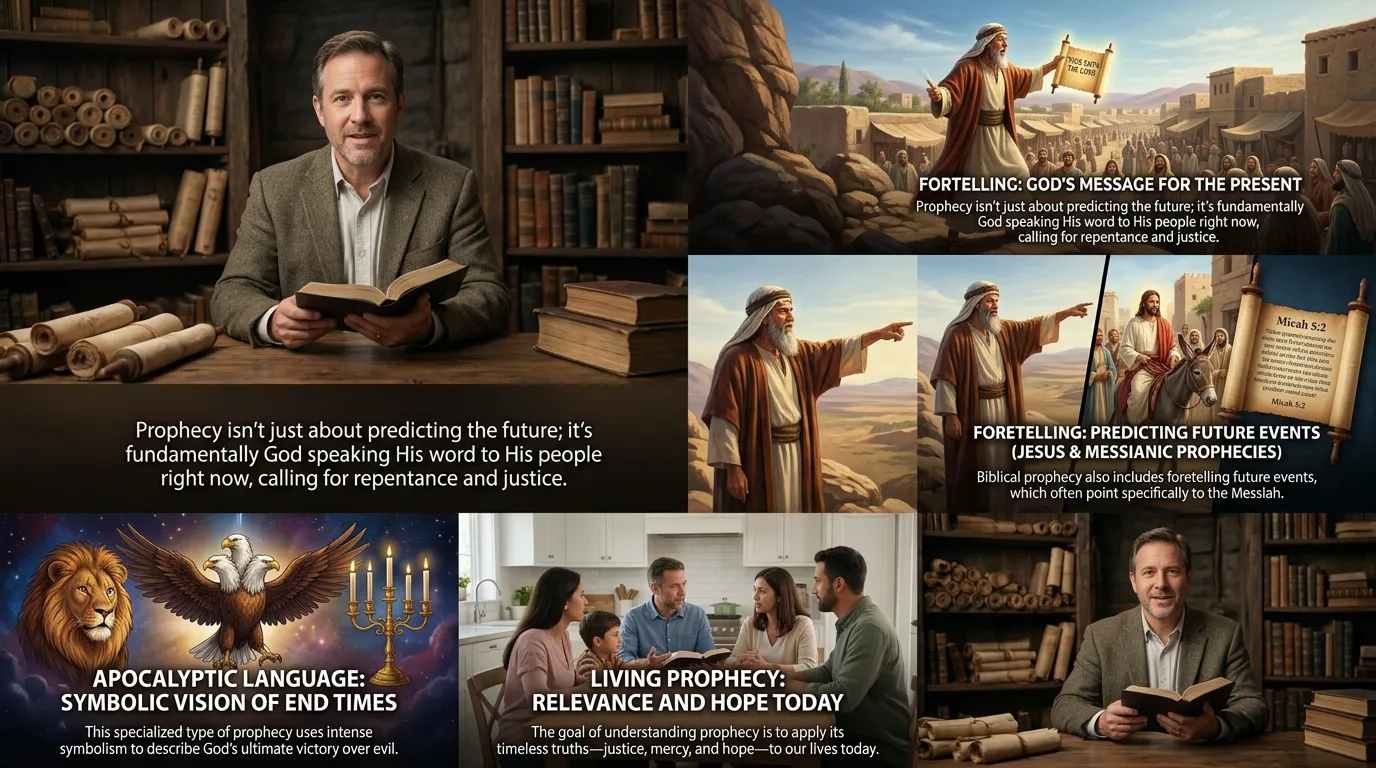
Prophecy attracts two opposite errors, and both are popular. The first treats the prophets like a puzzle book — a coded timetable of the future waiting to be cracked by anyone with enough charts and newspaper clippings. The second treats them like background music — vaguely inspiring, safely ignorable, best left to scholars. The Bible itself models a third way: prophecy as God’s Word to be understood, with care, humility, and method. The prophets were not writing riddles for the clever; they were preaching sermons to real people. Learning to read them well is less like decoding and more like listening — listening across centuries without distorting what was said.
What follows is a reader’s toolkit: five principles drawn from Scripture itself for understanding prophecy the way Scripture asks to be understood. They will not tell you the date of anything. They will do something better — teach you to hear what God was actually saying, then and now.
First, Meet the Original Audience
Every prophecy in the Bible was first a message to specific people in a specific crisis. Hosea preached to a northern kingdom drunk on prosperity and rotting with idolatry. Haggai preached to returned exiles who had built nice houses while God’s house lay in ruins. Malachi preached to a weary post-exilic community asking, “How have you loved us?” Before we ask what a prophecy means for us, we must ask what it meant for them — because the meaning does not change with the audience, even as the application widens.
This single discipline defuses most prophetic sensationalism. When a preacher declares that some Old Testament oracle “clearly predicts” this week’s headlines, the first question is always: what did it clearly predict to the people who first heard it? If the answer requires ignoring them entirely, the interpretation is not bold; it is rude — to the text and to its first hearers. “No prophecy of Scripture comes from someone’s own interpretation,” Peter warns, “for no prophecy was ever produced by the will of man” (2 Peter 1:20-21). The prophets spoke as they were carried along by the Spirit, to people whose names and troubles we can know. Start there. Read the historical books alongside the prophets. Learn what Assyria was doing, what Babylon threatened, what exile felt like. The prophecy will begin to sound less like a code and more like a voice — urgent, pastoral, specific.
None of this confines prophecy to the past. The New Testament constantly applies old prophecies to new situations — Matthew sees Hosea’s “out of Egypt I called my son” (Hosea 11:1) fulfilled in Jesus’ childhood flight (Matthew 2:15). But notice the direction: the apostles move from the original meaning outward, never bypassing it. The text’s first sense anchors its later senses. Cut the anchor, and interpretation drifts wherever the interpreter’s imagination blows.
Prophecy Speaks Covenant Before Calendar
Here is the reorientation most readers need: the prophets were primarily covenant enforcers, not future-tellers. When God established His covenant with Israel, it came with blessings for obedience and curses for rebellion (Deuteronomy 28). The prophets’ job was to stand in the public square and announce which way the nation was headed — you are breaking the covenant; here is where that road ends; turn back, and here is where the other road leads.
This is why so much prophecy sounds like a lawsuit. Micah stages one explicitly: “Hear, you mountains, the indictment of the LORD… O my people, what have I done to you?” (Micah 6:1-3). Isaiah opens with the heavens and earth summoned as witnesses against a rebellious nation (Isaiah 1:2). The prophets are prosecuting attorneys for the covenant, and their predictions of judgment are the threatened curses of Deuteronomy arriving on schedule. That is also why their predictions are so often conditional — Jonah’s “forty days and Nineveh shall be overthrown” (Jonah 3:4) never happened, because Nineveh repented. The prophecy was not false; it was a warning, and warnings are meant to be heeded, not merely fulfilled.
Understanding this rescues prophecy from the crystal-ball caricature. When Amos thunders against the wealthy women of Samaria (Amos 4:1), he is not predicting the stock market; he is applying covenant justice to economic oppression. When Isaiah promises that swords will become plowshares (Isaiah 2:4), he is describing the covenant’s ultimate blessing, not issuing a policy paper. Read prophecy as covenant preaching first — what is God saying about faithfulness right now? — and the future-telling passages will fall into their proper, smaller, still-important place.
Learn the Bible’s Time Grammar
Biblical prophecy speaks of time the way mountain ranges look from a distance: peaks that are miles apart can appear side by side. The prophets often describe near and far fulfillments in a single breath, without the chronological road signs modern readers expect. Isaiah speaks of a child named Immanuel as a sign to King Ahaz in his own crisis (Isaiah 7:14) — and Matthew, centuries later, sees the same words fulfilled in Jesus’ birth (Matthew 1:23). Both readings are legitimate. The prophecy had a near horizon (God’s presence with Judah in Ahaz’s day) and a far horizon (God’s presence in flesh in Bethlehem).
The New Testament gives this pattern a name: the already and the not yet. The kingdom has come in Jesus (Matthew 12:28) — and the kingdom is still coming in fullness (Revelation 11:15). Prophecy lives in that tension. When the prophets describe “the day of the LORD,” they may mean a near judgment (Babylon’s invasion), the ultimate judgment, or both at once — the near event as a down payment on the final one. Readers who demand that every prophecy refer to exactly one event on one date will flatten what the text deliberately leaves layered.
Practically, this means: be slow to declare “this prophecy is entirely future” or “this prophecy is entirely past.” Ask instead what the text itself emphasizes. And be deeply suspicious of any reading that requires a secret timeline the original audience could not have perceived at all. The prophets were preachers, not cryptographers; their hearers were meant to understand the main point — repent, trust, hope — even if the distant details stayed hazy. “The secret things belong to the LORD our God, but the things that are revealed belong to us” (Deuteronomy 29:29). Prophecy is in the second category: revealed, for obedience, not for speculation.
Test Everything; Hold Fast to What Is Good
Scripture does not ask us to accept every claim of divine revelation at face value — it commands the opposite. “Beloved, do not believe every spirit, but test the spirits to see whether they are from God, for many false prophets have gone out into the world” (1 John 4:1). The Bible’s own tests for prophecy are bracingly practical.
Test one: did it come true? “When a prophet speaks in the name of the LORD, if the word does not come to pass or come true, that is a word that the LORD has not spoken” (Deuteronomy 18:22). Simple, and devastating to the professional predictors whose failed dates are always explained away. A track record matters.
Test two: does it agree with what God already said? Even if the sign comes to pass, “if he says, ‘Let us go after other gods,’… you shall not listen” (Deuteronomy 13:1-3). Accuracy without orthodoxy is still false prophecy. No revelation from God will contradict revelation already given — which is why the Bereans were commended for examining the Scriptures daily to check even Paul’s preaching (Acts 17:11).
Test three: what fruit does it bear? “You will recognize them by their fruits” (Matthew 7:16). And test four: is it weighed by the church? “Let two or three prophets speak, and let the others weigh what is said” (1 Corinthians 14:29). Prophecy in the New Testament is a community activity, submitted to community discernment — the opposite of the lone voice demanding unquestioned obedience. Any “prophet” who forbids testing has failed the first test.
Read With Christ at the Center
The final principle is the one Jesus taught Himself. Walking with two confused disciples on the Emmaus road, “beginning with Moses and all the Prophets, he interpreted to them in all the Scriptures the things concerning himself” (Luke 24:27). The prophets were always, ultimately, about Him — His suffering and His glory, the two notes the disciples had failed to hold together (Luke 24:26). Any reading of prophecy that ends anywhere other than Christ has missed the road to Emmaus.
Revelation states it as a definition: “the testimony of Jesus is the spirit of prophecy” (Revelation 19:10). The animating breath inside all true prophecy — the thing that makes it prophecy rather than mere prediction — is its witness to Jesus. That is why Peter can say the prophets were serving us, searching to understand “what person or time the Spirit of Christ in them was indicating when he predicted the sufferings of Christ and the subsequent glories” (1 Peter 1:10-11). They did not fully grasp the horizons they described. We, reading backward from the cross and the empty tomb, get to see what they strained to see — and our advantage should produce humility, not arrogance.
So here is the toolkit in one sentence: meet the first audience, hear the covenant lawsuit, respect the layered time, test every claim, and let every road lead to Christ. Read this way, the prophets stop being a puzzle for specialists and become what they were always meant to be — the voice of God calling His people to repentance, faith, and hope. The point was never to make us clever about the future. It was to make us faithful in the present, with our eyes on the One who holds the future. And that is a kind of understanding no chart can give and no headline can take away.
Students of interpretation may also appreciate Wikipedia’s overview of biblical hermeneutics, which traces how readers across the centuries have approached texts like the prophets — a helpful companion to the Scripture-first principles above.










