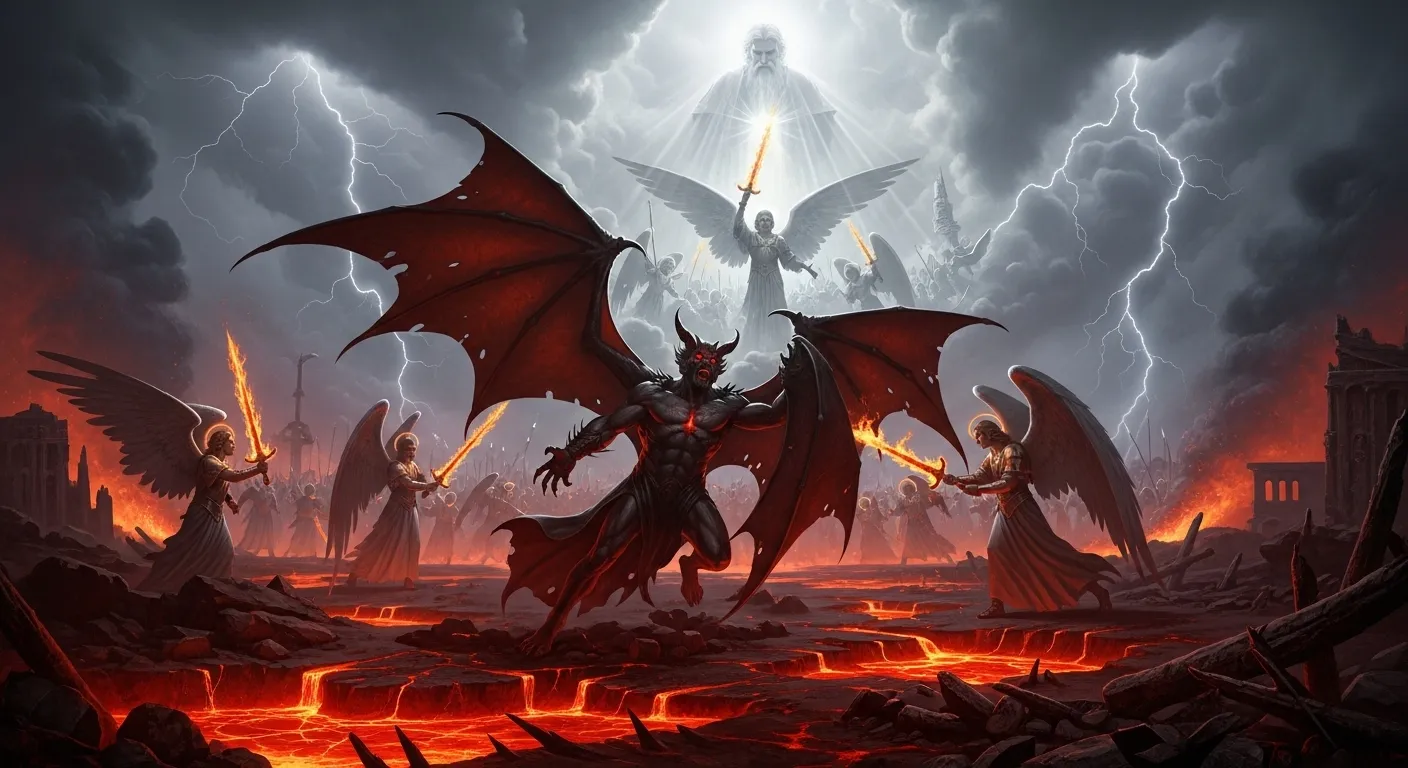
Most battle stories build toward the ending. The Bible’s account of Satan’s final battle does the opposite: it hands you the ending on the first page you read and then shows you how everything was always heading there. “And the devil who had deceived them was thrown into the lake of fire and sulfur… and they will be tormented day and night forever and ever” (Revelation 20:10). That is the last word on the subject. Every prophecy about the final conflict is simply the road leading to that sentence.
Reading the battle this way changes its emotional temperature. It stops being a horror story about what evil might do and becomes a war report about what God has already decided. The fear drains out; the vigilance remains. Here is the conflict as Scripture lays it out — ending first, then the gathering, then the battle Christ already won, and finally what it asks of you today.
The End, Stated First
Revelation 20:7–10 describes the last rebellion. After a thousand years of Satan’s binding, he is released “to deceive the nations,” and he gathers an army “like the sand of the sea” — the force called Gog and Magog — surrounding “the camp of the saints and the beloved city.” Then the shortest battle in literature: “fire came down from heaven and consumed them.” No prolonged combat. No suspense. No counterattack. One sentence of divine action ends the war.
The proportions are deliberate. John gives the rebellion three verses and the judgment one. Evil gets its final march; God gets the final word. The message is not that the last battle will be close. The message is that it will not be a contest at all. When Scripture wants you to feel suspense, it writes suspense. Here it writes certainty, because certainty is the point.
The Gathering Before the End
Before that last rebellion, Revelation describes an earlier gathering. “For they are demonic spirits, performing signs, who go abroad to the kings of the whole world, to assemble them for battle on the great day of God the Almighty… And they assembled them at the place that in Hebrew is called Armageddon” (Revelation 16:14, 16). Armageddon — Har Megiddo, the hill of Megiddo — was a real plain in Israel where ancient armies actually clashed: Deborah and Barak defeated Sisera there (Judges 5), Josiah fell there (2 Kings 23:29). John borrows a historic battlefield as the symbol of the final one.
Revelation 19 adds the other side of the muster: the beast and the kings of the earth gather “to make war against him who was sitting on the horse and against his army” (Revelation 19:19). Read that again — they assemble to make war against Christ Himself. The final battle is not nation versus nation. It is creation versus Creator, and the Creator arrives as a rider on a white horse, “and in righteousness he judges and makes war” (Revelation 19:11). The outcome was never in doubt because the two sides were never comparable.
The Battle That Was Already Fought
Here is what most readers miss: the decisive battle of this war already happened, and it looked nothing like Armageddon. It looked like a crucifixion. From the garden, God announced the strategy: the serpent would bruise the heel of the woman’s offspring, “he shall bruise your head” (Genesis 3:15). A bruised heel is a wound. A crushed head is a death. The cross was both at once — Christ wounded, Satan destroyed.
Jesus said it plainly before it happened: “Now is the judgment of this world; now will the ruler of this world be cast out” (John 12:31). Not “will be, someday, at Armageddon.” Now — at the cross. Paul explains the mechanics: God “disarmed the rulers and authorities and put them to open shame, by triumphing over them” in Christ (Colossians 2:15). The Greek word for “triumphing” is a military parade term — the victory march of a general displaying his captives. The cross was Satan’s defeat disguised as his greatest success. He thought he was killing the Son of God. He was actually signing his own sentence.
This is why the final battle reads so briefly. Armageddon is not the war’s turning point; it is the war’s paperwork. The turning point was a hill outside Jerusalem where the supposed victor lost everything. Everything after that — including the final rebellion — is a defeated enemy refusing to accept the verdict.
Why a Defeated Enemy Still Fights
If the war is decided, why does the fighting continue? Revelation gives the psychological profile: “the devil has come down to you in great wrath, because he knows that his time is short” (Revelation 12:12). Short time plus great wrath equals maximum damage. A condemned army with nothing to lose fights the dirtiest. Satan cannot change the outcome, so he tries to enlarge the casualty list — “to deceive, if possible, even the elect” (Matthew 24:24).
His weapon in this phase is almost entirely deception. He is called “the deceiver of the whole world” (Revelation 12:9), and deception is the weapon of the weak — the strong use force. Lies about God (“Did God actually say…?” — Genesis 3:1, still his opening line), lies about you (accusation — Revelation 12:10 calls him “the accuser”), lies about the future (despair). None of it can undo the cross. All of it can, for a season, keep people from trusting the cross. That is the whole war now: a defeated deceiver trying to keep the defeated news from spreading.
Your Orders in the Meantime
Scripture never tells believers to win the cosmic war. It tells them to stand in the victory already won — and it is specific about how. “For we do not wrestle against flesh and blood, but against the rulers, against the authorities, against the cosmic powers over this present darkness” (Ephesians 6:12). The wrestling is real, but notice: Paul follows the diagnosis with armor, not anxiety. Truth, righteousness, the gospel of peace, faith, salvation, the Word of God (Ephesians 6:13–17). Every piece is defensive except one. You are not the cavalry. You are the garrison, and the garrison’s job is to hold.
Two commands repeat through the end-times passages. The first is watchfulness: “Therefore, stay awake, for you do not know on what day your Lord is coming” (Matthew 24:42). Watchfulness is not panic; it is the opposite — the calm readiness of someone who knows how the story ends. The second is resistance: “Resist the devil, and he will flee from you” (James 4:7). That promise is astonishing when you think about it. The ancient serpent, the deceiver of nations, flees from an ordinary believer who simply refuses him. That is what a decided war looks like up close.
And when anxiety rises — because battle imagery does stir it — Paul prescribes the countermeasure: “do not be anxious about anything, but in everything by prayer and supplication with thanksgiving let your requests be made known to God” (Philippians 4:6). Prayer is not retreat from the war. In this war, prayer is participation.
After the Battle: What the War Was For
Revelation does not end with the lake of fire. It ends with a city. “Then I saw a new heaven and a new earth… And I heard a loud voice from the throne saying, ‘Behold, the dwelling place of God is with man'” (Revelation 21:1, 3). The war existed so that this could exist: a world with no deceiver in it. “He will wipe away every tear from their eyes, and death shall be no more, neither shall there be mourning, nor crying, nor pain anymore” (Revelation 21:4).
That is the final meaning of Satan’s last battle. It is the demolition before the construction — the clearing of the site where God will dwell with His people forever. Every prior battle in Scripture pointed here: the Red Sea, Jericho, David’s victories, the cross itself. All of them were God removing obstacles between Himself and His people. The demolition removes the last obstacle. What remains is presence: God with man, man with God, and no enemy left to interrupt.
The final battle of Satan, then, is not a warning to decode but a victory to rest in. The ending was published before the fighting started, the decisive blow fell at Calvary, and the mop-up operation — however loud — cannot fail. For the historical and theological background of the battlefield name itself, see the history of Armageddon as both a real place and a prophetic symbol; but Scripture’s own summary needs no supplement: the devil is thrown down, the tears are wiped away, and the dwelling of God is with His people forever.










