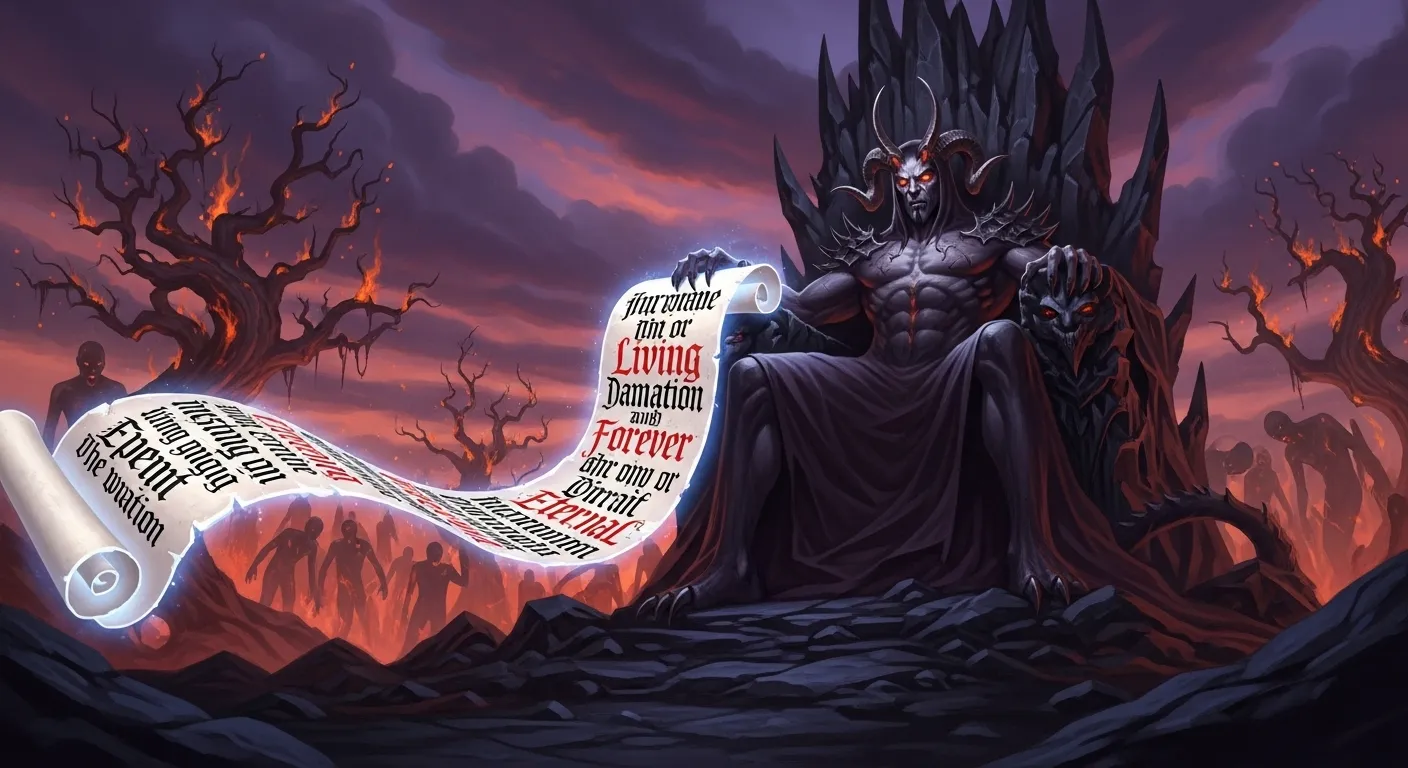
Does Satan live forever? The question sounds simple, but it hides two different questions inside it. The first is, “Will Satan exist forever?” The second is, “Will Satan reign forever?” Scripture answers them differently, and confusing the two is where most of the fear and most of the false teaching come from. The Bible is clear that Satan is a real, created being whose existence continues — and equally clear that his reign, his freedom, and his power have an expiration date written by God Himself.
Getting this right matters. Some teachers imply Satan is God’s eternal opposite, a dark god who will fight forever in some endless stalemate. That is not Christianity; it is dualism wearing Christian clothes. Other teachers suggest Satan will simply be annihilated and vanish. Scripture’s actual answer is more precise than either: Satan endures, but only as a judged prisoner, never again as a prince.
The Verse Everyone Quotes
The clearest statement about Satan’s future sits near the end of the Bible: “And the devil who had deceived them was thrown into the lake of fire and sulfur where the beast and the false prophet were, and they will be tormented day and night forever and ever” (Revelation 20:10). Read it slowly. The lake of fire is not a throne room. It is a prison. The torment “day and night forever and ever” speaks of an irreversible judgment, not an ongoing kingdom. Satan continues to exist — but existence is all that remains to him. Every trace of authority is gone.
Jesus said the same thing in different words: “Then he will say to those on his left, ‘Depart from me, you cursed, into the eternal fire prepared for the devil and his angels'” (Matthew 25:41). Notice the phrase “prepared for the devil.” The eternal fire was never made for human beings; it was made for the rebel and his followers. And Paul adds the human parallel: those who reject God “will suffer the punishment of eternal destruction, away from the presence of the Lord” (2 Thessalonians 1:9). The punishment is eternal in its finality. The rebellion is over.
A Created Being Cannot Be an Eternal Rival
Why is Satan’s defeat certain rather than merely likely? Because he is a creature. Ezekiel’s lament over the king of Tyre, widely understood to look beyond the human king to the spiritual power behind him, says, “You were blameless in your ways from the day you were created, till unrighteousness was found in you” (Ezekiel 28:15). Created. There was a day he began. And the same passage announces his end: “I turned you to ashes on the earth in the sight of all who saw you… you have come to a dreadful end and shall be no more forever” (Ezekiel 28:18–19).
This is the foundation everything else rests on. “For by him all things were created, in heaven and on earth, visible and invisible… all things were created through him and for him” (Colossians 1:16). Satan is inside the “all things.” He is not God’s counterpart. He never was. Isaiah thunders the point: “I am the Lord, and there is no other, besides me there is no God” (Isaiah 45:5). A created rebel can resist for a season. He cannot rival forever. The Book of Job shows the leash even now: Satan must ask permission, and God sets the boundaries — “Behold, all that he has is in your hand. Only against him do not stretch out your hand” (Job 1:12). That is not a war between equals. That is a master restraining a servant.
Why the Sentence Waits
The honest follow-up question is: if his end is certain, why hasn’t it happened yet? Scripture does not dodge this. Peter writes that the Lord “is patient toward you, not wishing that any should perish, but that all should reach repentance” (2 Peter 3:9). The delay is mercy wearing the disguise of slowness. Every day Satan remains unjudged is another day the gospel can reach someone he has deceived.
There is also a legal completeness to it. From the beginning God announced the outcome: “I will put enmity between you and the woman, and between your offspring and her offspring; he shall bruise your head, and you shall bruise his heel” (Genesis 3:15). The cross was the head-crushing — “having disarmed the rulers and authorities, he made a public spectacle of them, triumphing over them” at the cross (Colossians 2:15). The lake of fire is the sentencing. Between verdict and sentence, the defeated one rages precisely because he knows his time is short: “the devil has come down to you in great wrath, because he knows that his time is short” (Revelation 12:12). His fury is not a sign of strength. It is the thrashing of a condemned prisoner who has read his own sentence.
What the Lake of Fire Actually Is
The phrase “lake of fire” sounds like poetry, and it is — but it is poetry pointing at something real. Jesus Himself supplied the background image. He spoke of Gehenna, the valley outside Jerusalem where refuse burned day and night and where, centuries earlier, idolatrous kings had sacrificed children to Molech (2 Kings 23:10). When Jesus warned about “the hell of fire” (Matthew 5:22), His hearers pictured that smoldering valley: a place of ruin, refuse, and unending burning. Revelation takes that image and stretches it to its final scale — the permanent disposal site of everything that rebelled against God.
Three details in Revelation 20:10 deserve slow attention. First, Satan is thrown — he does not walk in as a ruler taking his throne. The verb is the language of defeat, the same word used when the dragon was “thrown down” from heaven (Revelation 12:9). Second, he joins the beast and the false prophet who are already there; he is not the warden of this place but its most famous inmate. Third, the torment is “day and night forever and ever” — language Scripture reserves for irreversible divine judgments. Some Christians understand this as conscious, unending punishment; others understand “eternal destruction” (2 Thessalonians 1:9) as a final, irreversible ruin. Honest believers differ on the nature of the suffering. What no faithful reading can do is soften the verdict itself: there is no appeal, no parole, and no return. The rebellion ends there, permanently.
It is worth saying plainly what the lake of fire is not. It is not Satan’s kingdom, where he reigns over the damned with a pitchfork. Popular art loves that image; Scripture never shows it. In the Bible’s final vision, Satan has no subjects, no throne, and no dignity — only judgment. The devil does not rule hell. Hell is where the devil is ruled.
What His Certain End Means While You Wait
Doctrine about Satan’s future is not trivia for prophecy charts. It is armor for Tuesday morning. First, it relocates your fear. “Your adversary the devil prowls around like a roaring lion, seeking someone to devour” (1 Peter 5:8) — sobering, but a prowling lion on a leash is a different creature than a reigning king. Peter’s answer is not terror but resistance: “Resist him, firm in your faith” (1 Peter 5:9). You resist what is already defeated; you do not negotiate with it.
Second, it steadies your mind. “For God gave us a spirit not of fear but of power and love and self-control” (2 Timothy 1:7). Christians who fixate on Satan’s activity end up with Satan-centered theology. Christians who fixate on Christ’s victory end up with peace. The question “will Satan live forever?” should always land in the same place: it hardly matters, because he will never rule again, and the One who rules forever has already beaten him.
Third, it clarifies your hope. The story of the Bible is not “Satan almost won.” It is “God was never in danger.” Evil is temporary because evil is created and judged. Goodness is eternal because God is eternal. Every temptation you resist, every lie you refuse, every act of forgiveness you choose is a small preview of the final state of things — the kingdom where the deceiver is silent and the truth reigns unopposed.
So will Satan live forever? In the narrow sense of continued existence under judgment, Scripture says his punishment endures. In every sense that matters — power, freedom, influence, threat — his forever was cancelled at the cross and will be enforced at the judgment. The deeper background on how the church has understood this figure is traced in the history of the devil in Christian theology, but the Bible’s own verdict is shorter and surer: the serpent’s head is crushed, his time is short, and the kingdom that replaces his will have no end.










