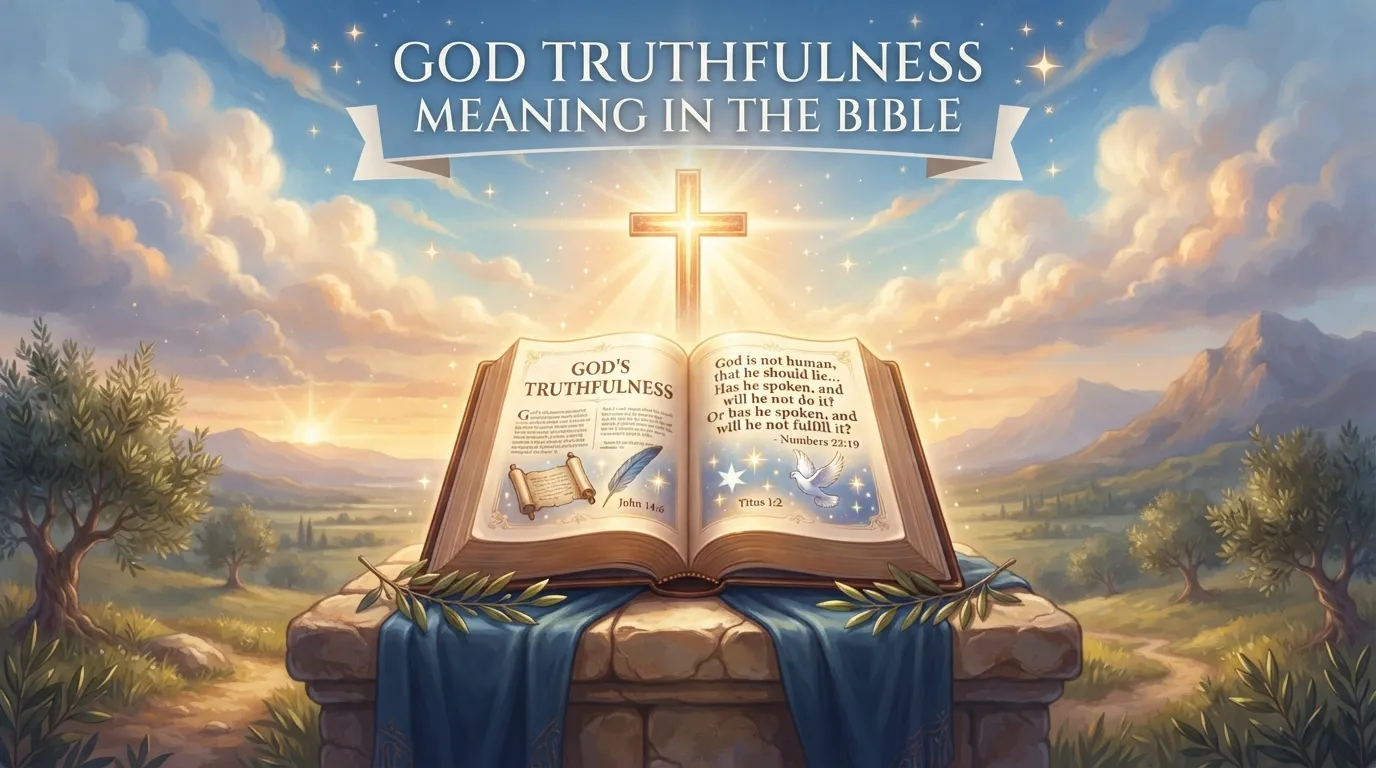
“God is not human, that he should lie, not a human being, that he should change his mind.” Those words from Numbers 23:19 sit at the center of one of the Bible’s most stabilizing claims: the God truthfulness meaning in the Bible is that God is true, honest, and completely trustworthy. His words are dependable because they flow from who He is. When everything around you feels uncertain — when friends disappoint, plans collapse, and your own feelings rise and fall — this truth is the ground under your feet. You can trust God completely, not because life is predictable, but because He is.
Truth as Reliability, Not Just Accuracy
Two Hebrew words open up what Scripture means by God’s truthfulness. The first is emet, which carries the ideas of truth, faithfulness, reliability, firmness, and trustworthiness. Biblical truth is not only about saying correct things. It is about being dependable. The second is emunah, often connected with faithfulness, firmness, and steadfastness — the kind of reliability you can lean your whole weight on.
Both words come alive in Exodus 34:6, when God reveals His character to Moses after Israel’s sin with the golden calf. He describes Himself as “abounding in steadfast love and faithfulness.” At the very moment Israel had proven faithless, God presented Himself as faithful. That is the pattern of the whole Bible: human beings waver, and God remains true.
Psalm 119:160 puts it boldly: “The sum of your word is truth.” And Jesus prayed to the Father, “Your word is truth” (John 17:17). For Christians, God’s Word is not merely inspirational advice. It corrects, promises, warns, and calls — and it can be trusted in each of those roles because the One who spoke it does not lie.
A Promise Keeper With a Long Memory
One of the clearest ways to see God’s truthfulness is through His promises. God promised Abraham that He would make him a great nation and bless him (Genesis 12:1–3). Then Abraham waited — for years, then decades. The story matters precisely because it shows that God’s promises often unfold on a schedule far slower than ours. A delay is not proof that God has failed. Hebrews 6:15 notes that Abraham, after patiently enduring, obtained the promise.
That said, Christians should be careful not to turn every personal hope into a guaranteed biblical promise. Not every verse is a personal guarantee about your future. Some promises were given to particular people in specific historical situations. Wisdom means holding firmly to what Scripture actually promises — forgiveness, God’s presence, His faithfulness, eternal life — while refusing to baptize our own wish lists as divine pledges.
The New Testament doubles down on this truthfulness. Titus 1:2 describes God as the One “who never lies,” connecting that fact to the hope of eternal life. Hebrews 6:18 says it is impossible for God to lie, and points to His promise as a secure source of encouragement. Human beings make promises they cannot keep: we forget, we change our minds, we misunderstand, we fail from weakness. God’s truthfulness is part of His unchanging character.
Truth With a Face
In the New Testament, God’s truthfulness gains a face. Jesus said, “I am the way, and the truth, and the life” (John 14:6). He did not merely teach truth; He identified Himself with it. John 1:14 describes Him as full of grace and truth, and John 1:17 contrasts the law given through Moses with the grace and truth that came through Jesus Christ.
That pairing — grace and truth — is essential. Truth without grace becomes a weapon. Grace without truth becomes sentiment. In Jesus, God’s truth arrives wrapped in compassion: teaching, healing, forgiving, and ultimately dying and rising again. His death and resurrection are central to the Christian message because they demonstrate God’s faithfulness to His redemptive purpose. God’s truth is not cold information. It is a relationship with God through Christ.
Truthfulness and faithfulness are close cousins, but they are not identical twins. Truthfulness emphasizes that God is true and does not lie. Faithfulness emphasizes that He remains reliable and keeps His covenant promises. Lamentations 3:22–23 holds them together in a painful setting: surrounded by suffering, the writer declares that God’s steadfast love never ends, His mercies are new every morning, and great is His faithfulness. You can acknowledge pain while still trusting God. You can grieve while still holding onto hope. Christian faith does not require denying pain. It teaches us where to take our pain.
When You Feel Forgotten
There are seasons when a Christian feels as though God has forgotten them. David knew that feeling. Psalm 13 opens with the repeated question “How long?” — how long will sorrow continue, how long will God seem distant? Yet the psalm eventually turns toward trust. The Bible does not hide the emotional struggles of God’s people. Faithful believers experienced fear, confusion, grief, and long waiting.
God’s truthfulness means our feelings do not determine whether God is faithful. Feeling abandoned and being abandoned are not the same thing. When emotions overwhelm, Christians can return to what Scripture says about God’s character rather than letting changing feelings become the final authority.
It also means we can be honest. The Psalms show believers bringing questions, sorrow, fear, and hope to God without varnish. You do not need to hide your fears from God. Prayer can be blunt. Trust is not the absence of questions; it is bringing the questions to the One who is true.
The Long Wait Between Promise and Fulfillment
Abraham’s story deserves a second look, because it is where God’s truthfulness gets tested in real time. God promised a great nation and blessing. Then came years of waiting, a childless tent, and an aging body. Abraham’s faith was not a single heroic moment; it was a long, uneven endurance. Hebrews 6:15 says that after patiently enduring, he obtained the promise. That verse does not teach that every personal desire is a promise from God — far from it. It teaches that God’s timetable is not ours, and that a slow fulfillment is not a failed promise.
This is where many Christians quietly lose heart. They pray for healing and still face uncertainty. They ask for direction and hear silence. They watch a financial pressure, a family problem, or a grief that does not lift. In those moments, faith does not require pretending everything is easy. Faith says: “I may not understand everything, but I know God is trustworthy.” That kind of trust changes how we face uncertainty. It lets us grieve honestly, wait patiently, and keep praying without demanding that God justify Himself on our schedule. His truthfulness is the anchor; our feelings are the weather.
What Truthfulness Demands of Us
God’s truthfulness should shape more than Sunday beliefs. It should shape everyday decisions. When you are tempted to lie because the truth would embarrass you, remembering God’s truthfulness can steady you toward honesty. When someone treats you unfairly, you can trust God’s justice while responding in a way that honors Christ. Ephesians 4:25 urges believers to put away falsehood and speak truth with one another. Because God is truthful, His people are called to become people of truth.
That same standard applies to spiritual experiences. The Bible contains genuine dreams and visions — Joseph’s dreams in Genesis 37, Joseph’s interpretation of dreams in Genesis 40–41 — but Scripture never teaches that every modern dream is a message from God. First John 4:1 tells believers to test the spirits rather than believing every spiritual claim. A dream that encourages something sinful or contradicts God’s revealed Word should not be accepted as divine truth. Experiences must be weighed against Scripture, never placed above it.
And there is a humble boundary to remember. Deuteronomy 29:29 reminds God’s people that some things belong to God, while what He has revealed belongs to us. Proverbs 3:5–6 encourages trust in the Lord rather than total reliance on our own understanding. When you cannot see the whole road, you can still trust the One who sees it. Jesus compared the person who hears His words and acts on them to someone who builds a house on rock (Matthew 7:24–27). Storms come either way. The foundation is what matters.
Learning to Lean
Trust in God’s truthfulness grows through simple habits. Read Scripture carefully and in context, rather than building a view of God on isolated verses. Remember God’s character when circumstances change — His faithfulness does not depend on whether today feels easy. Pray honestly. Keep biblical promises in context, learning who received a promise and why. And practice truthfulness yourself, because the God you worship is a God of truth.
So if you are walking through an uncertain season today, hold onto this: God is true. His Word is trustworthy. His faithfulness is greater than your fears. Life will bring questions without immediate answers, seasons of waiting, disappointment, grief, and uncertainty. Yet God’s truthfulness gives you a firm place to stand. You do not have to understand everything before you trust Him. Keep praying. Keep seeking His wisdom. Keep reading His Word. And keep trusting the God who has never needed to become someone else in order to remain faithful. Readers curious about how philosophers have defined truth across the centuries may find the Wikipedia entry on truth a helpful companion to the biblical picture.










