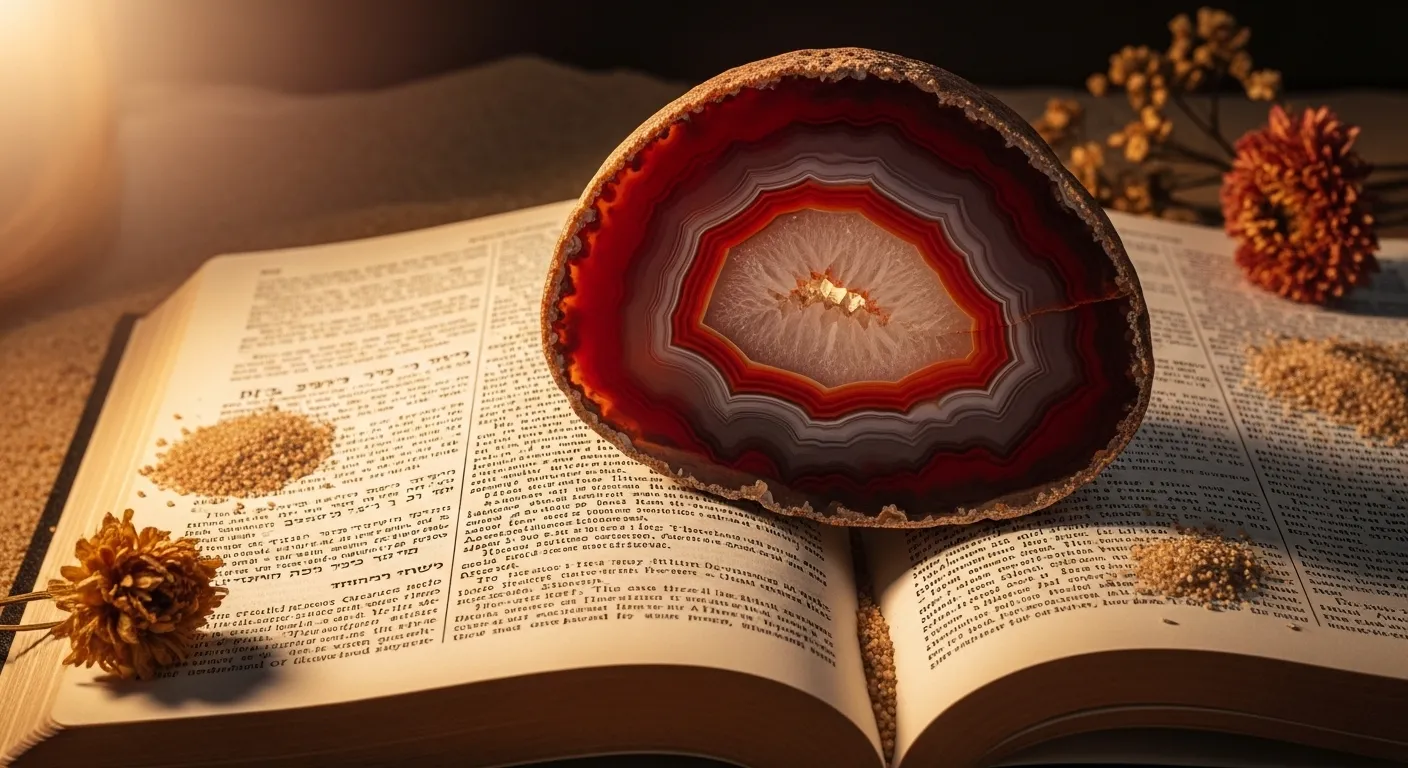
An uncut agate is one of nature’s best-kept secrets. Pick one up on a riverbank and you will hold a dull, rough nodule — gray, lumpy, entirely unremarkable. But agates form inside pockets of volcanic rock, where silica-rich water seeps in and deposits microscopic layers of quartz, one band at a time, over immense stretches of time. Saw the nodule open and the dull exterior gives way to concentric bands of color: milky white, rust red, smoky gray, honey amber. The beauty was always there. It was simply hidden, built layer by patient layer where no eye could see it.
That hidden architecture is exactly why this stone keeps appearing in reflections on the spiritual life — and it is why Scripture’s own mentions of agate deserve a careful look. The Bible does not treat agate as a magic stone. It treats it as a witness stone: something beautiful that points beyond itself to the God who works the same way in human hearts — slowly, in layers, out of sight, until one day the finished work is revealed.
Where Scripture Sets This Stone
Agate’s clearest biblical appearance is on the chest of Israel’s high priest. God commanded Moses: “You shall set in it four rows of stones… the third row, a jacinth, an agate, and an amethyst” (Exodus 28:17, 19). Twelve stones, one for each tribe of Israel, set in gold filigree and worn over Aaron’s heart “for a memorial before the Lord continually” (Exodus 28:29). Think about what that meant: when the high priest entered God’s presence, he carried the whole people with him — and agate was one of the stones doing the carrying. The stone’s message was identity and remembrance. God does not lose track of His people. Their names are, quite literally, set in stone before Him.
The prophet Isaiah gives agate a different setting — a city, not a breastplate. Speaking God’s promise of restoration to a battered Jerusalem, he writes: “O afflicted one, storm-tossed and not comforted, behold, I will set your stones in antimony, and lay your foundations with sapphires. I will make your pinnacles of agate, your gates of carbuncles, and all your wall of precious stones” (Isaiah 54:11–12). This is not interior decorating advice. It is a promise that God rebuilds ruins into something more beautiful than what was destroyed. The agate here stands in the architecture of hope: the pinnacles — the highest, most visible points of the restored city — made of a stone whose beauty was formed in darkness. God specializes in taking what was broken and setting it where everyone can see His repair work.
Ezekiel’s lament over the king of Tyre lists agate among the stones covering that proud figure “on the day you were created” (Ezekiel 28:13) — a reminder that every beautiful thing, even stones, belongs to the inventory of God’s creation before it belongs to anyone’s treasury.
The Slow Work of Layers
Here is where the stone starts preaching. Agate cannot be hurried. Each band of quartz is a separate deposit, laid down in its own season, and the finest specimens contain dozens or hundreds of layers. No single layer looks like much. Together they make the stone.
Scripture describes spiritual formation in precisely these terms. “The testing of your faith produces steadfastness. And let steadfastness have its full effect, that you may be perfect and complete, lacking in nothing” (James 1:3–4). Steadfastness having its full effect — that is layer-language. So is Paul’s confidence “that he who began a good work in you will bring it to completion at the day of Jesus Christ” (Philippians 1:6): begun, not finished; in progress, layer upon layer. And David’s wonder at being “fearfully and wonderfully made,” knit together in the hidden depths (Psalm 139:13–15), is the same wonder a geologist feels sawing open a nodule — beauty assembled in secret by a patient Maker.
This reframes the seasons believers are tempted to despise. The uneventful years of quiet obedience, the prayers that seem to change nothing, the slow sanctification that never makes a testimony video — these are deposit seasons. God is laying down bands. “And we know that for those who love God all things work together for good” (Romans 8:28), not always visibly, not always quickly, but truly. The agate’s testimony to the impatient heart is simple: the layers you cannot see are still layers.
A Stone With No Power of Its Own
Honesty requires a warning here, because the modern market sells agate as something Scripture never claims it is. Crystal shops attribute healing energies, protective vibrations, and spiritual powers to the stone itself. That is not biblical symbolism; it is animism with better marketing. The Bible’s stones never work magic. The breastplate stones did not protect Israel — God protected Israel, and the stones reminded Israel of the God who did. Urim and Thummim gave guidance not because the stones were powerful but because God had appointed them as instruments (Exodus 28:30). The power was always His; the stones were always pointers.
This distinction matters enormously. When a believer keeps an agate on a desk as a reminder to trust God’s slow work, that is wisdom — the same instinct that set up memorial stones at the Jordan (Joshua 4:6–7) so future generations would ask, “What do these stones mean?” and hear the story of God’s faithfulness. When someone believes the stone itself heals, protects, or channels energy, that is superstition, and Scripture consistently steers God’s people away from trusting created things (Isaiah 44:9–20 is unsparing on this point). Admire the stone. Learn from the stone. Never worship the stone — or expect the stone to do God’s job.
What Agate Preaches to the Discouraged
There is a final sermon in the stone, and it is for the person who feels plain. The uncut agate looks like nothing — and that is precisely the condition of most real spiritual growth. Nobody applauds the layer being deposited today. Nobody sees it. The stone’s whole splendor is interior until the cutting wheel reveals it, and even then the cutting is not the stone’s doing.
So it is with the believer. “Your Father who sees in secret will reward you” (Matthew 6:4) — the secret is where the layers go down. The public beauty, whenever and however God chooses to reveal it, is His craftsmanship, not your achievement. If your faith feels dull and lumpy right now, like the outside of the nodule, remember that the outside was never the point. The bands are forming. The colors are gathering. And the God who built beauty into rock in the dark is building something in you in the dark too — “for it is God who works in you, both to will and to work for his good pleasure” (Philippians 2:13).
Stones That Remember
Agate’s place on the breastplate belongs to a larger biblical habit: God keeps giving His people stones as memory devices. When Israel crossed the Jordan, Joshua ordered twelve stones taken from the riverbed and set up at Gilgal — “that this may be a sign among you. When your children ask in time to come, ‘What do those stones mean to you?’ then you shall tell them” (Joshua 4:6–7). The stones were not sacred objects; they were conversation starters, designed to make the next generation ask questions.
Jacob did the same at Bethel, setting up the stone he had slept on: “this stone, which I have set up for a pillar, shall be God’s house” (Genesis 28:22). Samuel set up the Ebenezer stone after a deliverance — “Thus far the Lord has helped us” (1 Samuel 7:12). In each case the pattern is identical: something worth remembering, a stone to mark it, and a story attached for the future. The stone has no power. The memory has all the power.
This is the right category for thinking about agate in the Christian life. Kept as a reminder of Isaiah 54’s restored city, it functions like the Gilgal stones: a prompt to remember. Expected to heal or protect by its own energy, it crosses the line Scripture draws between memorial and idol. The question is never “is the stone beautiful?” The question is always “what is the stone for?” Memorial: biblical. Talisman: forbidden. The breastplate stones were worn over the heart “for a memorial before the Lord continually” (Exodus 28:29) — and remembrance, directed Godward, is one of the most spiritual things a physical object can do.
Agate’s biblical meaning, gathered up, is this: remembrance (the breastplate), restoration (Isaiah’s pinnacles), patience (the layers), and perspective (the plain exterior hiding glory). It is a small stone with a large sermon, and its text is the slow, hidden, faithful work of God. The geology of how agates actually form only deepens the wonder — silica, water, time, and pressure producing banded beauty — and leaves the believer with the same conclusion the stone has always suggested: trust the process, because the Craftsman knows exactly what He is layering into you.










