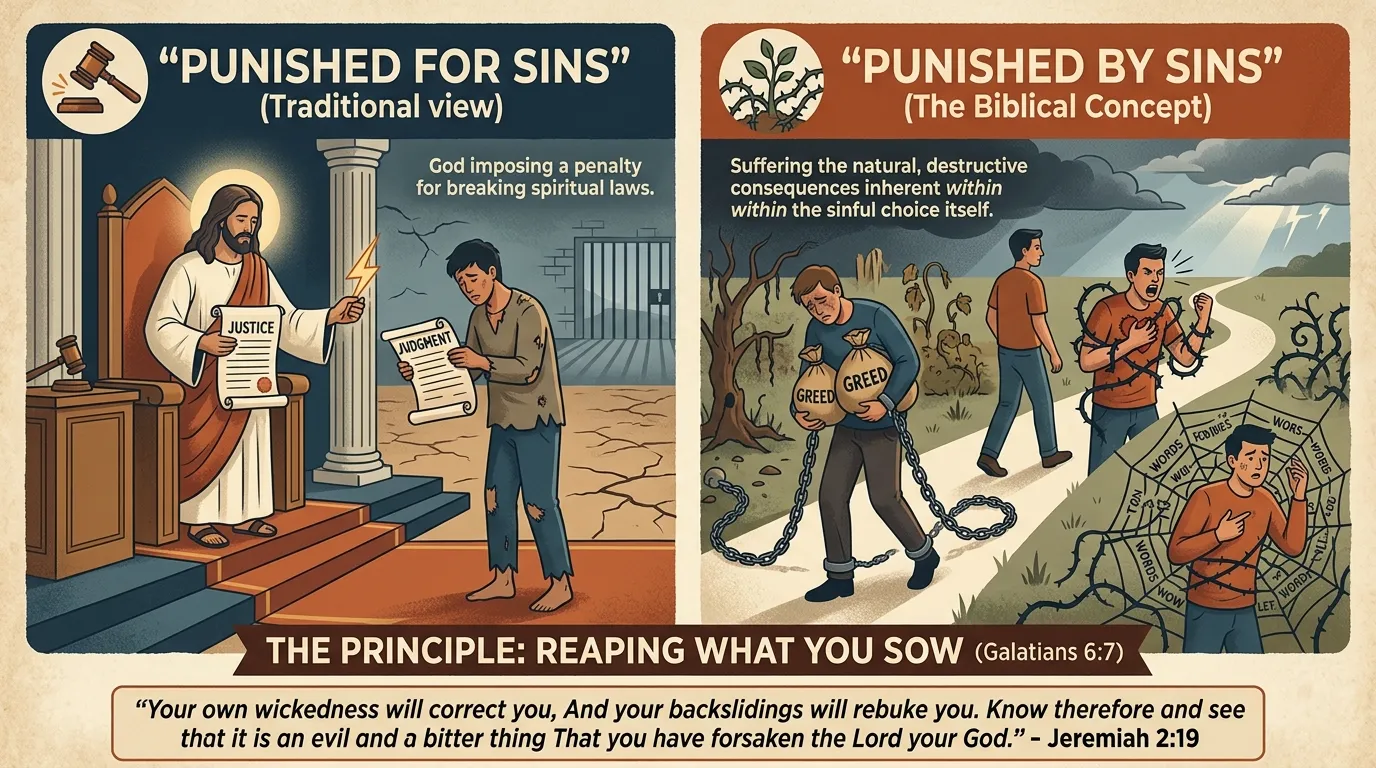
It usually arrives at night. The diagnosis, the pink slip, the broken relationship, the child in trouble — and underneath the grief, a colder question: Is God punishing me for my sins? The question is asked in hospital chapels and unemployment lines, in the aftermath of divorce and the wreckage of addiction. It is one of the most human questions in existence, and the Bible — which never dodges human questions — answers it with unusual care. Because the true answer is neither the flippant “don’t worry about it” nor the crushing “yes, and you deserve worse.” It is something more honest, and far more hopeful, than either.
Yes, Sin Has Real Consequences — Scripture Won’t Pretend Otherwise
Begin with the hard honesty, because cheap comfort insults the grieving. The Bible teaches, without apology, that actions have consequences, and that God built the moral order that way. “Do not be deceived: God is not mocked, for whatever one sows, that will he also reap” (Galatians 6:7). This is not divine vindictiveness; it is divine reality — the spiritual equivalent of gravity. Sow dishonesty, reap distrust. Sow neglect, reap estrangement. Sow addiction, reap bondage. The field does not hate the farmer; it simply returns what was planted.
David learned this in the most painful classroom imaginable. After his adultery with Bathsheba and his murder of Uriah, Nathan confronted him, David repented — “I have sinned against the LORD” — and Nathan pronounced the stunning verdict: “The LORD also has put away your sin; you shall not die” (2 Samuel 12:13). Full forgiveness, instantly. But the very next verse adds: “Nevertheless, because by this deed you have utterly scorned the LORD, the child who is born to you shall die.” Forgiven — and still facing consequences. The sword would never depart from his house (2 Samuel 12:10). Grace canceled the eternal penalty; it did not rewind history. Forgiveness and fallout can coexist, and pretending otherwise keeps wounded people from understanding their own lives.
The Proverbs are blunt about the mechanics: “Whoever digs a pit will fall into it” (Proverbs 26:27). “The wicked are ensnared in the work of their own hands” (Psalm 9:16). And Moses warned Israel corporately: “be sure your sin will find you out” (Numbers 32:23). None of this means every hardship is traceable to a specific sin. It means the moral universe is real, and living as if actions don’t matter is the actual fantasy.
But Not Every Hardship Is Punishment
Here is where the Bible corrects the most common — and most damaging — version of the night-time question. Suffering is not always punishment. Sometimes it is not even about your sin at all.
Job is the standing rebuke to the formula. His friends were certain: suffering proves sin, so Job must have sinned. They said it for thirty-seven chapters with increasing confidence. And God’s verdict on their theology? “My anger burns against you… for you have not spoken of me what is right” (Job 42:7). The friends’ doctrine — pain equals punishment — was declared wrong by God Himself. Job’s suffering had a heavenly purpose his friends never imagined, and his righteousness was never in question. Every time we tell a sufferer “this must be because of your sin,” we risk joining the friends on the wrong side of God’s anger.
Jesus dismantled the formula twice in public. When His disciples saw a man blind from birth and asked, “Rabbi, who sinned, this man or his parents, that he was born blind?” — the standard theology of the day — Jesus answered flatly: “It was not that this man sinned, or his parents, but that the works of God might be displayed in him” (John 9:2-3). And when told about Galileans murdered by Pilate and eighteen crushed by the tower of Siloam, He warned the crowd not to read those tragedies as measurements of guilt: “Do you think that they were worse offenders than all the others? No, I tell you” (Luke 13:2-5). Disaster is not a sin-meter. The rain falls on fields regardless of the farmer’s holiness.
Paul’s thorn in the flesh (2 Corinthians 12:7-9) was not punishment but protection — given “to keep me from becoming conceited.” The persecution of the early church was not punishment but privilege — “it has been granted to you… not only to believe in him but also to suffer for him” (Philippians 1:29). Hebrews 11’s heroes include those “of whom the world was not worthy” — tortured, destitute, mistreated (Hebrews 11:37-38). Were they being punished? The text calls them the world’s unworthy owners. Suffering, in the Bible, is multicolored: sometimes consequence, sometimes discipline, sometimes warfare, sometimes mystery, sometimes glory. The night-time question deserves better than a single answer.
The Discipline of a Father, Not the Payback of a Judge
When God does connect hardship to His children’s behavior, the Bible gives it a name that changes everything: discipline — and discipline, in Scripture, is what fathers do, not what judges do. “My son, do not despise the LORD’s discipline… for the LORD reproves him whom he loves, as a father the son in whom he delights” (Proverbs 3:11-12; Hebrews 12:5-6). The distinction is everything. A judge punishes to settle accounts; a father disciplines to shape character. Punishment looks backward at what you did. Discipline looks forward at who you are becoming.
Hebrews develops the image at length: “God is treating you as sons. For what son is there whom his father does not discipline?” (Hebrews 12:7). The logic is startling — discipline is evidence of sonship, not evidence of rejection. The child who is never corrected is the child who has been abandoned; the one God bothers to train is the one He claims. And the stated goal is explicit: “he disciplines us for our good, that we may share his holiness” — and “it yields the peaceful fruit of righteousness to those who have been trained by it” (Hebrews 12:10-11). Trained by it: discipline is a gym, not a courtroom.
This reframes the night-time question entirely. Instead of “Is God punishing me?” — which imagines a judge settling scores — the believer can ask, “Father, what are You teaching me?” — which imagines a father shaping a son. The first question breeds fear and hiding (Adam, Genesis 3:8). The second breeds honesty and growth. And the New Testament is explicit that for those in Christ, the judicial question is already settled: “There is therefore now no condemnation for those who are in Christ Jesus” (Romans 8:1). Punishment, in the ultimate sense, fell on Christ (Isaiah 53:5). What remains for God’s children is not payback but parenting — sometimes painful, always loving, aimed at holiness.
David Again: Forgiven Fully, Consequences Remained
David’s story deserves a second look, because it holds the two truths together without blurring them. When Nathan said “the LORD has put away your sin,” the forgiveness was total — David would not die the death the Law prescribed (Leviticus 20:10). Psalm 51, written from this wreckage, shows a man who understands grace: “Have mercy on me, O God, according to your steadfast love… Wash me thoroughly from my iniquity” (Psalm 51:1-2). He appeals to mercy, not merit. He asks to be washed, not merely excused. And God answers.
Yet the child died. Absalom rebelled. The sword never left his house. David lived the rest of his life inside the fallout of forgiven sin — and the Psalms he wrote afterward are deeper, tenderer, and more useful to sufferers than anything he wrote before. That is the mysterious economy of grace: God can forgive completely and still let the consequences teach. The consequences are not the price of forgiveness — Christ paid that. They are the curriculum of the forgiven, the field where repentance grows into wisdom.
This is why the right response to sin’s fallout is neither despair (“God has abandoned me”) nor denial (“consequences don’t apply to the forgiven”). It is repentance plus realism: own the sin fully, receive the forgiveness fully, and then walk honestly through whatever remains — trusting the Father to use even the wreckage for “the peaceful fruit of righteousness.” David did. His worst chapter became the church’s greatest prayer book for penitents.
The Way Back Is Always Open
If the night-time question has exposed real sin — not imagined guilt, but actual wrongdoing — the Bible’s answer is the most hopeful sentence in this whole discussion: the way back is always open, and it is shorter than you think. “If we confess our sins, he is faithful and just to forgive us our sins and to cleanse us from all unrighteousness” (1 John 1:9). Faithful — He will do it. Just — it is right for Him to do it, because the cross settled the account. All unrighteousness — no exceptions, no fine print.
The prodigal son rehearsed his speech for the long walk home — “make me like one of your hired servants” — but the father was already running before the speech was finished (Luke 15:20). Joel’s invitation stands over every guilty conscience: “return to me with all your heart… for he is gracious and merciful, slow to anger, and abounding in steadfast love” (Joel 2:12-13). And Isaiah’s promise defies the math of guilt: “though your sins are like scarlet, they shall be as white as snow” (Isaiah 1:18).
So ask the night-time question honestly — and then let Scripture answer it honestly. Is this a consequence of my actions? Perhaps; own it, learn from it, make restitution where you can. Is God punishing me as a judge? If you are in Christ — no; the punishment fell on Him. Is my Father teaching me something? Possibly; ask Him, and listen. Can I be forgiven? Completely, right now, on the authority of 1 John 1:9. The God who disciplines His children never stops being their Father — and no night is so dark that His mercy cannot find you in it by morning.
Readers wrestling with guilt and forgiveness may find Wikipedia’s overview of repentance across traditions a useful wider lens on the turning-back this article describes from Scripture.










