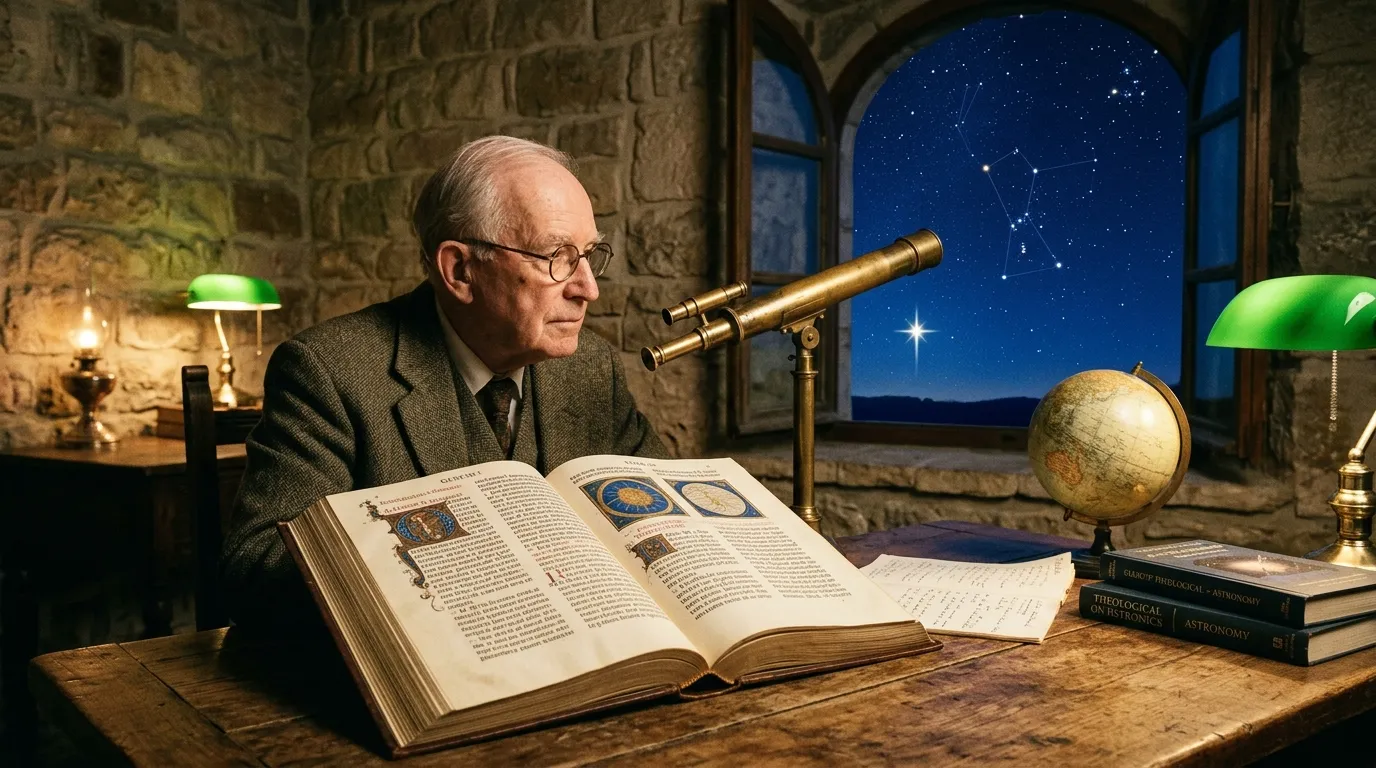
On a clear night far from city lights, the sky does something to the human soul that no argument can quite replicate. The sheer number of stars, the depth of the dark between them, the slow turning of constellations overhead — it shrinks the viewer and enlarges the questions. What is all this for? Is anyone behind it? Is it saying something? The Bible’s answer to those night-sky questions is one of Scripture’s most beautiful themes — and also one of its most carefully guarded. For the heavens, in the Bible, are allowed to declare; they are never allowed to dictate. That single distinction is the key to everything Scripture says about astronomy.
The Heavens Are a Pulpit, Not a Script
“The heavens declare the glory of God; the skies proclaim the work of his hands. Day after day they pour forth speech; night after night they reveal knowledge” (Psalm 19:1-2). David’s claim is sweeping: creation’s most visible feature is a preacher, and its sermon never stops. The stars do not whisper; they declare — the Hebrew suggests a herald’s proclamation. Their message has content: glory, power, wisdom, faithfulness. Paul picks up the theme: “his invisible attributes, namely, his eternal power and divine nature, have been clearly perceived… in the things that have been made” (Romans 1:20). The night sky is general revelation — God introducing Himself to every human being who looks up, in every century, on every continent.
But note what the heavens don’t preach. They declare God’s glory; they do not dictate your future. They reveal His power; they do not reveal your horoscope. The stars are a pulpit, not a script — they announce the Speaker, not the schedule. This is precisely where biblical astronomy parts ways with astrology, and the parting is absolute. The heavens point upward to the Creator; astrology tries to read them inward, as a map of human destiny. One is worship. The other, in Scripture’s verdict, is a counterfeit that steals worship’s object.
Signs God Himself Appointed
The Bible does give the heavenly bodies a job description, and it includes the word “signs.” On the fourth day, God set the sun, moon, and stars in the expanse “for signs and for seasons, and for days and years” (Genesis 1:14). The lights are God’s appointed markers — for timekeeping (seasons, festivals, calendars) and for signs: moments when God uses the sky as a canvas for His message.
Scripture records several. At Joshua’s command, the sun stood still over Gibeon and the moon over the Valley of Aijalon — “there has been no day like it before or since” (Joshua 10:13-14) — a sign that God fought for Israel. For Hezekiah, the shadow retreated ten steps on the sundial as a sign of healing (2 Kings 20:9-11). At the crucifixion, darkness came over the whole land from noon to three (Luke 23:44-45) — the sky itself mourning, or testifying, at the death of its Maker. Joel prophesied cosmic signs — sun to darkness, moon to blood — before the great day of the LORD (Joel 2:30-31), words Peter quoted at Pentecost (Acts 2:19-20).
The pattern in every case: God appoints the sign, God explains the sign, and the sign points to God’s action — never to a human technique for reading the future. The signs are God’s initiative, God’s vocabulary, God’s timing. No one in Scripture is ever commended for scanning the skies to discover what God might be saying; they are commanded to watch when God is saying it, and to listen to the prophets He sends to interpret. The difference is between receiving a letter and steaming open someone else’s mail.
Even the calendar of Israel’s worship was written in the sky. The new moon marked the months, the Passover was tied to the spring moon, and the Feast of Trumpets began at the sighting of the new moon (Numbers 10:10; Psalm 81:3). The heavens were God’s appointed timepiece for His people’s holy days — a reminder, every month, that sacred time itself is His gift, measured out by lights He hung and rhythms He set.
The Star Over Bethlehem
The most famous heavenly sign in the Bible is the star that led the magi to Jesus — and it is worth reading carefully, because it is so often misread as an endorsement of astrology. “We saw his star when it rose and have come to worship him” (Matthew 2:2). The magi were eastern scholars, likely familiar with the stars; God met them where they were, using a phenomenon they would notice. But everything about the story subverts astrology rather than endorsing it.
First, the star did not tell them the future from a chart — it led them, moving and stopping (Matthew 2:9), behaving like no natural star behaves. This was God’s special sign, not a horoscope. Second, the magi still needed Scripture to find the child: it was the chief priests, quoting Micah 5:2, who told them Bethlehem (Matthew 2:5-6). The star got them to Jerusalem; the Word got them to the manger. Third, the story’s climax is not stargazing but worship: “they fell down and worshiped him” (Matthew 2:11). The sign did its job when it produced worship of Christ — which is exactly what every legitimate heavenly sign does, and exactly what astrology never does.
God can use anything — a star, a donkey, a burning bush — to draw people to Himself. That He once used a star to guide seekers to Jesus is grace, not a method. No one is invited to repeat the magi’s astronomy; everyone is invited to repeat their worship.
The Line Scripture Draws: Wonder, Not Worship
Now the guarded side — and Scripture guards it fiercely. The same Bible that celebrates the starry heavens forbids their worship with unusual severity. “Beware lest you raise your eyes to heaven, and when you see the sun and the moon and the stars, all the host of heaven, you be drawn away and bow down to them and serve them” (Deuteronomy 4:19). The temptation is real precisely because the heavens are glorious; glory misdirected becomes idolatry. Every culture that worshiped the sun was responding to something genuinely awesome — and getting the direction of the awe exactly backward.
Astrology — reading human destiny in the stars — gets the same verdict. Isaiah mocks Babylon’s astrologers with withering sarcasm: “Let them stand up, those who divide the heavens, who gaze at the stars, who at the new moons make known what shall come upon you” — and then delivers the punchline: “Behold, they are like stubble; the fire consumes them; they cannot even deliver themselves” (Isaiah 47:13-14). In Daniel, the magi, enchanters, and astrologers of Babylon repeatedly fail where Daniel’s God succeeds (Daniel 2:10-11, 27-28; 4:7; 5:8) — the book’s running argument that the heavens’ Creator reveals mysteries the heavens’ readers cannot.
Jeremiah states the principle for God’s people directly: “Learn not the way of the nations, nor be dismayed at the signs of heaven because the nations are dismayed at them” (Jeremiah 10:2). The nations tremble at eclipses and alignments; God’s people are not to. Why? Because they know the One who hung the lights. A child who knows his father is not frightened by the father’s shadow. The Christian’s relationship to the cosmos is one of confidence, not divination — the stars are not our masters but our fellow creatures, and our Father owns them all.
The Saints Will Shine Like Stars
There is one more astronomical image in Scripture, and it is the most personal of all: the Bible promises that God’s people will one day share the stars’ shining. “Those who are wise shall shine like the brightness of the sky above; and those who turn many to righteousness, like the stars forever and ever” (Daniel 12:3). Jesus echoes it: “Then the righteous will shine like the sun in the kingdom of their Father” (Matthew 13:43). Paul applies it to the present: believers are to shine “as lights in the world” amid a crooked generation (Philippians 2:15).
And the one called “the bright morning star” (Revelation 22:16) is Christ Himself — the dawn that the night sky has been announcing all along. Job heard God ask, from the whirlwind, “Can you bind the chains of the Pleiades or loose the cords of Orion?… Do you know the ordinances of the heavens?” (Job 38:31, 33). The answer, for Job and for us, is no — but we know the One who does. That is enough. More than enough.
So look up. Let the heavens preach their endless sermon of glory. Receive God’s appointed signs with reverence when He sends them. But never bow to the lights, never read your destiny in them, never trade the Creator for the creation. The stars are not your horoscope; they are your hymnbook — and every night they sing the same chorus: great is the God who made us, and He is worthy of your worship.
The story of the most famous star in Scripture — the one that announced a birth in Bethlehem — is told in detail on Wikipedia’s page on the Star of Bethlehem, including the astronomical theories scholars have proposed for what the magi may have seen.










