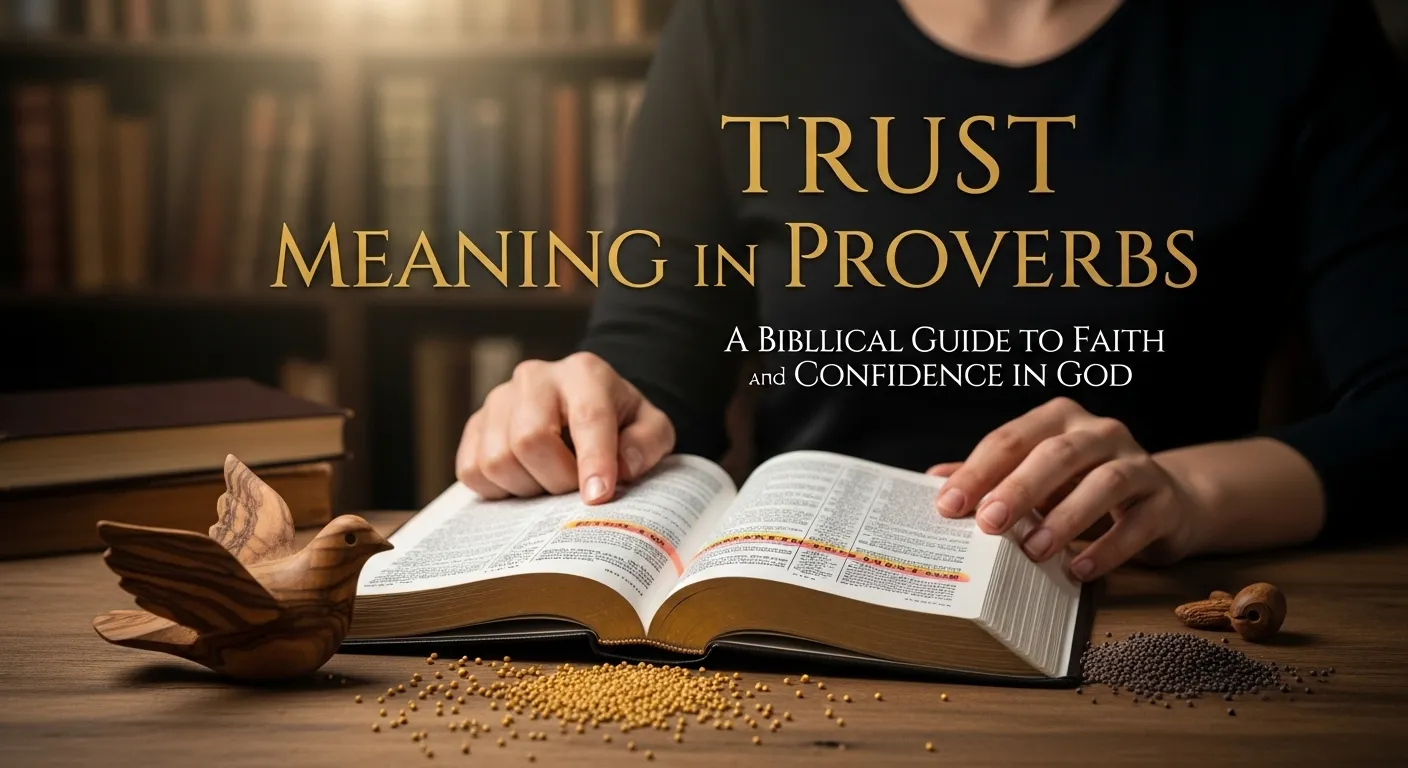
Few verses in the Bible are more memorized — and more misread — than Proverbs 3:5: “Trust in the LORD with all your heart and lean not on your own understanding.” It is quoted at graduations, printed on wall art, whispered in hospital corridors. But familiarity can flatten it. “Lean not on your own understanding” is sometimes taken to mean “don’t think” — as though faith required switching off the mind God gave you. That is not what Proverbs teaches, and it is not what trust means. The verse is not anti-intellectual; it is anti-self-sufficiency. It describes a reorientation of the entire self — heart, mind, and path — from self-reliance to God-reliance. Unpack its three movements, and you have Proverbs’ complete theology of trust.
With All Your Heart: Trust as Surrender
“Trust in the LORD with all your heart.” In Hebrew thought, the heart (lev) is not the seat of emotion but the command center — the place of will, decision, and allegiance. To trust with all your heart is not to feel confident; it is to decide allegiance. It is the difference between admiring a bridge and walking onto it. Many people admire God’s trustworthiness from the riverbank. Trust walks onto the bridge.
The word for “trust” here (batach) carries the sense of lying face-down in total dependence — the posture of someone who has stopped trying to hold themselves up. It is used of a child asleep on a parent, of a warrior behind a shield. Proverbs uses it deliberately: trust is not a mood but a posture. And it is total — “with all your heart.” Partial trust is the great temptation of the comfortable: trusting God with eternity but not with the finances, with the children but not with the career, with Sundays but not with Mondays. Proverbs will not bless a divided heart. “A double-minded man is unstable in all he does” (James 1:8) is the New Testament’s echo of the same wisdom.
This is why trust and surrender are the same motion. You cannot trust God with all your heart while keeping a backup plan in your back pocket. The heart has limited seating; whatever occupies it is what you actually trust.
Lean Not: The Renunciation of Self-Sufficiency
“And lean not on your own understanding.” The image is physical: leaning is what you do with your weight. To lean on your own understanding is to put your full weight on your own judgment — to make your perspective the final court of appeal. Proverbs does not say understanding is worthless; the whole book is an education in understanding. It says understanding makes a terrible foundation. It is a good servant and a disastrous master.
Proverbs returns to this renunciation again and again, because self-sufficiency is humanity’s default religion. “Those who trust in themselves are fools, but those who walk in wisdom are kept safe” (Proverbs 28:26). “The fear of man will prove to be a snare, but whoever trusts in the LORD is kept safe” (Proverbs 29:25) — trusting people’s opinions is just self-sufficiency outsourced to the crowd. “Whoever trusts in his riches will fall, but the righteous will thrive like a green leaf” (Proverbs 11:28) — wealth is understanding’s favorite crutch, and it snaps under weight.
The renunciation is not a one-time event but a daily discipline. Every morning presents the choice afresh: will I navigate today by what I can see, or by the God who sees what I cannot? “Lean not” is present tense, continuous action. The believer who trusted God yesterday must trust Him again today — not because yesterday’s trust expired, but because today’s challenges are new, and self-sufficiency regenerates overnight like weeds.
In All Your Ways Acknowledge Him: Trust as Practice
The third movement turns trust from posture into practice: “in all your ways submit to him, and he will make your paths straight” (Proverbs 3:6). “All your ways” — not just the religious ways, the crisis ways, the Sunday ways. The commute, the budget meeting, the parenting decision, the medical choice: all of it is brought under His acknowledgment. The Hebrew for “acknowledge” (yada) means to know intimately, to recognize — it is the knowledge of relationship, not of information. To acknowledge God in all your ways is to live each decision in conscious companionship with Him.
And then the promise — the only promise in the verse, and it is gloriously modest: “he will make your paths straight.” Not “he will make your paths easy.” Not “he will show you the map.” Straight — direct, unobstructed, cleared of what would trip you. God’s guidance is often recognized in retrospect: the straightened path is visible from behind. Proverbs does not promise believers a preview; it promises them a Pilot. “The LORD makes firm the steps of the one who delights in him” (Psalm 37:23) sings the same tune in a different key.
This is where trust becomes practical rather than merely devotional. Acknowledging God in all your ways looks like prayer before the decision, not just after the disaster. It looks like bringing the offer letter, the diagnosis, the relationship question to Him first. It looks like obeying the last thing He showed you while waiting for the next. Trust is not passive; it is the most active thing a believer does — it just directs the activity Godward.
Trust at Midnight: Proverbs for the Anxious
Proverbs 3 doesn’t end with verse 6 — and the verses that follow are trust’s night shift. “Do not be afraid of sudden terror… for the LORD will be at your side” (Proverbs 3:25–26). Then the tender promise: “When you lie down, you will not be afraid; when you lie down, your sleep will be sweet” (Proverbs 3:24). Trust, it turns out, has a bedtime application. Anxiety does its worst work at 3 a.m. — the mind replays the day, previews the disasters, and leans hard on its own understanding in the dark. Proverbs prescribes trust as a sleep aid: the heart that surrendered its weight during the day doesn’t have to carry it at night.
This is deeply practical. The anxious mind treats every unknown as a threat; trust treats every unknown as God’s territory. “The LORD will be at your side” — not “the LORD will explain everything,” but “the LORD will be at your side.” Presence, not answers, is the promise. And presence is enough, because the One at your side is the One who “by wisdom founded the earth” (Proverbs 3:19) — the same chapter’s reminder that the God you’re trusting is competent. Anxiety says, “What if He can’t handle this?” Wisdom answers, “He founded the earth. He can handle this.”
So the nightly practice: name the specific fear — not “everything,” but the thing, the appointment, the conversation, the symptom. Speak Proverbs 3:5–6 over it, out loud if you can. Then do what the verse says: lie down. Trust has a posture, and sometimes the posture is horizontal. “In peace I will lie down and sleep, for you alone, LORD, make me dwell in safety” (Psalm 4:8). Sweet sleep is not the absence of problems; it is the presence of trust. The problems will still be there in the morning. So will He.
The Counterfeits: Where Proverbs Says Not to Trust
Proverbs is as clear about misplaced trust as about true trust, and the counterfeits deserve naming because they are trust’s most persuasive impostors. Riches — “Whoever trusts in his riches will fall” (11:28). Wealth promises security and delivers anxiety; it is a shield made of paper. Your own heart — “Those who trust in themselves are fools” (28:26). Feelings are real but they are not reliable; the heart is a compass that needs calibration, not a guide to follow blindly. People’s approval — “The fear of man will prove to be a snare” (29:25). Building your life on others’ opinions is building on weather. Your own righteousness — the subtle trust that God owes you because you’ve been good; Proverbs dismantles it with “There is a way that appears to be right, but in the end it leads to death” (14:12; 16:25).
Each counterfeit offers what only God can give: certainty, safety, identity. Each delivers a fraction and bills you for the whole. The wisdom of Proverbs is learning to spot the counterfeit before it costs you — to notice when your peace rises and falls with the bank balance, the applause, or your own performance, and to relocate your weight back onto the only foundation that does not shift.
Trust, in the end, is Proverbs’ answer to the question every anxious heart asks: who is actually in charge here? The book’s answer is tender and absolute: the LORD is — and He can be trusted with all your heart, in all your ways, for the straightening of every path. “When you lie down, you will not be afraid; when you lie down, your sleep will be sweet” (Proverbs 3:24) — that is what trust feels like at midnight. The psychology and philosophy of trust as a human phenomenon is surveyed in the Wikipedia article on trust; the practice of it — heart, understanding, and path, surrendered daily — is Proverbs 3:5–6, memorized by millions and still waiting, patiently, to be lived.










