Think of the last time a relationship broke — not drifted, broke. The harsh words, the slammed door, the silence afterward that felt heavier than the shouting. Maybe it was a marriage, a friendship, a family split down the middle at a holiday table. In that silence lives one of the Bible’s oldest words: enmity. It means more than disagreement. It means hostility — a settled state of opposition, the opposite of peace. And Scripture traces enmity from its first outbreak in Eden to its final execution on a cross, telling a story that is darker and more hopeful than we usually admit.
The First Hatred
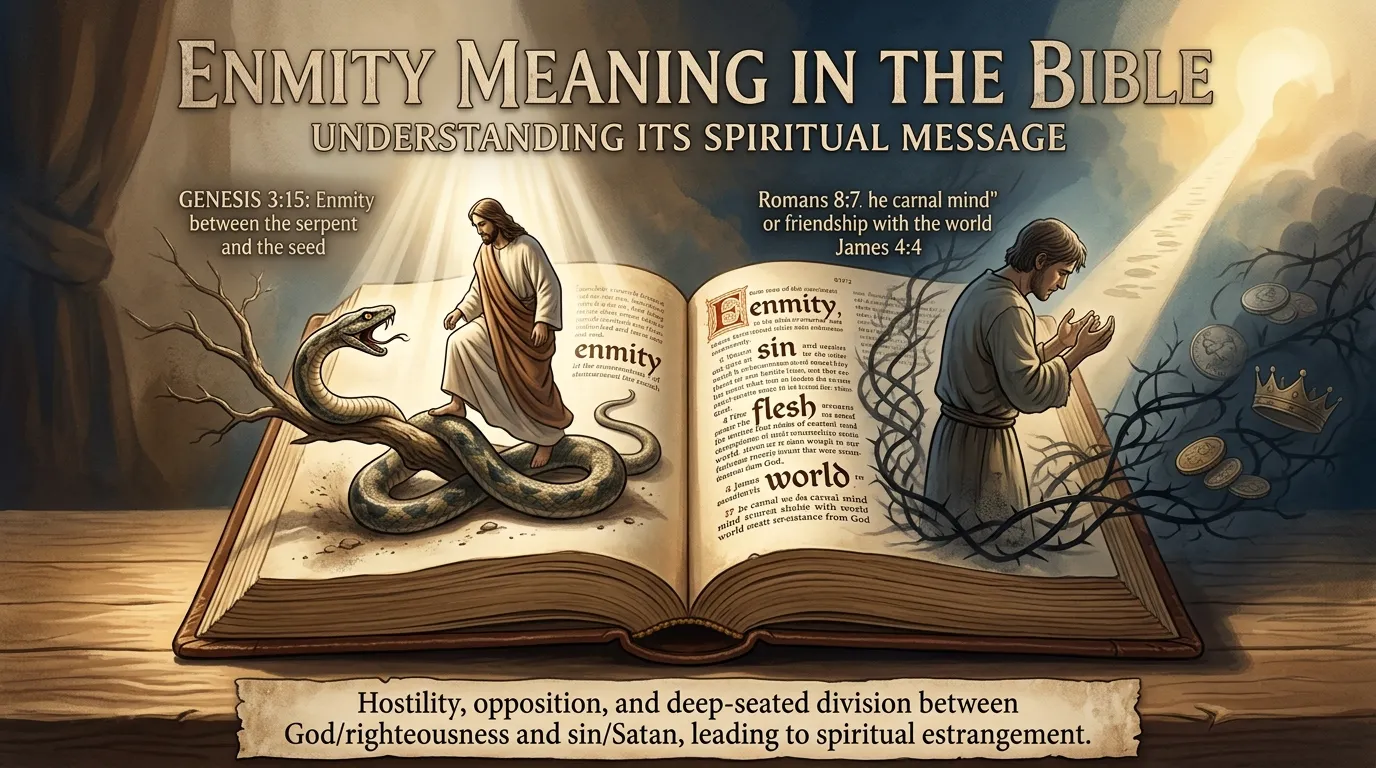
Enmity enters the Bible almost the moment sin does. After the fall, God speaks to the serpent: “And I will put enmity between you and the woman, and between your offspring and hers” (Genesis 3:15). The Hebrew word is ‘eybah — deep-seated hostility, not a passing quarrel. Notice who initiates it: God puts the enmity there. This is not God endorsing hatred; it is God ordaining opposition between good and evil. Left to ourselves, humanity would have made peace with the serpent — would have settled comfortably into rebellion. God’s enmity-decree means there will always be a holy friction, a divine refusal to let evil and good coexist quietly.
This reframes every spiritual struggle you have ever felt. That inner war — the pull toward what you know is wrong, the grief after you give in, the restlessness that will not let you settle — is not a malfunction. It is the ‘eybah of Genesis 3:15 doing its work in your conscience. God put hostility between you and the serpent so that you would never feel at home in sin. The discomfort is the mercy.
Enmity With a Promise Inside
But Genesis 3:15 does not end with hostility. It ends with a heel, a head, and a victory: “he will crush your head, and you will strike his heel.” Theologians call this the protoevangelium — the first gospel, preached in the wreckage of Eden. Inside the enmity-decree is a promise: the woman’s offspring will destroy the serpent, though wounded in the doing.
The rest of the Bible is the slow unfolding of that sentence. The serpent strikes the heel — the cross, where evil does its worst to the Son. The offspring crushes the head — the resurrection, where the wound becomes the victory. Every enmity in Scripture after this one is a skirmish in that war: Pharaoh against Israel, Goliath against David, Herod against the Christ child, the dragon against the woman’s child in Revelation 12. They are all local expressions of the cosmic ‘eybah — and they all end the same way, because the outcome was announced before the war properly began.
At War With God
Here is the turn most readers resist: Scripture says the enmity is not only between us and evil. Left to ourselves, we are at enmity with God. “The mind governed by the flesh is hostile to God; it does not submit to God’s law, nor can it do so” (Romans 8:7). The word “hostile” is echthra — the Greek equivalent of enmity. James is blunter: “Anyone who chooses to be a friend of the world becomes an enemy of God” (James 4:4).
This is the Bible’s most offensive and most necessary diagnosis. We prefer to think of ourselves as neutral parties — decent people who might need a little improvement. Scripture says we were combatants: “you were alienated from God and were enemies in your minds because of your evil behavior” (Colossians 1:21). Enmity with God is not an emotional state; it is a legal and relational one. It describes a will set against its Maker, whether expressed in open rebellion or polite indifference.
Why does this matter? Because you cannot appreciate reconciliation until you admit there was a war. A gospel that starts with “God wants to improve you” produces consumers. A gospel that starts with “you were His enemy, and He died for you” produces worshipers. “While we were God’s enemies, we were reconciled to him through the death of his Son” (Romans 5:10). Read that sentence until it detonates: the reconciliation happened while the enmity was active. God did not wait for a ceasefire. He walked into the war.
The Wall Torn Down
Paul’s most architectural description of this reconciliation is Ephesians 2:14-16: “For he himself is our peace, who has made the two groups one and has destroyed the barrier, the dividing wall of hostility… His purpose was to create in himself one new humanity out of the two, thus making peace, and in one body to reconcile both of them to God through the cross, by which he put to death their hostility.”
The “two groups” are Jew and Gentile — the deepest ethnic and religious enmity of the ancient world, encoded in temple architecture itself (a literal wall separated the Court of the Gentiles, with an inscription threatening death to trespassers). Paul says the cross demolished it. Not papered over — demolished. “He himself is our peace” — peace is not a program or a treaty; it is a Person.
The implications detonate outward. If the cross reconciled the most entrenched hostility of the ancient world, then no human enmity is beyond its reach — not the family feud, not the racial divide, not the political hatred, not the church split. This does not mean reconciliation is easy, quick, or always possible this side of eternity (Paul himself says “as far as it depends on you, live at peace with everyone” — Romans 12:18 — implying it does not always depend on you). But it means no enmity gets the final word. The wall is down. The peace is a Person. And He is still in the demolition business.
Enmity Between People: The Daily Battlefield
Most of us experience enmity not cosmically but domestically: the coworker, the ex, the in-law, the neighbor. Scripture is unsparing about its sources. Paul lists “hatred, discord, jealousy, fits of rage, selfish ambition, dissensions, factions and envy” among the “acts of the flesh” (Galatians 5:19-21) — note how many are relational. Enmity between people is usually sin’s shrapnel: pride detonating near other pride.
Jesus’ counter-command is the most radical ethic ever proposed: “Love your enemies and pray for those who persecute you” (Matthew 5:44). Not tolerate. Not avoid. Love — and pray for, which is love’s hardest form, because you cannot sincerely pray for someone while nursing hatred for them. The prayer dissolves the poison or exposes the hypocrisy; either way, something has to give.
Why such an extreme command? “That you may be children of your Father in heaven” (Matthew 5:45). God loved His enemies — that is the gospel (Romans 5:8). Loving ours is not moral heroism; it is family resemblance. Every act of enemy-love is a small reenactment of the cross, a Genesis 3:15 skirmish won the way the war was won: not by crushing the enemy, but by absorbing the strike and answering with grace.
From Hostility to Hospitality: The Way Back
So how does enmity actually end — in a marriage, a family, a church? Scripture’s pattern has four movements.
Name it honestly. Call it enmity, not “a rough patch.” The Bible never heals what it will not name. Confession — to God first, then where appropriate to the person — is the doorway (James 5:16).
Absorb rather than return. “Do not repay evil with evil” (1 Peter 3:9). This is the cross applied to conflict: someone has to stop the cycle, and in the kingdom, that someone is you. It will feel like losing. It is winning by heaven’s arithmetic.
Pursue peace actively. “Make every effort to keep the unity of the Spirit through the bond of peace” (Ephesians 4:3). Reconciliation is work — conversations, apologies, changed patterns, sometimes mediation (Matthew 18:15-17 gives the process). Peace is not the absence of effort; it is the product of it.
Trust God with the outcome. Some enmities will not resolve this side of heaven, and that is not your failure. Joseph’s brothers meant evil; God meant good (Genesis 50:20) — but the reconciliation took decades. Plant peace, water it with prayer, and leave the harvest to God.
And remember the deepest comfort of all: the enmity that mattered most — yours with God — is already resolved. “Since we have been justified through faith, we have peace with God through our Lord Jesus Christ” (Romans 5:1). Peace with God is the fountain; peace with people is the river. You cannot give what you have not received, but once you have received it, the river wants to flow. Every reconciliation you pursue is simply the gospel leaking out of a reconciled heart.
Enmity began in Eden as God’s merciful refusal to let us make peace with evil. It ends at the cross, where God made peace with His enemies by becoming the casualty. Every reconciliation since — every forgiven debt, every restored marriage, every former enemy become brother — is an echo of that first and final peacemaking. For a concise overview of the concept’s broader usage, see Enmity — and then return to Ephesians 2, where hostility is not managed but put to death, and the wall that divided the world lies in rubble at the foot of a cross.










